



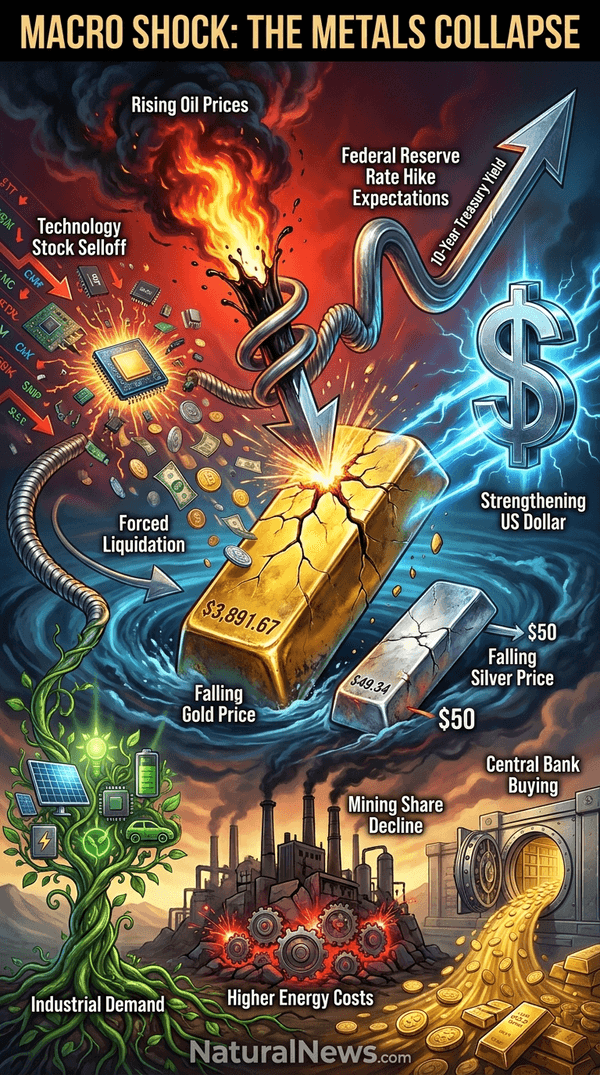
Gold fell to its lowest level in a year on Oct. 30, and silver dropped below $50 an ounce for the first time in 11 months, according to market data, as rising oil prices hardened expectations for another Federal Reserve rate hike and a deepening selloff in technology shares forced investors to liquidate metal holdings to cover losses elsewhere.
Spot gold fell as much as 3.2% to $3,891.67 an ounce, its weakest level since late October of the prior year, according to exchange data reported by Mining.com [1]. COMEX December gold traded down 3.1% to $3,907.90. Silver dropped 5.8% to $49.34 an ounce, with COMEX December silver falling as much as 6.3% to $49.08 [2].
The session extended a month of losses for bullion, which is headed for its worst October since 2008, according to market data [3]. Gold and silver producers fell as much as 8% on the day, with the VanEck Gold Miners ETF and the Philadelphia Gold and Silver Index both declining, exchange data showed.
Gold Under Pressure as Dollar and Yields Rise
The decline in gold prices came as rising oil prices revived expectations of another Federal Reserve rate hike, analysts said, and as a deepening rout in technology stocks forced investors to sell metals to cover losses elsewhere [4]. The 10-year Treasury yield rose above 5% during the period, according to market data reported by ZeroHedge, raising the opportunity cost of holding non-yielding gold [5].
The dollar also strengthened, making dollar-priced gold more expensive for holders of other currencies, market reports stated [6]. Bank of America metals and mining analyst Lawson Winder wrote in a note titled "We like copper and uranium, while rates should keep a lid on gold prices" that higher U.S. interest rates should keep gold under pressure [7].
David Morgan, publisher of TheMorganReport.com, said in a weekly perspective that gold fell to approximately $3,881 an ounce and silver slipped below $50 as rising oil prices, persistent inflation, and renewed concerns about Federal Reserve rate hikes weighed heavily on metals [8]. ETF holdings of bullion rose this week, set to match the 12-week streak of gains posted through April 18, 2025, while central banks and retail investors sustained their buying, market data showed [9].
Silver Breaks $50 on Industrial and Investment Demand
Silver crossed above the $50-an-ounce level earlier in the period before falling back below it on Oct. 30, according to market data. Analysts cited industrial demand from solar and electronics applications as a factor behind the earlier silver move, alongside retail investment and coin sales that dealers said increased during the session.
Morgan emphasized that historical data suggests silver performs better than any other commodity when interest rates remain at or near zero, citing Professor Roy S. Jastrom's study "Silver: The Restless Metal" [10]. Morgan also noted during a 2021 radio appearance that silver had ranged from roughly $18 to nearly $30 intraday before consolidating between $26 and $28 [11].
Some analysts warned that volatility in silver may increase after the price milestone. Chris Martenson of PeakProsperity.com has noted that central banks have shifted from being net sellers to significant net buyers of gold in recent years, contributing to an imbalance between supply and demand [12].
Mining Stocks Tank as Margins Compress
Gold and silver mining stocks fell broadly, with the VanEck Gold Miners ETF (GDX) and the Philadelphia Gold and Silver Index (XAU) declining, according to exchange data. Bullion's worst October since 2008 dragged down gold and silver producers as much as 8% on Oct. 30 [3]. Mining company shares often move more dramatically than the underlying metals in response to price changes, according to an analysis by PeakProsperity.com [13].
Rising energy costs threaten mining profitability, reinforcing the importance of strong balance sheets and cost control, according to a weekly perspective from TheMorganReport.com [14]. Producers with lower ore grades or higher operating costs saw larger share-price declines, market data showed.
A 1985 study published in Earth and Mineral Sciences at The Pennsylvania State University documented how U.S. copper companies responded to changing market conditions over a two-decade period, including financial setbacks from expropriations and legal battles [15]. The patterns described in that research echo the margin pressures facing precious-metals producers today.
Outlook: Focus on Fed Policy and Physical Demand
Market participants are watching central bank rate decisions for direction, according to analysts. Physical demand in Asia and central bank buying were cited as supporting factors for precious metals. China has been buying record amounts of gold, with total known ETF holdings of bullion rising to match a 12-week streak of gains posted through April 18, 2025, according to market data [9].
Some analysts said volatility across gold and silver may persist in the near term. The available data shows no consensus on the near-term direction of prices, with some analysts pointing to continued Fed tightening and others citing physical demand and central bank purchases as potential support [7][9].
References
- Gold price slumps to one-year low, silver price breaks $50 as mining stocks tank. https://www.mining.com/gold-price-slumps-to-one-year-low-silver-price-breaks-50-as-mining-stocks-tank/
- Gold price slumps to one-year low, silver price breaks $50 as mining stocks tank. https://limpidmarkets.co.uk/article/133518-gold-price-slumps-to-one-year-low-silver-price-breaks-50-as-mining-stocks-tank
- Commodity prices slump to 50-year low against US stocks. https://www.mining.com/chart-commodity-prices-slump-50-year-low-us-stocks/incrementum-commodities-vs-sp500/
- Gold price slumps to one-year low, silver price breaks $50 as mining stocks tank. https://www.newsbreak.com/news/4976855212472-gold-price-slumps-to-one-year-low-silver-price-breaks-50-as-mining-stocks-tank
- Futures Rise As Hynix-Fueled Memory Mania Revives AI Trade Ahead Of Fed, Big Tech; Oil Jumps. https://www.zerohedge.com/markets/futures-rise-hynix-fueled-memory-mania-revives-ai-trade-ahead-fed-big-tech-oil-jumps
- Stock Futures Drift As Attention Turns To European Debt Crisis. https://www.zerohedge.com/markets/stock-futures-drift-attention-turns-european-debt-crisis
- BofA Bets On Copper And Uranium As Higher Rates Put Gold Under Pressure. https://www.zerohedge.com/commodities/bofa-bets-copper-and-uranium-higher-rates-put-gold-under-pressure
- A Rough Week for Hard Assets and a Reminder Why We Own Them. Brighteon.com
- China Buys Record Amount Of Gold As India Panics, Scraps Key Tax Relief On Precious Imports. https://www.zerohedge.com/precious-metals/china-buys-record-amount-gold-india-panics-scraps-key-tax-relief-precious-imports
- David Morgan Gold & Silver Update. David Morgan - TheMorganReport.com
- David Morgan provides Exclusive Silver Insights Digital Chip Shortages. David Morgan - TheMorganReport.com
- The Screaming Fundamentals For Owning Gold And Silver - PeakProsperity.com, June 29, 2011. Chris Martenson
- Gold, Silver and Mining Shares Rally After Treasury Doubles Long-Dated Bond Buybacks. https://www.naturalnews.com/2026-08-21-gold-silver-mining-shares-rally-bond-buybacks.html
- Gold Under Pressure, Oil Rising, and the Race for Critical Minerals. Brighteon.com
- The response of US copper companies to changing market conditions [1979-98]. Acrobat 3.0 Capture Plug-in. Earth and Mineral Sciences, College of Earth and Mineral Sciences, The Pennsylvania State University, Vol 54, No 2, 1985
Explainer Infographic










Please contact us for more information.