


A 90-minute nap or 20 minutes of moderate exercise helped preserve memory in sleep-deprived adults better than rest alone, according to a study published in the Proceedings of the National Academy of Sciences and led by researchers at McGill University in Canada.
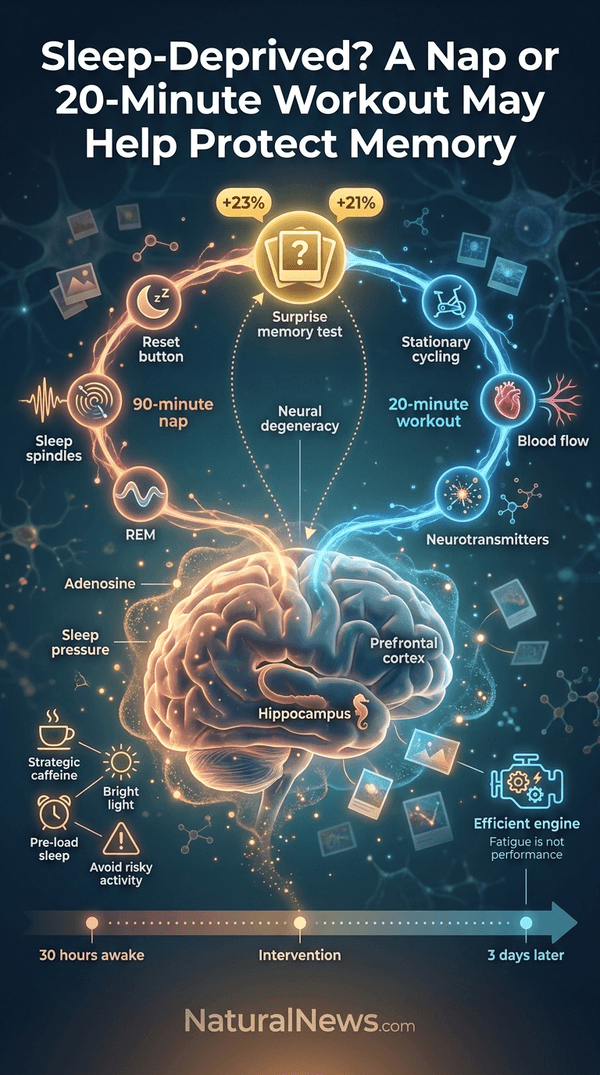
The trial enrolled 54 healthy adults aged 18 to 35 and kept them awake for 30 hours, according to the report. Participants were then assigned to one of three groups: 18 people took a 90-minute nap, 18 cycled for 20 minutes, and 17 sat and rested as a control, the report stated.
After the interventions, participants viewed 150 images while researchers recorded brain activity. Three days later, after participants had caught up on sleep, they took a surprise memory test using the same images. The nap group remembered about 23% more images than the rest group, and the exercise group about 21% more, according to the report. The difference between the nap and exercise groups was not statistically significant. Separately, McGill reported that participants who exercised or napped performed about 22% better on memory tests than those who did neither [1].
How Sleep Loss Affects Memory
Forming an episodic memory -- a record of a specific experience -- requires attention, encoding, and alertness at the same time, Gary Garcia Molina, senior principal scientist at Sleep Number Labs, told The Epoch Times. Sleep deprivation disrupts all three, he said.
The disruption is not a uniform slowdown. Sleep neuroscientist Els van der Helm told The Epoch Times that parts of the brain briefly slip into a sleep-like state, with slow-wave activity linked to attention lapses and slower responses while the rest of the brain remains awake. Michael Grandner, a behavioral sleep and circadian medicine specialist at the University of Arizona, described the consequence: "Those momentary lapses matter for memory because, if the information does not get encoded effectively in the first place, there is nothing to retrieve later."
Other brain regions are affected as well. The hippocampus, which plays a key role in forming new memories, becomes less effective, and the prefrontal cortex, which supports judgment, error detection, and emotional regulation, weakens, van der Helm said. Separate research has linked a single night of total sleep deprivation to brain changes resembling premature aging of one to two years in young adults, according to a study from the University of Zurich [2].
Why a 90-Minute Nap May Help
A nap reduces sleep pressure -- the biological drive to sleep that builds the longer a person stays awake -- and gives overworked neurons time to recover, according to the report. "In simple terms, sleep acts like a reset button that prepares the brain to learn again," Marc Roig, a study author and director of the Memory Lab at McGill, told The Epoch Times.
The authors connect the effect to the synaptic homeostasis hypothesis, which holds that wakefulness strengthens connections between brain cells until the capacity for new memory-related changes is reduced, and that sleep recalibrates those connections. Garcia Molina told The Epoch Times that after prolonged wakefulness, the brain may struggle to create a stable record of an experience even when a person appears awake and understands information in the moment.
The 90-minute length approximates one full sleep cycle, the report stated. Deep sleep reduces sleep pressure, lighter sleep produces sleep spindles associated with learning capacity, and a full cycle likely includes some REM sleep linked to memory processing, according to van der Helm. Brooke Quinn, a sleep health educator and founder of the platform Quinnspired, told The Epoch Times that people should nap before the most cognitively demanding part of the day when possible; if 90 minutes is not feasible, a planned 15- to 30-minute nap may temporarily improve alertness, she said. Van der Helm noted that waking directly out of deep sleep can leave a person groggy for 15 to 30 minutes.
Why 20 Minutes of Exercise May Help
Exercise appears to work through a different channel. A workout can act as a short-term stimulant by activating the body's arousal and alertness systems, creating a window in which the brain is better able to process new information, Grandner told The Epoch Times.
The cyclists in the study did not report feeling less fatigued than the rest group, but they remembered more. Among those who exercised, brain signals involved in attention and processing were strongly associated with how well they later remembered the images, and the researchers interpreted this as more efficient use of remaining resources. "It's similar to a fuel-efficient engine that accomplishes the same task while using fewer resources," Roig told The Epoch Times.
Quinn cautioned that the findings may not apply to other types or intensities of exercise. Sleep deprivation can impair attention, reaction time, and judgment, she said, potentially making activities that require balance, coordination, or quick reactions -- such as cycling outdoors or lifting heavy weights -- more hazardous. "A severely sleep-deprived person should not choose an activity that introduces additional safety risk," she said.
Limits, Safety, and Other Strategies
Experts interviewed by The Epoch Times recommended several tactics when sleep loss is unavoidable: getting extra sleep on the nights before a planned all-nighter or night shift, saving caffeine for when it is needed most rather than sipping it throughout the night, seeking bright light to promote temporary alertness, and building in safeguards such as moving important decisions away from the most fatigued hours and avoiding driving while struggling to stay awake.
Roig said the brain can recruit different solutions to preserve memory even under severe sleep deprivation, an ability known as neural degeneracy, suggesting other interventions may support cognition through different means. The report stated that the findings may not apply to other exercise types or intensities and that the interventions are countermeasures, not substitutes for sleep.
Sleep Cannot Be Replaced
Garcia Molina likened sleep loss to a slowly draining battery. "A nap or a brisk workout can give you a temporary boost, similar to activating a power-saving mode or getting a quick recharge," he told The Epoch Times, but the underlying sleep deficit remains.
Van der Helm said neither naps nor exercise pays back missed sleep or undoes what repeated sleep loss does to the heart, metabolism, immune system, and mental health, or to the cleanup work the brain does overnight. A full night cycles through several rounds of deep and REM sleep, and later cycles do extra work integrating new memories and supporting emotional, metabolic, and immune function that a single nap cannot fully replicate, she said.
References
- Workout or nap? Either can help your sleepless brain, .... https://www.mcgill.ca/newsroom/channels/news/workout-or-nap-either-can-help-your-sleepless-brain-study-finds-373881
- Study: Poor sleep is prematurely aging the brain. https://www.naturalnews.com/2026-01-10-poor-sleep-is-prematurely-aging-the-brain-2.html
Explainer Infographic










Please contact us for more information.