


The Engineering of a Global Food Collapse
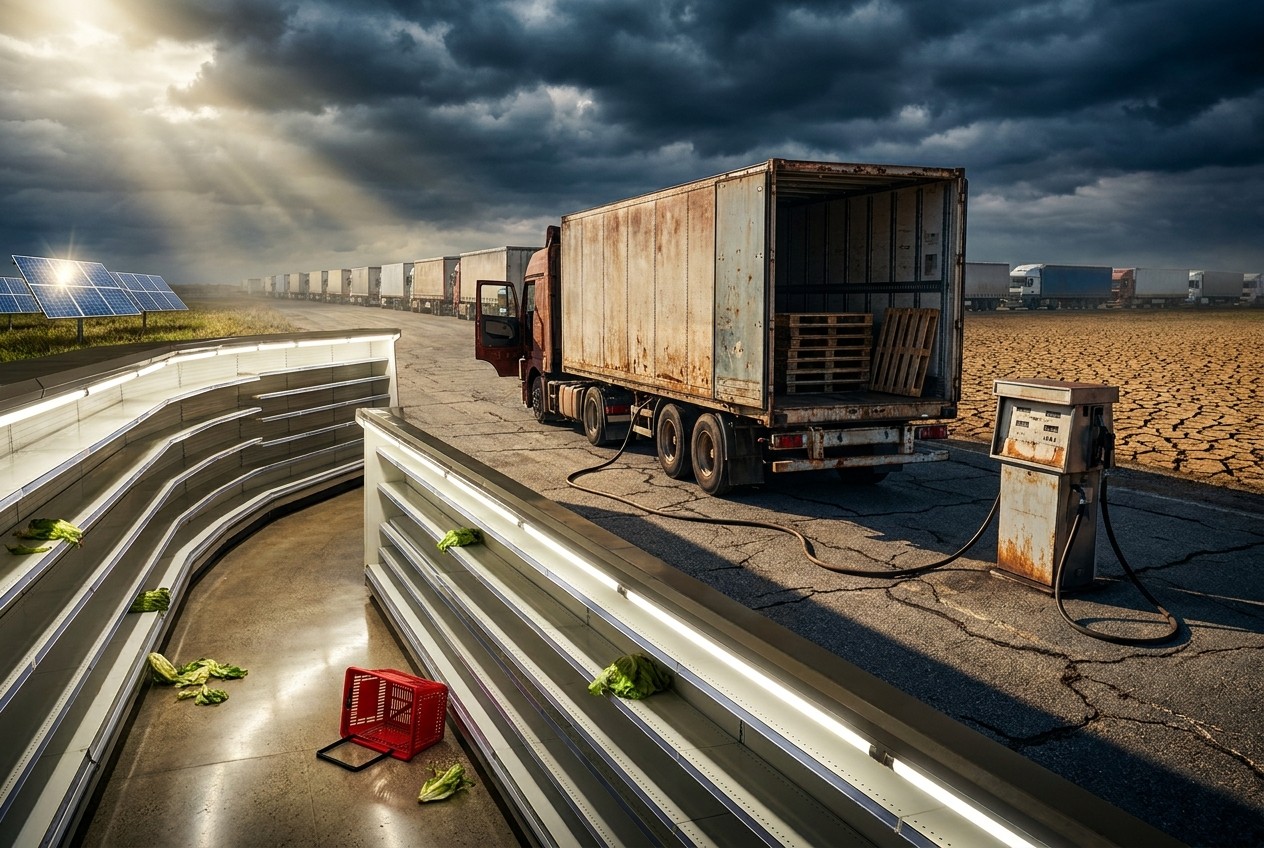
I watched the grocery store footage from southern Italy this week with a sick feeling in my gut. The shelves were stripped bare -- not because of a nationwide shortage, but because truckers are protesting sky-high diesel prices and key distribution routes are blocked. In a country that's one of Europe's agricultural giants, stores are running out of basic foodstuffs. A localized trucker strike should not empty the bread aisle in a modern economy. But it did.
This looks like a temporary inconvenience in a distant country. That's what the establishment media will tell you. But in my view, this is exactly how the opening act of a global food collapse begins -- not with a bang, but with a trucker protest, a blocked highway, a few empty shelves. By the time the shelves stay empty, it will be too late to prepare. The warning shots are being fired right now, and almost nobody is listening.
Consider what happens when truckers cannot afford to drive. Diesel is not a minor input cost for food distribution; it is the lifeblood. When diesel goes above a certain price point, trucking companies lose money on every haul. They park their rigs. And when the rigs park, the food stops moving. The Italian trucker strike is not an isolated incident -- it's the first domino.
Diesel Is the Master Valve of the Entire Food System
Most people have no idea how fragile and fuel-dependent the modern food supply really is. Diesel runs the tractors that plow the fields. It runs the harvesters that bring in the crops. It runs the refrigerated trucks that move produce from farm to distribution center. It runs the trains that carry grain across continents. It runs the ships that haul food between nations. Every single link in the food chain depends on diesel -- and there is no substitute at scale.
This is the reality that the climate alarmists and the energy transition fantasists refuse to acknowledge. You cannot run a modern agricultural system on solar panels and wind turbines. You cannot harvest wheat with an electric combine that runs for six hours before needing a charge. The scale of energy required to feed eight billion people is staggering, and the vast majority of it comes from fossil fuels. When diesel becomes scarce or unaffordable, the entire system seizes up.
Worse still, fertilizer production is also tied to energy -- specifically natural gas. As energy costs spike, fertilizer production becomes unprofitable. As fertilizer production declines, farmers cannot afford to fertilize their fields. As fertilization declines, yields collapse. This is a chain reaction that cannot be stopped once it begins. As I wrote in a prior article, 'This is not a drought or a plague -- it is a man-made catastrophe' [1]. The destruction of affordable energy is the quickest path to starvation hell [2].
The Chain Reaction: Energy Crisis, Fertilizer Crisis, Food Crisis, Social Unrest
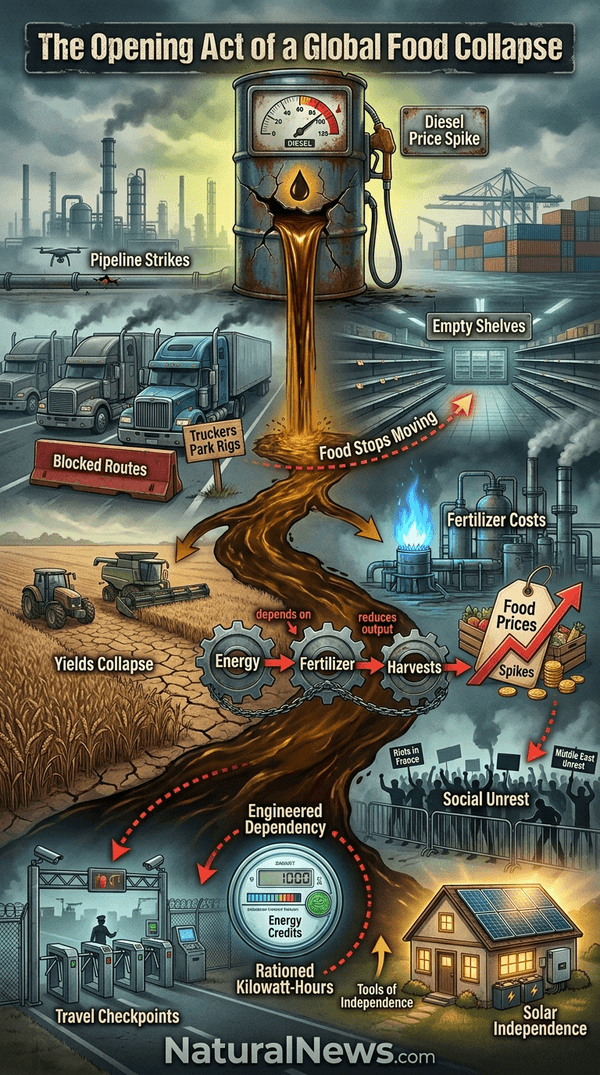
The sequence I see unfolding is energy scarcity first, fertilizer shortage second, food scarcity and price spikes third, and social upheaval last. This is not speculation -- it is basic chemistry and logistics. When energy costs rise, fertilizer production falls. When fertilizer production falls, crop yields decline. When crop yields decline, food prices spike. When food prices spike, people take to the streets.
I am not alone in this assessment. Chris Martenson, Tucker Carlson, Michael Yon, David DuByne and I have all reached the same conclusion independently: the effects of this energy destruction are known and intended. When multiple well-informed people arrive at the same verdict from different angles, that convergence is itself evidence. The destruction of refinery and distribution infrastructure -- from St. Petersburg to Ukraine's drone strikes -- is not accidental in its consequences. These are deliberate acts of economic warfare.
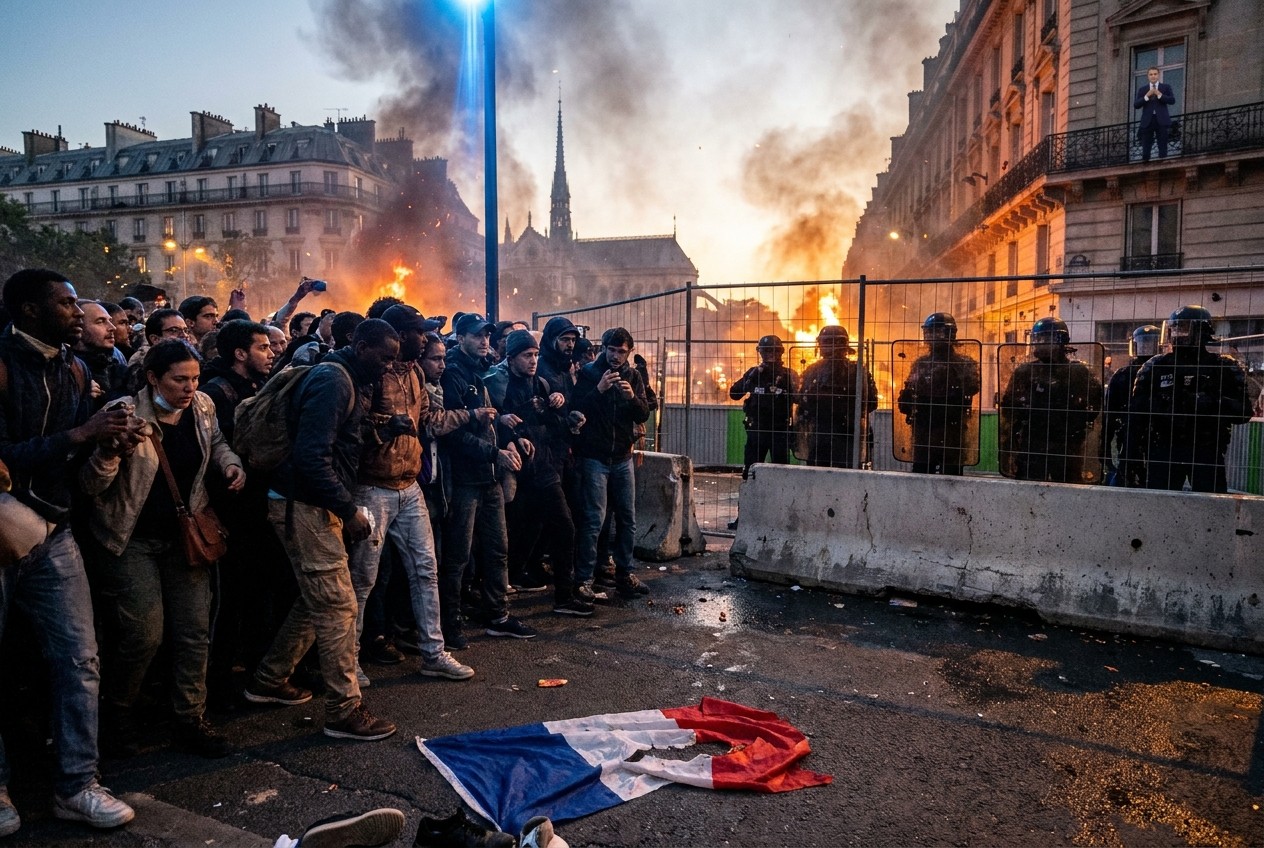
The fertilizer shortages will be far more pronounced in 2027 and 2028. That means the worst harvests are still ahead of us. The global food crisis is not a distant threat; it is already here, and it is getting worse. As one analysis noted, a convergence of horrifying events has set into motion an irreversible collapse of food production and crop harvests, leading to global famine throughout 2024 [3]. When people cannot afford food, every nation is only about nine meals away from anarchy. The rioting in France and unrest in the Middle East are early signals of what spreads when food and fuel run short.
This Is Not a Coincidence -- Independent Voices Are Converging on the Same Conclusion
It's now obvious that the energy crisis did not happen by accident. The war on fossil fuels -- the deliberate strangulation of domestic energy production, the refusal to build pipelines and refineries, the carbon taxes and cap-and-invest schemes -- has created the conditions for exactly what we are seeing now.
The destruction of refinery and distribution infrastructure is not accidental in its consequences. Ukraine's drone strikes on Russian export terminals, the attacks on Saudi pipelines, the closure of California refineries -- these are not isolated incidents. They are coordinated attacks on the global energy system. And they are designed to bleed into a food crisis.
I believe this is an engineered energy panic, just as COVID served as a pilot program for obedience and control. The same people who brought you the lockdowns, the vaccine mandates and the digital ID push are now engineering an energy crisis that will lead to food shortages and social unrest. The goal is not to save the planet -- the goal is to control (and then partially eliminate) the population. They want you dependent on the system for your very survival.
What an Energy Emergency Will Actually Require of You
If an energy national energy emergency is declared -- and I believe it is coming -- you need to understand what that will mean for your daily life. During COVID, we saw the playbook: travel restrictions, checkpoints, papers-please authorization to move. The same tools will be used again. You will need permission to travel. You will need to prove you are compliant. You will be tracked and monitored. (Why do you think they're installing all the cameras nationwide?)
Winter heat and summer cooling limits are the logical next step. The elites will tell you it's for the good of the planet. They will ration kilowatt-hours, issue credits or allowances, and shut off your power if you exceed them. They will tell you it's an emergency. But the control architecture is already built.
This is precisely why I recommend solar so aggressively. You will need to gather your own kilowatt-hours from the sun. You cannot rely on the grid when the grid is being weaponized against you. Solar panels, batteries, inverters -- these are not just preparedness items; they are tools of independence. When the grid goes down or gets rationed, you need to be able to power your own home. The technology exists. The only question is whether you will act in time.
Decentralize or Die -- My Case for Radical Self-Reliance Right Now
So what do you do? The answer is radical self-reliance. Store food -- enough to feed your family for months, not days. Grow food -- even a small garden can produce a surprising amount. Build soil with compost and leaves. Collect rain water. Set up your own solar power while the grid still works. Learn to preserve food. Learn to repair tools. Learn to defend what you have.
The window to act is still open. The dollar still works and goods are still available -- but that window is closing fast. When the shelves are empty and the trucks have stopped running, you will not be able to buy what you need at any price. The time to prepare is now, while the system is still functioning.
This is the big one people have been preparing for. And the good news is that doing something meaningful right now is still relatively easy. You do not need a bunker in the mountains. You need a pantry full of staples, a garden plot, a water filter, a solar panel, and the knowledge to use them. Start today. Teach your family. Build community with like-minded people. The empty shelves in Italy are a warning. Heed it.
Watch my shows at Decentralize.TV for interviews with experts who can decentralized living.
References
- The Coming Famine Why Millions Will Starve and What You Must Do Now - NaturalNews.com, May 09, 2026. by NaturalNews.com
- -No Fertilizer No Food_ Global shutdown of fossil fuels the quickest way to STARVATION HELL - basic chemistry les - NaturalNews.com, November 05, 2021. by NaturalNews.com
- -Global crop collapse now a certainty widespread famine to plague planet Earth from 2022 - 2024 it is set in moti - NaturalNews.com, March 07, 2022. by NaturalNews.com
Explainer Infographic






Please contact us for more information.