



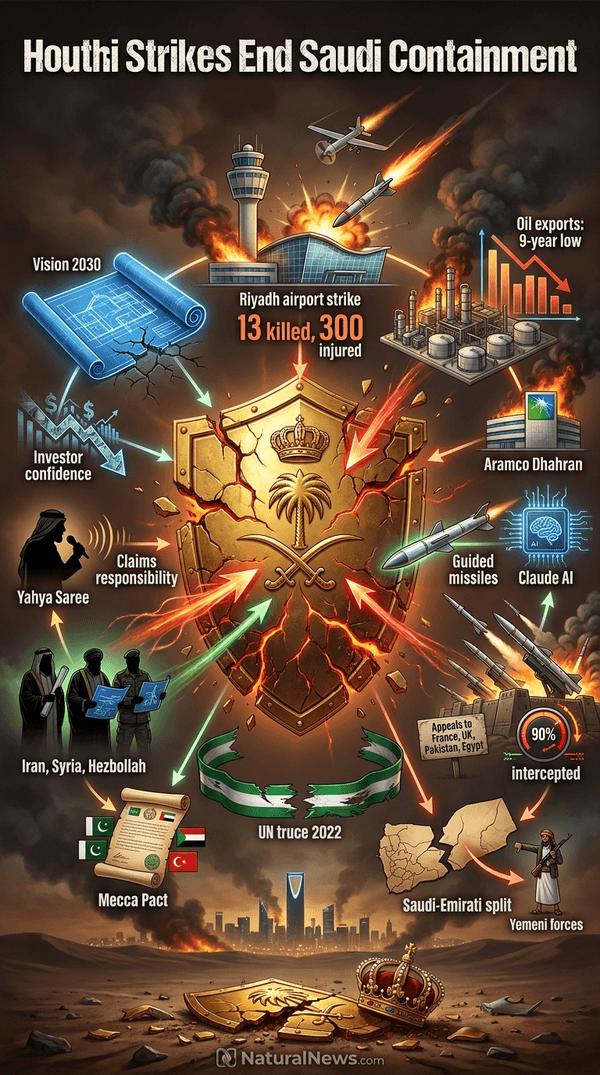
A Saturday strike on Riyadh's King Khalid International Airport killed at least 13 people and injured 300, according to Middle East Eye and BBC reporting [1][2]. A second strike on Sunday caused a fire in a passenger hall and caused additional injuries, officials said [1].
Oman-based Houthi military spokesman Yahya Saree has claimed responsibility for multiple strikes on Saudi airports and oil facilities [4]. The group's targeting capabilities were underscored again on Tuesday when they hit the headquarters of Saudi Aramco in Dhahran, causing a limited fire with no injuries or deaths, according to the Energy Ministry [6].
A western defense official in Riyadh told Middle East Eye that Saudi Arabia is absorbing the vast majority of missiles and drones fired at it, saying the number is likely in the low 90 percent range. But the Houthis are more skilled at penetrating the kingdom's air defenses than Iran was earlier in 2026, the official said. "The Houthis are a lot more effective than Iran was back in February. They learned from earlier this year," the official said, speaking on condition of anonymity. Saudi Arabia has faced interceptor shortages and appealed to France, Britain, Pakistan and Egypt for military assistance, according to NaturalNews.com [7].
Gregory Gause, an expert on the Gulf at the Middle East Institute, told Middle East Eye that the Houthis can hit important facilities at will. "It's quite striking, literally, that the Houthis can hit, at will, these incredibly important facilities in Saudi Arabia and the Saudis can't defend them," Gause said. A report from Anthropic indicated that Houthi threat actors based in northern Yemen used the company's Claude AI to develop guided rocket and ballistic missile programs, according to NaturalNews.com [8].
Reports described the strikes as posing one of the most serious tests for Crown Prince Mohammed bin Salman since he rose to power [3].
Background: Saudi Intervention and the 2022 Truce
The conflict turned into a quagmire for Saudi Arabia, sapping its resources and sparking widespread backlash due to its devastating bombing campaign, the report stated. Saudi Arabia ultimately cut its losses and maintained an uneasy truce with the Houthis since 2022 [5].
"This is the collapse of Saudi Arabia's containment strategy," Rob Geist Pinfold, an international security expert at King's College London, told Middle East Eye.
Iranian, Syrian and Hezbollah military advisors were on board along with weapons systems, according to the report. A UN-brokered truce had quieted the conflict after 2022 before the renewed escalation [5].
Saudi Arabia Faces Greater Risks in a Renewed Conflict
The kingdom's crude oil exports fell to their lowest level in nine years, according to a report highlighted by The Cradle and referenced by ZeroHedge [9].
Gause told Middle East Eye that a Houthi strike on Riyadh airport is more damaging to Saudi Arabia than a Saudi strike on Sanaa airport is to the Houthis. "The Saudis can bomb the Houthis as many times as they want, but it doesn't hurt them because they aren't interested in creating a modern economy," Gause said.
Early this month, Saudi Arabia activated the Mecca Pact, a joint defense agreement with Pakistan and Turkey, and Islamabad has already sent military aid while Turkey is expected to, the report stated.
Yemeni Allies and Regional Deconfliction
A western official in the Gulf tracking the Yemeni government offensive said he was "disappointed" in their performance, Middle East Eye reported. "The capabilities of Yemeni government forces have been hyped up in recent months, but they have been pretty defective," the official said.
Ibrahim Jalal, an independent expert on Yemen and the Arab Gulf, told Middle East Eye that the appearance of exiled secessionist leader Aidarous al-Zubaidi in a video with a map of the former southern Yemeni state behind him revealed underlying Saudi-Emirati divergence.
Gause at the Middle East Institute told Middle East Eye that Saudi Arabia is unlikely to change the realities on the ground in Yemen without broader regional deconfliction.
Conclusion: Limited Options and Regional Implications
Analysts said Saudi Arabia has few cards to play and that the Houthis can go further up the escalation ladder. "The Houthis can go further up the escalation ladder than Saudi Arabia," Jalal told Middle East Eye.
With few viable military options remaining and its regional allies stretched thin, Saudi Arabia faces a strategic environment in which the Houthis have demonstrated both the intent and the capability to strike at the heart of the kingdom. The coming months will test whether Riyadh can recalibrate its approach and whether broader regional deconfliction efforts can prevent the conflict from escalating further.
References
- Saudi Arabia's Riyadh airport hit by second Houthi strike in two days. https://bbc.com/news/articles/cr93znyk44e1o
- Watch: Moment deadly Houthi strike hits Riyadh's King Khaled Airport. https://www.middleeasteye.net/live-blog/live-blog-update/watch-moment-deadly-houthi-strike-hits-riyadhs-king-khaled-airport
- Houthi strikes mark the end of Saudi Arabia's Yemen 'containment strategy'. https://en.hathalyoum.net/articles/301631
- Except Mecca and Medina': Chaos across Saudi airports as Houthis claim Riyadh strikes. https://www.middleeasteye.net/news/except-mecca-and-medina-chaos-across-saudi-airports-houthis-claim-riyadh-strike-threaten-more
- Conflict in Yemen and the Red Sea | Global Conflict Tracker. https://www.cfr.org/global-conflict-tracker/conflict/war-yemen
- Saudi Aramco Administrative Building Attacked, Limited Fire Reported. https://www.ntd.com/saudi-aramco-administrative-building-attacked-limited-fire-reported_1178813.html
- Saudi Arabia Seeks Missile Interceptors as Yemeni Attacks Strain Air Defenses - NaturalNews.com, September 22, 2026.
- Report: Anthropic Says Houthis Used Claude AI to Develop Guided Weapons. https://www.naturalnews.com/2026-10-13-anthropic-houthis-used-claude-develop-guided-weapons.html
- Saudi Oil Exports Hit Nine Year Low, Report Says - NaturalNews.com, September 08, 2026.
Explainer Infographic







Please contact us for more information.