


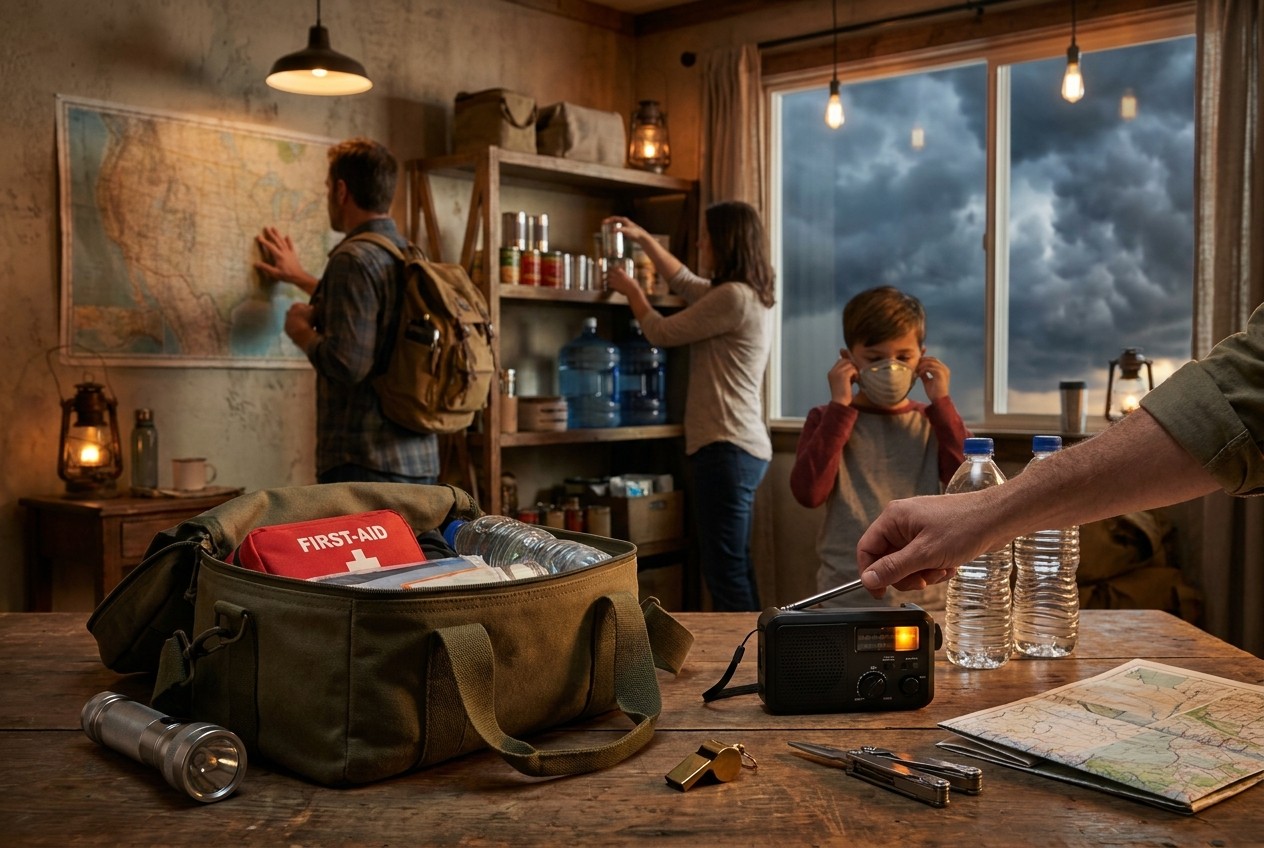
Major storms demonstrate nature's unpredictable force and expose how vulnerable communities can be, according to a home preparedness guide published by The Epoch Times [1]. The guide outlines essential steps and supplies that households need to remain self-sufficient for at least two weeks when normal services are disrupted.
"It's not a matter of 'if' but 'when' such events will occur," Creek Stewart, an author of more than 40 books on survival, told The Epoch Times [1]. Preparedness expert Paul Martin told the publication that preparedness functions like an insurance policy. "None of us like paying insurance premiums, but we do it in order to transfer the risk of loss," Martin said [1].
The guide states that a robust preparedness plan has three core elements: family communication, evacuation, and sheltering in place. Stewart told The Epoch Times that preparedness is simple in principle but requires guidance to avoid becoming overwhelming. "Preparedness is very simple, but without a proper guide, you are going to become overwhelmed," he said [1].
Family Communication Plan
The cornerstone of any disaster plan is effective family communication, according to the guide. This involves establishing clear meeting points and alternative methods of staying in touch, steps that prepper-focused publications consistently describe as the foundation of household readiness. A guide published by NaturalNews.com states that emergency plans save lives by reducing stress, improving communication, and ensuring faster evacuations during disasters such as hurricanes, wildfires, or power outages [2]. The same guidance recommends designating an out-of-state contact, storing emergency numbers physically, and setting meeting points [2].
Jim Cobb, author of "Urban Emergency Survival Plan," writes that during and immediately following disasters, cell phone towers can quickly become overwhelmed. Even when a phone shows four full bars of signal strength, so many people may be trying to make calls at the same time that few calls actually get through. Cobb notes that text messages will often still get through during those times because they are routed through a different system, and he advises trying texting if a voice call will not connect [3].
The guide recommends three specific steps:
- Establish an out-of-town contact whom all family members can reach
- Ensure everyone has memorized key phone numbers in case cell phones are lost or not working
- Designate meeting places both near the home and outside the neighborhood
Stewart told The Epoch Times that families should "know where to meet, how to get in touch, and how to get there... so that there's no guessing." The guide notes that online templates such as the Department of Homeland Security's Make a Plan form can be used to create a comprehensive family plan [1].
Evacuation and Bug-Out Bag
An evacuation plan involves deciding well ahead of time what to take and where to go if evacuation becomes necessary. It also requires identifying and practicing evacuation routes. Separate reporting has found that only about half of U.S. households have an emergency evacuation plan, and that advance planning prevents chaos during crises [4]. That reporting recommends identifying specific "go signals" and preparing at least three destinations in opposite directions [4].
Stewart suggests preparing a "bug-out bag" for at least 72 hours of self-sufficiency for the entire family. Essential items include:
- Shelter
- Water
- Fire-starting tools
- Food
- First-aid supplies
- Important documents
The guide also cites Federal Emergency Management Agency recommendations for a basic emergency kit:
- Battery-powered or hand-crank radio
- NOAA weather radio with tone alerts
- Cell phone with chargers and backup battery (power bank)
- Flashlight
- First-aid kit
- Extra batteries
- Whistle to signal for help
- Dust mask to filter contaminated air
- Plastic sheeting
- Scissors
- Duct tape
- Moist towelettes
- Garbage bags
- Plastic ties for personal sanitation
- Wrench or pliers to turn off utilities
- Manual can opener
- Local maps
On first-aid supplies specifically, a former battalion chief for the Howard County Department of Fire and Rescue Services in Maryland, Chris Meyer, told Everyday Health that "the most valuable supply is knowing how to use one" and that a solid kit covers three jobs: cleaning, covering, and, most importantly, controlling bleeding [5].
Stewart told The Epoch Times that families should prepare for the possibility of returning to a home that is no longer there. The guide's framing reflects a broader principle that disasters do not wait for convenient timing [1].
Shelter-in-Place Plan
Shelter-in-place plans focus on surviving comfortably at home. This entails having a two-week supply of nonperishable food, ample water, and off-grid solutions for cooking and heating. A web-based emergency preparation guide states that a two-week emergency kit is the level recommended by the American Red Cross for household emergency preparedness, and that at 14 days a household is covered for essentially every realistic disaster scenario most American households will face, including extended power outages, severe weather events, supply disruptions, and public health emergencies [6]. A separate preparedness resource states that preparing for a two-week power outage means creating a complete survival system that includes enough water, food, cooking capability, backup power, lighting, communication equipment, medical supplies, sanitation, and security to remain self-sufficient for at least 14 days [7].
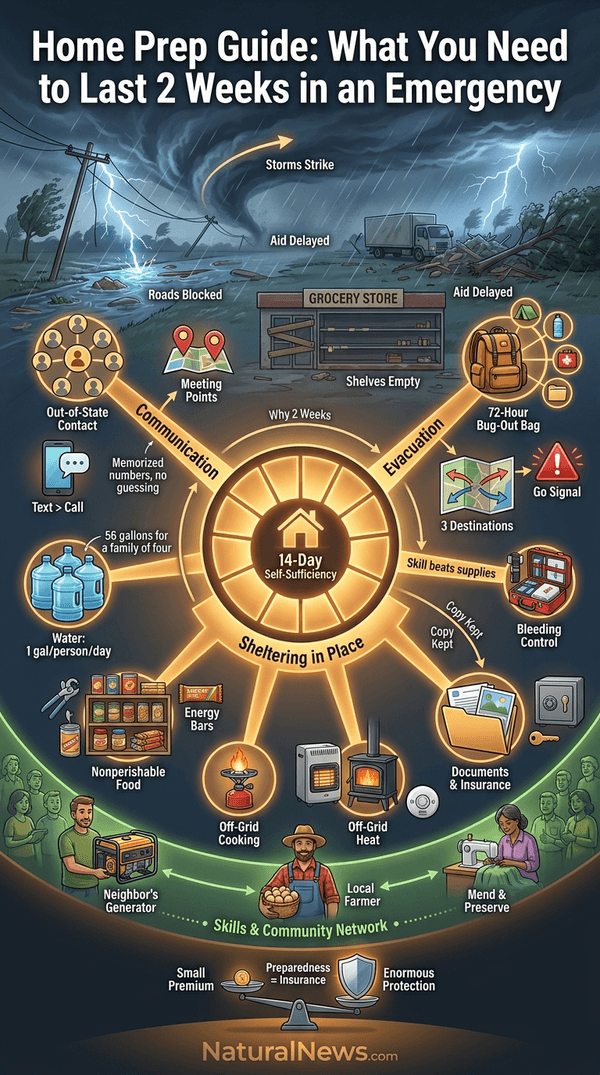
The Epoch Times guide includes an infographic with detailed guidance on how to effectively shelter in place. Broader guidance on sustaining a household through extended disruptions points to the importance of focusing on skills as well as supplies. For those who are single parents or living paycheck to paycheck in small city apartments, skills become invaluable during a disaster scenario. Learning how to mend clothes, practice animal husbandry, and prepare food are essential skills everyone should acquire, along with building relationships with local farmers [8].
The guide states that by concentrating on the three elements of family communication, evacuation planning, and sheltering in place, individuals can replace fear and uncertainty with confidence and readiness.
Ongoing Review and Conclusion
Preparedness is an ongoing process. Families should regularly review and practice their plans with all family members, update their supplies, and stay informed about the types of emergencies most likely to occur in their area.
Stewart stressed that while no plan is perfect, taking proactive steps can significantly improve the ability to face the unexpected [1]. Research on emergency preparedness supports the value of review as an ongoing discipline; one analysis states that plans tested merely to put a checkmark in a box fall short, and it quotes the observation that those who do not obstinately prepare to face crisis will soon be subjected to its reign [9].
A full version and printable infographic of the guide are available for download here [1]. For households seeking to build the knowledge base that supports preparedness, the Activist Post notes that having a good survival book on hand is almost as important as having the right gear, and that during a real crisis, when the power is out and help is not coming, what you know matters more than what you own [10].
References
- Home Prep Guide: What You Need to Last 2 Weeks in an Emergency. https://www.theepochtimes.com/article/a-guide-to-home-preparedness-5740113
- Prepping 101 The ultimate guide to building a family emergency plan - NaturalNews.com, May 22, 2025.
- Urban Emergency Survival Plan by Jim Cobb
- The art of EVACUATION: Why every family needs a pre planned escape strategy - NaturalNews.com, June 12, 2026.
- Unsure of What to Put in Your First Aid Kit? Experts Share the Essentials You Need. https://www.everydayhealth.com/wellness/first-aid-kit-supplies/
- 2-Week Emergency Kit: Serious Preparedness for $100–$250. https://www.survivalstockup.com/emergency-prep-guides/2-week-emergency-kit/
- 2-Week Power Outage: What Runs Out First (Most People Get This Wrong). https://www.thesavvysurvivalist.com/two-week-power-outage-preparedness/
- Mike Adams interview with Seth Holehouse - November 8 2024 by Mike Adams
- Protecting your business: from emergency planning to crisis management. Journal of Hazardous Materials 65 1999
- Best Survival Books: Top Prepper Reads to Master Survival. https://www.activistpost.com/best-survival-books-top-prepper-reads-to-master-survival/
Explainer Infographic








Please contact us for more information.