



Meta Platforms released a new artificial intelligence (AI) model called Muse Wonder on Monday, Oct. 12, saying it matches OpenAI's ChatGPT and Anthropic's Claude on coding and financial or legal tasks.
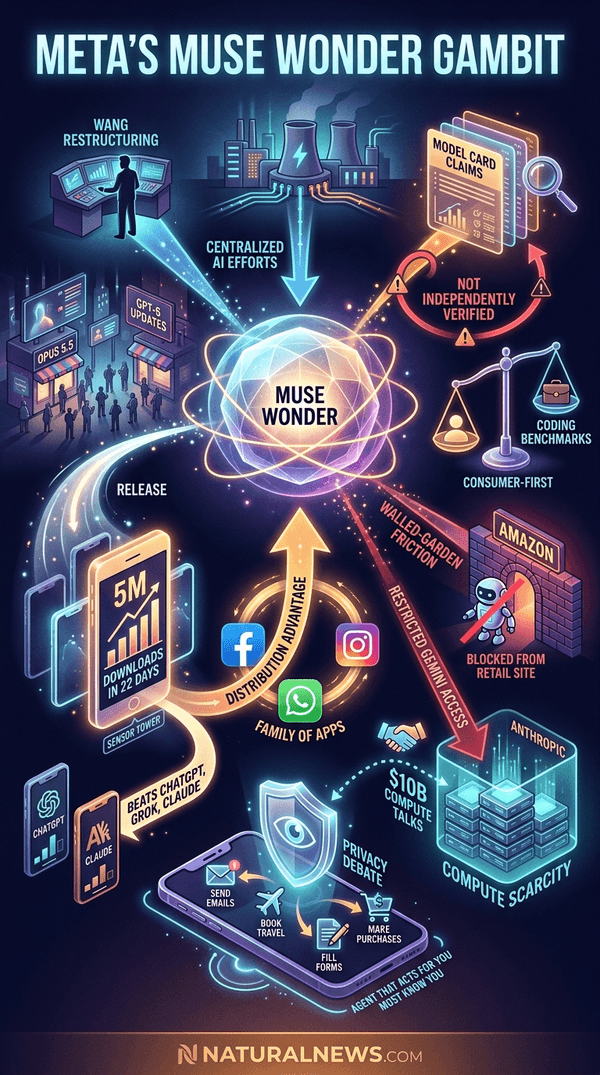
The release marks Meta's first frontier model release since chief AI officer Alexandr Wang restructured Meta's AI efforts in August of last year, a period during which Meta avoided the kind of state-of-the-art model releases OpenAI and Anthropic are known for [1]. Meta first released the Muse personal AI agent on Sept. 8, and the app reached 5 million downloads in 22 days – faster than ChatGPT, Grok and Claude, according to market intelligence firm Sensor Tower [2].
Meta Positions Muse Wonder as Frontier Model
Wang said the new models are competitive with the best systems available. He noted that Meta has sought to distinguish itself from competitors by targeting broad consumer use cases rather than narrowly emphasizing coding. Muse is capable of sending emails, booking travel, filling out forms and making purchases on a user's behalf, the company said [3].
The company has also moved to expand Muse across more surfaces. Amazon previously blocked Muse from its retail site after the social media company declined a request to remove the bot, according to Bloomberg [4].
Verification Questions Remain
Meta's testing, presented in the model card, states that the Wonder models achieve comparable results, but the company's claims have not been independently verified [1]. The launch follows a pattern of rapid model releases across the industry. Anthropic rolled out Opus 5.5, and OpenAI followed with GPT-6 model updates shortly after, with Meta's Muse drawing attention during the same period [5].
Background: Meta's 14-Month AI Push
The buildout has not been without friction. Google restricted Meta's access to its Gemini AI models amid a shortage of computing power, disrupting Meta's internal AI projects, according to reports [6].
Meta also has been in discussions to rent computing power from its AI data centers to Anthropic in a deal that could be worth as much as $10 billion over two years, according to three people with knowledge of the talks [7]. The release occurs as debate continues over AI's impact on employment, privacy and concentration of power in large technology companies.
Conclusion: What to Watch
Key questions include whether independent benchmarks confirm Meta's claims and how developers and consumers adopt Muse Wonder through the API and Muse Code.
Critics have pointed to unresolved concerns around automation, data privacy and centralized control of AI systems. Meta has disputed a claim that Muse read a user's private messages without permission, saying the agent cannot access a user's Messages without explicit permission [8]. The company has also been testing a human concierge for Muse, with contractors handling some phone calls placed via the digital agent, according to internal company posts seen by Reuters [9].
References
- Meta releases its first frontier model, Muse Wonder. https://techcrunch.com/2026/10/12/meta-releases-its-first-frontier-model-muse-wonder/
- Meta launches Muse Wonder AI model to rival ... - Quartz. https://qz.com/meta-muse-wonder-ai-model-launch-101226
- Meta Launches Muse AI Agent to Handle Tasks, Plan Goals and Act on Users’ Behalf. https://yournews.com/2026/09/09/7190232/meta-launches-muse-ai-agent-to-handle-tasks-plan-goals/
- Agentic Wars Begin: Amazon Blocks Meta's Agents As Muse Takes World By Storm. https://www.zerohedge.com/technology/agentic-wars-begin-amazon-blocks-metas-agents-muse-takes-world-storm
- Will Meta’s AI Tamagotchi bet is…working?. https://techcrunch.com/video/will-metas-ai-tamagotchi-bet-isworking/
- Google restricts Meta's Gemini AI access amid computing crunch - NaturalNews.com, June 30, 2026.
- Meta in Talks to Lease AI Computing Power to Anthropic in Potential $10 Billion Deal - NaturalNews.com, July 23, 2026.
- Meta disputes claim that Muse read a user’s private messages without permission. https://techcrunch.com/2026/09/30/meta-disputes-claim-that-muse-read-a-users-private-messages-without-permission/
- Meta Tests Human Concierge for Muse AI Assistant, Internal Posts Show - NaturalNews.com, September 27, 2026.
Explainer Infographic











Please contact us for more information.