



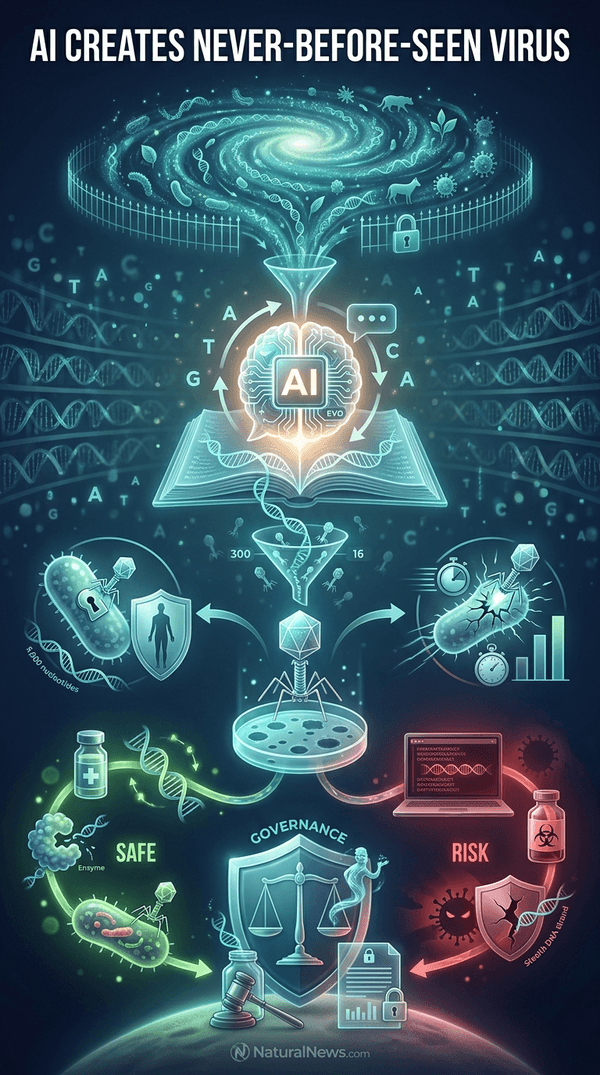
Researchers at the Arc Institute in Palo Alto, California and Stanford University used an artificial intelligence (AI) model called Evo to generate new versions of a virus not found in nature, according to the study authors.
The resulting pathogens, known as bacteriophages – viruses that infect bacteria – cannot infect humans or animals, the report stated. Samuel King, a Stanford graduate student and study author, told the New York Times (NYT): "It just felt like the obvious next step." Large language models, which underlie tools such as ChatGPT, can generate realistic text and pose risks of misuse in creating fake news or other misinformation [1].
Evo Model Trained on Genetic Sequences
Evo, a program similar to ChatGPT, scanned about nine trillion nucleotide bases from animals, plants, viruses and microbes, according to the research team. Rather than analyzing written text, the model was used to dissect and form genetic code, the report stated.
After learning natural DNA patterns, Evo generated nearly 300 genomes of Phi X-174, a virus chosen because it cannot infect humans or animals. Sixteen of those genomes were determined to be viable, the study reported.
In petri dish tests, some AI-designed phages multiplied faster than the original Phi X-174 and burst out of host cells, according to the authors. The researchers selected Phi X-174 because a virus genome is less complex than the DNA instructions found in a human cell, the report stated.
Researchers Call Study a Turning Point
Marc Güell of Pompeu Fabra University in Spain told the BBC the study was "a very significant turning point" and "allows us to dream of exciting possibilities for tackling humanity's greatest challenges." Güell said that "for the first time in history, we are beginning to design biology on a computer," according to the BBC.
The scientists said they did not provide the model with data from viruses that infect humans, animals, plants or fungi, the article noted. The team also excluded similar viruses that infect other organisms, the report stated.
Biosafety and Biosecurity Questions Raised
But Dr. Thomas Inglesby and Dr. Moritz Hanke of the Johns Hopkins Center for Health Security wrote in a Science article that the results raised "urgent biosafety and biosecurity questions." They said the issue is no longer "whether generative viral genome design will exist" but whether it can be used without "enabling serious harm." Viruses that could cause disease "should not be pursued," they added, according to the report.
Hanke told NYT: "You could say, 'Hey, genomic language model, make me an influenza genome that is modified to be more transmissible or to be more lethal.'" A Microsoft study demonstrated that AI can be used to design novel, toxic biological agents by "paraphrasing" the genetic sequences of known toxins, allowing them to bypass commercial biosecurity screening software, according to a NaturalNews.com report [2].
The U.S. National Institutes of Health should improve how it regulates lab-generated viruses that could pose a national security risk, according to its biosecurity advisers, the National Science Advisory Board for Biosecurity [3]. In a previous case, a team at Boston University's National Emerging Infectious Diseases Laboratories developed a new strain of the Wuhan coronavirus (COVID-19) that killed 80% of infected mice in a laboratory setting, according to a preprint study [4]. Declassified documents released in June 2026 showed U.S.-funded coronavirus research included planning for spike-protein modifications, receptor-adaptation experiments, and testing in humanized mice, according to ZeroHedge [5].
Implications of AI-Designed Pathogens
The study is among the first examples of generative AI being applied to biology, according to researchers, and the field remains at an early stage. Scientists emphasized that the resulting bacteriophages pose no threat to humans, but the methods could be adapted to other genomes, experts said.
Some analysts have said that only a few companies in the world have the resources to invest in developing large language models similar to GPT-4, a factor that could shape oversight [1]. The report raised policy questions about future oversight of AI-generated biological sequences, with the authors stating that dangerous viruses should not be pursued. A technology executive described one path as "to completely prioritize technology to maximize what's possible without considering potential implications." [1]
References
- aacid zlib3 files 20241105T001425Z 29870425 3zFrZWC8qLJzJ5FoyS9nN5.
- Ava Grace. "Digital Pandora's Box: How AI Outsmarts Biosecurity and Paves the Path for Next-Generation Threats". NaturalNews.com. October 09, 2025.
- Emily Kopp. "'Vague and Secretive': Risky NIH Research Not Adequately Regulated, Experts Say". Children's Health Defense. January 21, 2024.
- Michael Nevradakis. "Insane: Boston Researchers Create 'More Lethal' Strain of COVID, Prompting Calls to Shut Down Risky Gain-of-Function Research". Children's Health Defense. January 21, 2024.
- "Gabbard Drops Fauci COVID-19 Receipts On Last Day: He Funded The Research, Cooked The Cover Story, Then Lied To Congress". Zero Hedge. June 19, 2026.
Explainer Infographic











Please contact us for more information.