


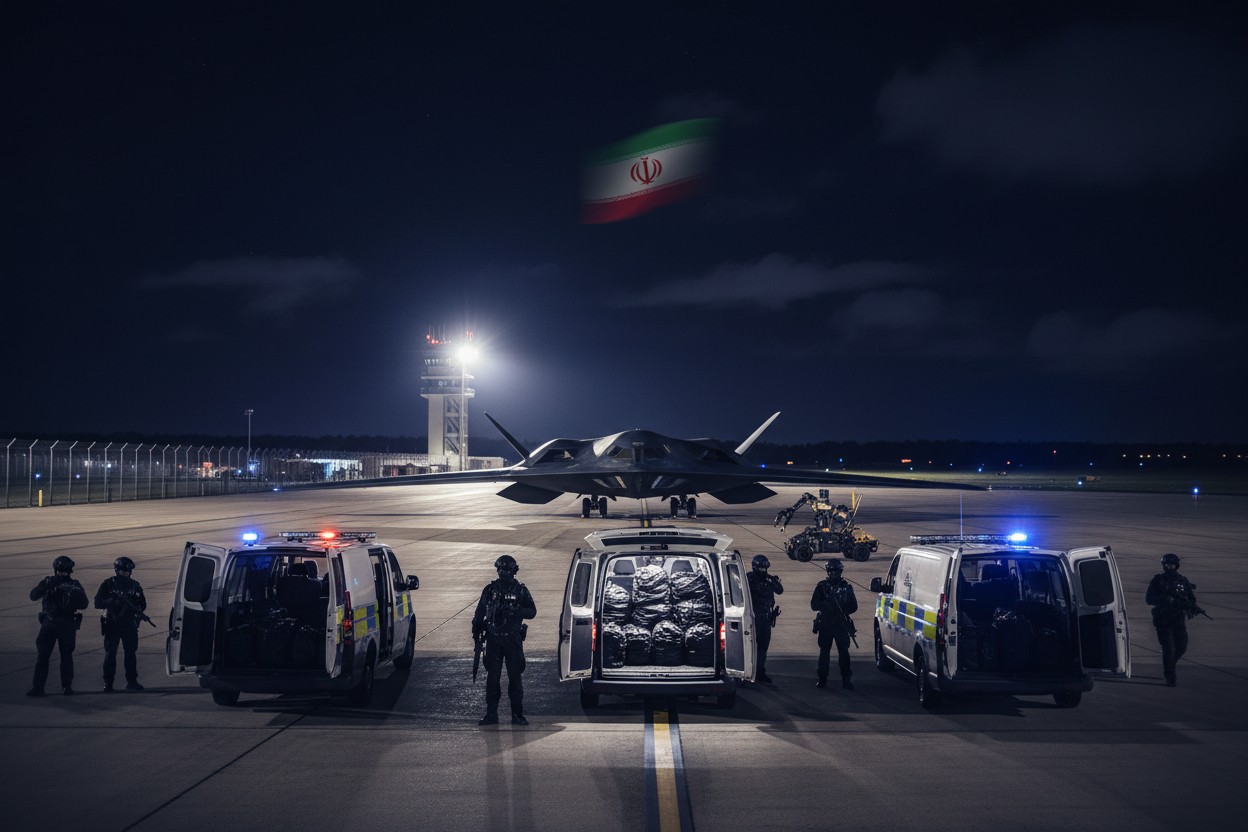
- Iran’s Foreign Ministry rejected British claims that it plotted an attack on RAF Fairford, a UK airbase used by U.S. bombers, calling it a false flag.
- British Prime Minister Andy Burnham told Parliament the plot was almost certainly directed by Iran’s Islamic Revolutionary Guard Corps.
- Five British men arrested near the base on September 27 were released on bail without charge, and police found gasoline but no explosives.
- The UK sanctioned two Iranians, but neither was explicitly identified as a Fairford organizer.
- U.S. bombers have since left the base, and analysts remain divided over what actually happened.
On Monday, Iran’s Foreign Ministry categorically rejected British accusations that it was behind a plot against RAF Fairford, a southwestern England airbase that U.S. bombers used to strike Iran, calling the allegations a “clumsy false flag operation” designed to deflect blame for London’s role in the American-Israeli war on Iran. The confrontation began after five British men in their 20s were arrested near the base on September 27 on suspicion of preparing a terrorist act and breaching explosives law, prompting Prime Minister Andy Burnham to tell Parliament the suspected plot was “highly likely” coordinated from Iran and almost certainly directed by Iran’s Islamic Revolutionary Guard Corps (IRGC).
Tehran dismisses allegations as baseless fabrication
The Iranian Foreign Ministry issued a strongly worded statement Monday asserting the accusations were aimed at “advancing an anti-Iran campaign and evading accountability for Britain’s involvement in the US-Israeli military aggression against the Iranian people.” Tehran explicitly rejected any connection to the incident, holding the British government responsible for all consequences of what it called fabrications.
Iran’s ambassador to London, Ali Moussavi, called on the UK to back up its claims with evidence, according to the state news agency IRNA. The ministry characterized the affair as part of a broader Western effort against Iran, noting Britain’s “track record of fabricating security claims against other countries” has sometimes triggered tensions in the Middle East.
Release of suspects on bail raises questions about evidence
Despite dramatic security operations that included 85 home evacuations, a bomb disposal robot, and armed police manning roadblocks in the rural Gloucestershire area, all five initially arrested suspects were released on bail without charge. Police later confirmed finding no explosives in the three white vans, only accelerants like gasoline.
Many security analysts told Al Jazeera the quick release suggested the UK had little evidence, at least for now, of a major attack. Former UK National Counter Terrorism Security Office head Chris Phillips noted that under the Terrorism Act 2000, suspects can be detained without charge for as long as 14 days, adding, “If there had been any trace of explosives found in the vans, or any thoughts that these men were actually terrorists, they would not have been released.” Loughborough University visiting fellow Afzal Ashraf, a former senior RAF officer, concurred.
UK sanctions two Iranians amid international condemnation
Foreign Secretary Ed Miliband announced asset freezes and travel bans against Ruhollah Bazghandi, who heads counterespionage for the IRGC, and Shahram Ali Reza Tamarzadeh Jakki, who allegedly aided the Zindashti network, a criminal group the UK ties to plots against Iranian dissidents. Neither was explicitly identified as a Fairford organizer.
Miliband said Iran’s ambassador was also summoned to be warned that Britain would not accept attacks on its territory. A joint statement signed by more than two dozen countries recognized the UK’s attribution of the Fairford incident to Iran and condemned “in the strongest terms Iran’s use of violent attacks,” including lethal plotting, arson, sabotage and cyberattacks.
U.S. bombers leave Fairford amid reported drone fears
The United States pulled roughly a dozen B-1 bombers out of RAF Fairford following the incident, and U.S. media outlets, citing unnamed sources, reported intelligence that small drones could target the aircraft. The Pentagon later said every U.S. bomber deployed there had returned to the United States.
The base, located roughly 100 miles west of London, hosted U.S. bombers during the war with Iran, which began February 28, under British approval for what London calls defensive strikes. Israeli Prime Minister Benjamin Netanyahu told Fox News that Israel had warned the UK about an Iranian-sponsored attack, although he made the claim while criticizing British measures over Israeli settlement expansion.
Not all analysts agree. Anthony Glees, emeritus professor of security and intelligence studies at the University of Buckingham, told Al Jazeera he believes the men were hired by a foreign state to stage an incident meant to embarrass London rather than carry out an attack. With no one charged, no explosives found and the government’s evidence undisclosed, the case could still pull Britain deeper into the U.S.-Israeli war on Iran, and Tehran has said any base used against it is a legitimate target.
Sources for this article include:







Please contact us for more information.