


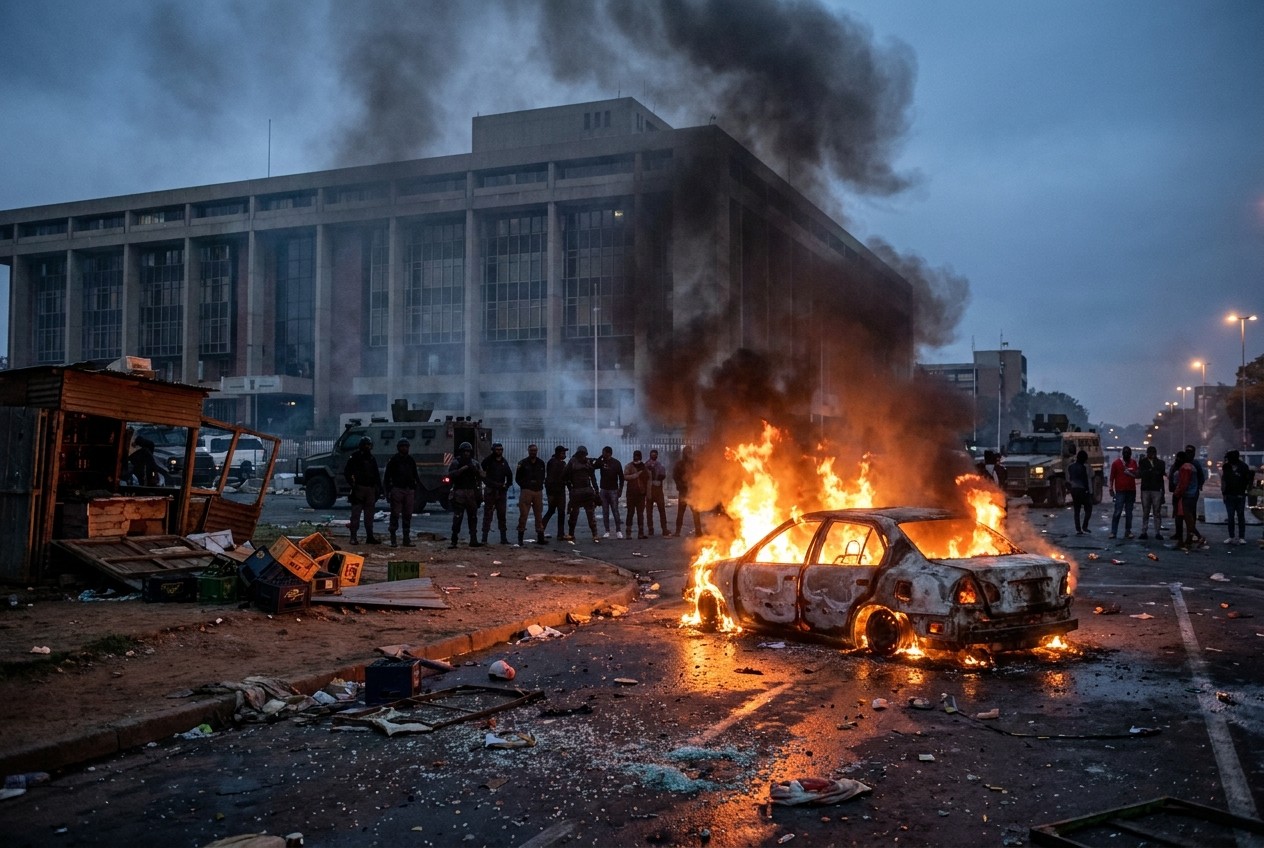
When South African President Cyril Ramaphosa deployed 510 troops into KwaZulu-Natal under the guise of quelling “misinformation-driven” violence, the official narrative barely scratched the surface of a deeper, more insidious pattern. The government’s claim that a Constitutional Court ruling on asylum seekers sparked riots (only to later admit its own mismanagement of the rollout) exposes a disinformation strategy that weaponizes public fear to advance political agendas and government control. As soldiers stand guard ahead of November elections, the question lingers: is this a response to unrest, or a calculated move to control the narrative and suppress dissent? The facts suggest the latter, revealing a state that thrives on confusion, not clarity.
Key Points:
- The Constitutional Court ruling did not grant amnesty to asylum seekers but merely required procedural fairness in processing claims.
- Government officials failed to communicate this nuance, allowing anti-immigrant misinformation to fester.
- The timing of troop deployment aligns with pre-election tensions, suggesting a bid to manage optics over addressing root causes.
- Military use in domestic affairs, under Operation Prosper, reflects a pattern of leveraging force to suppress unrest rather than resolve systemic issues.
The court ruling vs. the misinformation narrative
The Constitutional Court’s July decision was a technical correction, not a policy shift. It mandated that asylum seekers denied entry due to procedural flaws, (such as missing paperwork) must be given a hearing, but it did not grant automatic refugee status or amnesty. Yet, the government’s failure to explain this distinction allowed conspiracy-laden claims to spread. By the time Home Affairs reversed its directive in early October, the damage was done: misinformation had taken root, and violence erupted.
The state’s refusal to acknowledge its role in the chaos is telling. Government spokesman William Baloyi blamed “false information,” a convenient narrative that absolves officials of their own incompetence. As commentator Malaika Mahlatsi noted, the ruling ANC should have pre-emptively explained the legal changes, especially in a nation still reeling from 2008’s 'xenophobic violence'. Instead, the Home Affairs department blinked, withdrawing its directive after protests, effectively conceding that its rollout was a disaster.
Military deployment as political theater
The troop deployment’s end date [November 4, the day of local elections] reveals a strategic intent. Analysts like ACLED’s Ladd Serwat have long warned that anti-immigrant rhetoric is a tool for political gain, not public safety. The ANC, facing a likely electoral drubbing amid 30% unemployment, is using soldiers to project control while deflecting blame for economic failures. This is not new: Operation Prosper, originally deployed in 2021 to manage Jacob Zuma’s imprisonment, has become a default tactic for crises the state cannot resolve.
Criminologist Guy Lamb’s warnings about soldiers being untrained for policing ring true. Their presence is a deterrent until the first confrontation, after which the state can pivot to narratives of “law and order” while avoiding accountability. The lack of published rules of engagement for this deployment further highlights the militarization of domestic affairs as a political tool, not a public service.
South Africa’s crisis is a microcosm of global trends where governments weaponize misinformation and military force to manage dissent. The Durban riots are not merely about asylum seekers but about a state that has abandoned transparency, opting instead for theatrics and coercion. As the November elections loom, the question is not whether the troops can restore order, but whether the ANC can admit its failures and address the real grievances fueling the unrest. Until then, the soldiers will stand by -- symbols of a regime more interested in controlling the narrative than solving the problem. The misinformation crackdown in South Africa is a test run for further governmental control on the streets to cull civil unrest that will eventually occur in other nations.
Sources include:




Please contact us for more information.