


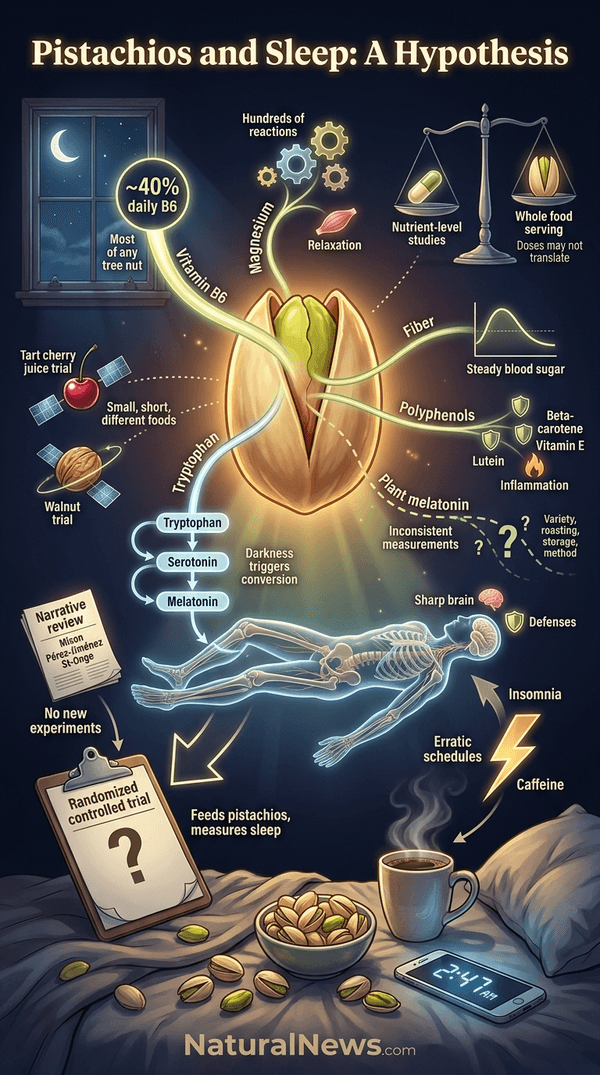
A narrative review published in Nutrition Research Reviews suggests that pistachios contain nutrients linked to sleep regulation, including vitamin B6, magnesium, tryptophan, fiber, and polyphenols, as well as a plant form of melatonin. The review was conducted by researchers from Augusta University Medical College of Georgia, Spain's Institute of Food Science, Technology and Nutrition, and Columbia University. The authors synthesized existing research on pistachio nutrients and sleep but did not conduct new experiments, and they call for randomized controlled trials that feed pistachios to people and measure sleep outcomes.
One ounce of pistachios provides nearly 40% of daily vitamin B6, the most of any tree nut [1]. The body uses vitamin B6 to produce GABA and serotonin, which are involved in sleep regulation [2]. Pistachios also contain magnesium, fiber, tryptophan, and polyphenols, nutrients that have been studied for their effects on sleep.
The review, titled "Exploring the role of pistachio nutrients and bioactive components in sleep health: a narrative review," was authored by Ashley Mixon, Jara Pérez-Jiménez, and Marie-Pierre St-Onge.
Sleep Problems and Dietary Research
Sleep is a crucial component of optimal health that helps keep the brain sharp, boosts defenses against disease, and carries out important biological processes, yet erratic schedules, caffeine consumption, and conditions such as insomnia can prevent people from getting seven to nine hours of uninterrupted sleep each night [3].
The review examined pistachios as a potential food-based approach to sleep improvement. The review focused on how the nutrients and bioactive components found in pistachios might influence sleep health, while acknowledging that existing evidence remains preliminary and that controlled human trials are still needed to establish any causal relationship.
Comparative nutrition research has also positioned pistachios among the top healthiest nuts. Dietitians consulted by Fox News Digital identified walnuts, pistachios, almonds, Brazil nuts, and cashews as the top choices based on factors including omega-3 content, fiber, protein, and mineral density [4].
Pistachio Nutrients Linked to Sleep
One ounce of pistachios, roughly a small handful, supplies close to 40% of the daily recommended vitamin B6, the most of any tree nut [1]. The body uses B6 to build GABA, a chemical that calms the nervous system, and serotonin, which later turns into melatonin, the hormone that signals bedtime [1]. Pistachios provide tryptophan, vitamin B6, and magnesium, which the body uses in the production of serotonin and melatonin, according to researchers [2].
Pistachios are also a rich source of polyphenols. Pistachio nuts contain high levels of antioxidants such as lutein, beta-carotene, and tocopherol (vitamin E), which has caught the attention of researchers investigating their potential health benefits [5]. These compounds, along with the nutrients already described, are part of why pistachios have drawn interest as a food that may support sleep, though researchers caution that nutrient-level findings do not always translate directly to effects from eating the whole food.
Conflicting Melatonin Measurements
Melatonin is where the numbers disagree most. Pistachios supply melatonin and vitamin B6 that naturally regulate the circadian rhythm, according to natural health reporting [6]. Different analyses have reported widely varying melatonin content in pistachios, and researchers have not settled on a consistent figure, which makes it difficult to draw firm conclusions about how much melatonin a serving of pistachios actually delivers.
The gap matters because of two small trials of other melatonin-rich foods. Those studies suggest that melatonin-containing foods can influence sleep, but the trials were small and involved foods other than pistachios, so the results cannot be directly applied to pistachios.
Tart cherry juice increases melatonin, resulting in significant increases in time in bed, total sleep time, and sleep efficiency ratio, and walnuts can help improve sleep because of their natural melatonin, serotonin, and polyphenol content [7]. Pistachios are among the richest natural sources of melatonin, a hormone responsible for regulating sleep cycles, according to recent research [8].
Limitations and Funding Disclosures
The review is a narrative review rather than a systematic review or meta-analysis, which means the authors selected and interpreted the studies they discussed rather than applying a strict, predefined selection method. Narrative reviews can be useful for summarizing a field, but they are generally considered weaker evidence than systematic reviews because they may be more susceptible to selection bias. The authors also did not run any new experiments, so their conclusions rest entirely on previously published research.
The limitations matter because food-based sleep research often leans on nutrient-level findings that may not translate to whole foods. A nutrient like tryptophan or magnesium may show an effect when studied in isolation or at high doses, but the amount present in a normal serving of pistachios might be too small to produce a measurable change in sleep. The authors acknowledge these gaps and call for randomized controlled trials that feed pistachios to people and directly measure sleep outcomes. Until such trials are conducted, the review's findings should be treated as a hypothesis rather than a confirmed benefit.
References
- Could a Handful of Pistachios Mean Better Sleep? .... https://studyfinds.com/pistachios-better-sleep/
- Can pistachios support sleep? Here’s what a new... | EurekAlert!. https://www.eurekalert.org/news-releases/1146440
- 14 Best foods to eat for better sleep - NaturalNews.com, September 24, 2020
- Dietitians Identify Top 5 Healthiest Nuts to Eat Based on Nutritional Value - NaturalNews.com, May 07, 2026
- The complete encyclopedia of superfoods with 150 high-impact power-packed recipes cooking for health energy weight loss and by Deane Audrey
- The science of sleep How nutrition can transform your nightly rest - NaturalNews.com, May 13, 2026
- Eat for extraordinary health healing by Unknown
- Pistachios have attracted scientific interest because .... https://www.facebook.com/Brainybytes.us/posts/pistachios-have-attracted-scientific-interest-because-researchers-have-detected-/122143400895003279/
Explainer Infographic






Please contact us for more information.