


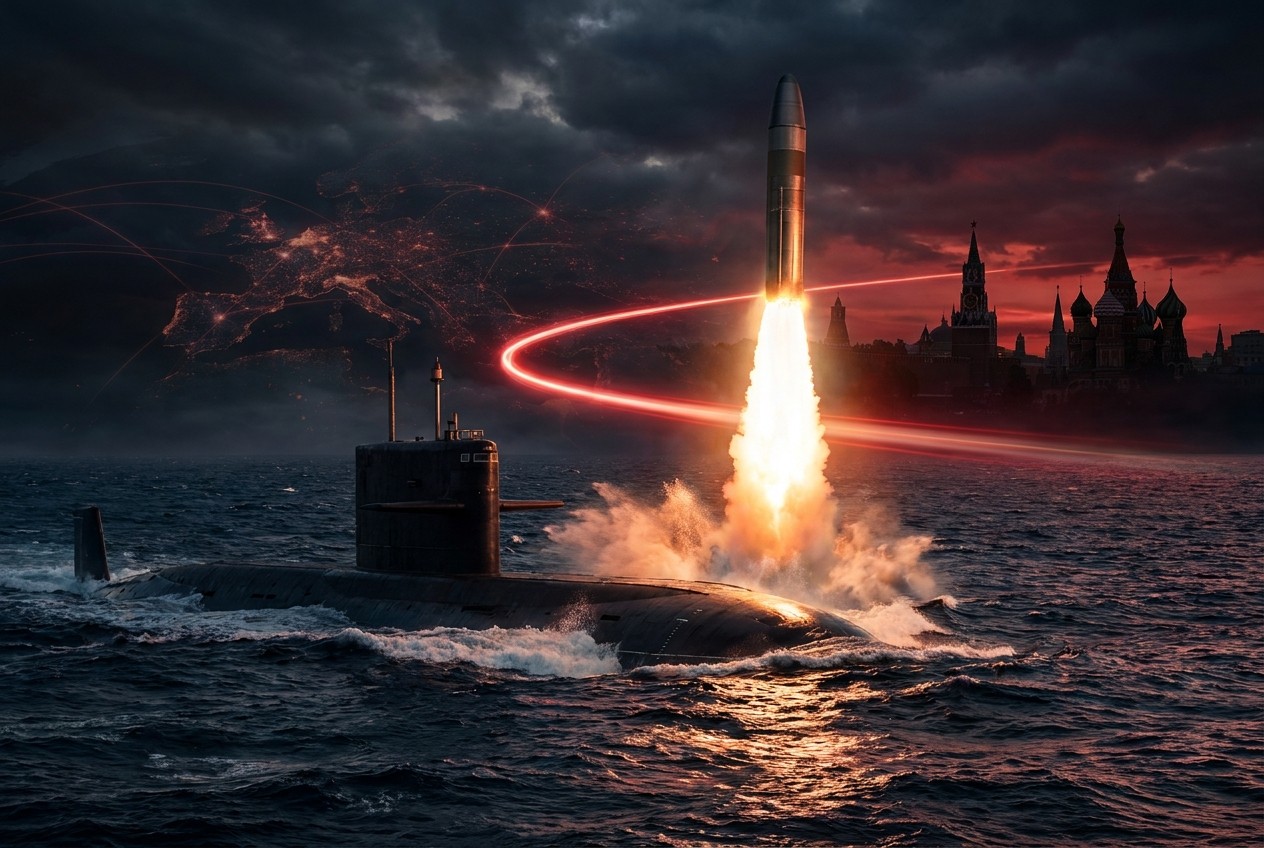
The Kremlin said Wednesday that Russia views France's recent nuclear-capable missile launch as a "loud and clear message" and will take "all necessary measures" to protect its national security, according to Kremlin spokesman Dmitry Peskov.
The French military test-fired a submarine-launched M51.3 ballistic missile on Tuesday in the Atlantic Ocean, an exercise observed by French President Emmanuel Macron, the French military said. The missile was launched without a warhead and splashed down in the North Atlantic "hundreds of kilometers from any coastline," according to the French military.
Peskov spoke to reporters on Wednesday, one day after the test, and said the launch would not advance dialogue between Moscow and Paris.
French Military Confirms M51.3 Test in Atlantic
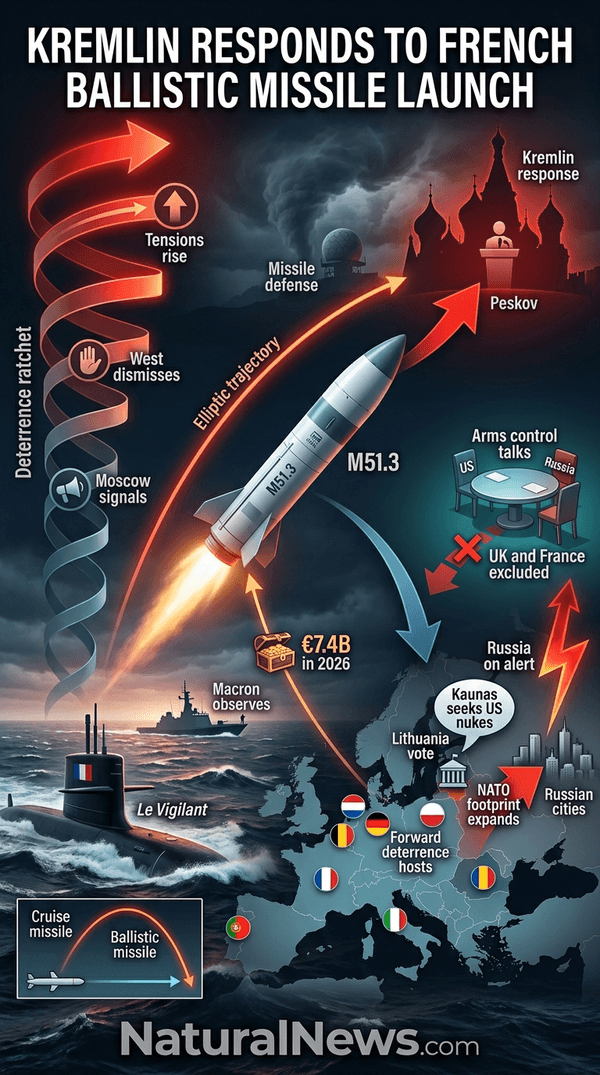
The M51.3 is a new variant of France's 16-year-old M51 missile family, according to the French military, and the launch was conducted without a warhead. The unarmed missile was launched off Brittany to certify the nuclear submarine Le Vigilant's ability to deploy it following a major overhaul [1]. French officials did not provide further technical details about the test.
Macron said in the video, "Today we are stronger. The message has been sent loud and clear for wherever it must be received" [2].
Outside the United States, France possesses NATO's only independent nuclear arsenal, which Macron is currently modernizing and expanding [3]. Ballistic missiles such as the M51.3 are distinct from cruise missiles due to their flight characteristics; while cruise missiles typically follow a low-altitude, straight trajectory, ballistic missiles like the M51.3 are launched in an arc, following an elliptic trajectory [4].
Peskov Cites Dialogue, Warns on European Militarization
He said Europe has become obsessed with plans to militarize the European Union and is building its defense identity on confrontation with Russia, calling this approach a "dead end" [3].
"Against the backdrop of such aggressive actions and such plans, Russia is on alert," Peskov added. "We are taking all necessary measures to ensure our national security at the strategic level" [3]. Peskov did not specify what measures Russia might take, according to the report.
Earlier, Peskov said on Tuesday that Russia cannot view the deployment of atomic weapons on its borders "as anything other than a step toward escalating tensions" [3]. He was responding to the Lithuanian parliament's vote to remove a constitutional ban on hosting nuclear weapons on its soil. Although Lithuania has not signed on to France's "forward deterrence" plan, Defense Minister Robertas Kaunas has expressed interest in hosting American nukes in Lithuania, the report stated [3].
French Defense Spending and Forward Deterrence Plan Outlined
France plans to spend €7.4 billion ($8.3 billion) on nuclear deterrence in 2026, and its updated military program adds €36 billion to overall defense spending through 2030, according to the report [3]. Much of this money will be spent on multi-year submarine, missile, and warhead contracts, but a substantial sum will go toward Paris's "forward deterrence scheme."
Under this scheme, Belgium, Denmark, Finland, Germany, Greece, the Netherlands, Norway, Poland, Sweden, and the UK will potentially host French nuclear weapons on a temporary basis and take part in French nuclear exercises, officials said [3].
The Kremlin has also said that the British and French arsenals must ultimately be included in negotiations on reducing strategic nuclear weapons, though it maintains that talks must first be conducted between Russia and the U.S. [5]. Russia possesses the world's largest nuclear arsenal, according to the report [3].
Lithuania Vote and Nuclear Deployment Concerns
Responding to the Lithuanian parliament's vote to remove a constitutional ban on hosting nuclear weapons, Peskov said Russia cannot view the deployment of atomic weapons on its borders "as anything other than a step toward escalating tensions," according to the report [3]. Lithuania has not signed on to France's "forward deterrence" plan, but Defense Minister Robertas Kaunas has expressed interest in hosting American nuclear weapons in Lithuania, the report stated [3].
The exchange follows previous Kremlin comments on NATO nuclear activities near Russia's borders, including statements that the deployment of nuclear weapons or technology to Ukraine would trigger retaliation [6]. Russian Security Council Deputy Chairman Dmitry Medvedev has warned that Moscow will retaliate if NATO members transfer nuclear weapons or technology to Ukraine [6].
No Further Details; Observers Note Tensions
French officials did not immediately respond to Peskov's remarks, and no further statements were provided by either side. The exchange follows previous Kremlin comments on NATO nuclear activities near Russia's borders, officials said.
Observers noted the test and response come amid broader tensions over nuclear posture in Europe. The Kremlin has also said that talks on reducing strategic nuclear weapons must ultimately include the British and French arsenals [5].
References
- Macron Observes Test of New Nuclear-Capable Missile .... https://www.facebook.com/firstpostin/posts/macron-observes-test-of-new-nuclear-capable-missile-without-warheadfrance-has-co/1634842708676710/
- France Tests Upgraded Nuclear Missile Against Backdrop .... https://www.usnews.com/news/world/articles/2026-10-06/france-tests-upgraded-nuclear-missile-against-backdrop-of-russia-tensions
- Kremlin responds to French ballistic missile launch. https://www.rt.com/russia/646886-russia-france-missile-test/?utm_source=rss&utm_medium=rss&utm_campaign=RSS
- France’s Strategic Pursuit of Ballistic Missile... https://debuglies.com/2024/11/29/frances-strategic-pursuit-of-ballistic-missile-capability-a-european-response-to-geopolitical-realities/
- Kremlin says British and French arsenals must ultimately be part of .... https://www.reuters.com/world/kremlin-says-british-french-arsenals-must-ultimately-be-part-nuclear-disarmament-2025-09-29/
- Medvedev: Russia will RETALIATE if NATO arms Ukraine with nuclear weapons. https://www.naturalnews.com/2026-02-25-medvedev-russia-retaliate-nato-arms-ukraine-nukes.html
Explainer Infographic





Please contact us for more information.