



Energy Secretary Chris Wright said Wednesday the Trump administration plans to steer clear of an outright ban on diesel exports, rejecting a Politico report that the White House was preparing a 90-day prohibition that could be announced within days, according to remarks reported by the Wall Street Journal.
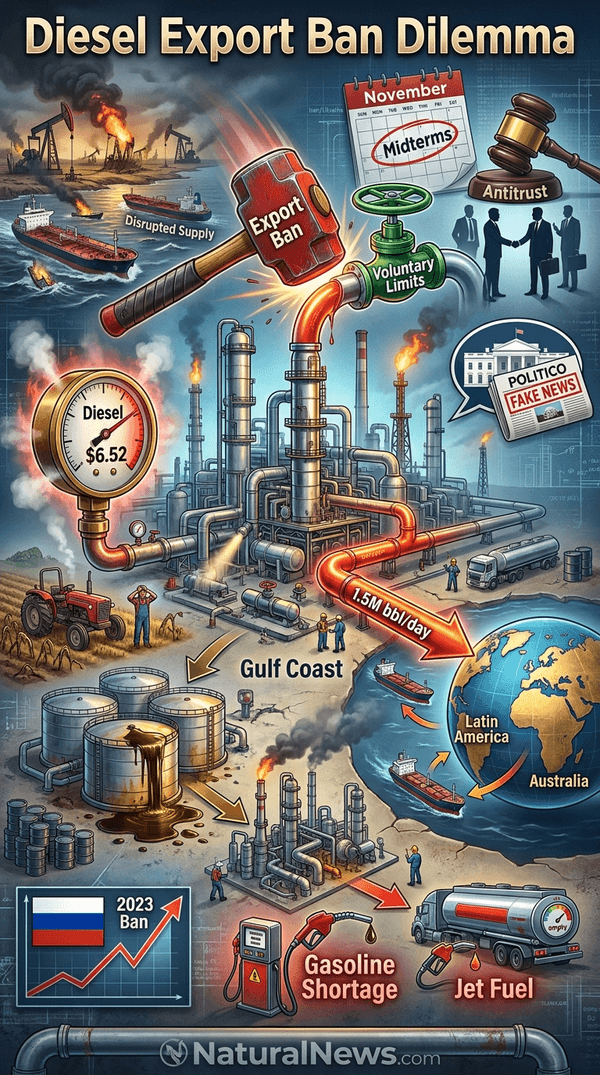
Speaking on the sidelines of the United Nations General Assembly, Wright said he favors voluntary limits on diesel exports instead. "We're trying to avoid a blunt hammer of a government policy, understanding the complexity of refining," he told the Journal.
The position pushes back on a Politico report published Wednesday that cited five people familiar with the discussions. The White House denied that report [1].
Politico Reported White House Preparing 90-Day Ban; White House Denies
Politico reported Wednesday that the White House was preparing an outright ban on diesel exports, citing five people familiar with the discussions. The legal process for such a ban was still being worked out, and President Trump was leaning toward announcing the move by the end of the week despite opposition, according to the report.
Wright, Treasury Secretary Scott Bessent and Interior Secretary Doug Burgum all voiced internal objections to a total ban, Politico reported. Wright also called energy CEOs Tuesday night to say a 90-day ban was likely in the coming days, according to a Trump energy adviser cited by Politico, prompting some executives to contact the White House and urge it to reconsider.
Trump on Tuesday voiced support for stopping diesel exports as Republicans from farm states and competitive congressional districts pressed the administration to act on fuel costs ahead of the Nov. 3 midterm elections. "Well, I've called for that too. I've said, let's not send out the diesel," Trump said Tuesday, according to the Epoch Times [2]. Bessent said at the time that officials were studying whether a full or partial restriction would be feasible [3].
Wright Warns Ban Could Cut Refinery Runs, Raise Other Fuel Prices
Wright said Wednesday at an event hosted by the Economist in New York that the blunt tool of banning diesel exports definitely does not work. He warned that blocking exports could leave refiners with nowhere to put excess diesel, eventually forcing them to cut refinery runs and putting upward pressure on gasoline and jet fuel prices.
The warning came as diesel prices have surged to record highs. Average U.S. diesel prices stood at $6.52 a gallon Wednesday, up 76% from a year earlier, according to AAA. The average price of a gallon of gas was $4.47, according to AAA.
The national average diesel price had already crossed the $6 mark for the first time in mid-September, hitting $6.06 a gallon on Sept. 11, up from $5.98 the previous day, according to AAA data [4]. The record exceeded the prior peak of $5.82 per gallon set on June 17, 2022. The surge in fuel costs is adding to inflationary pressures that have already strained consumers and businesses this year [4]. The national average price had climbed about 60% compared with the same period last year, when the fuel cost some $3.71 per gallon [5].
Trump Backs Keeping Diesel at Home as Midterms Approach; Industry Lobbies
President Trump said Tuesday that he backed keeping more U.S. diesel at home as his administration weighs restrictions on exports. "Well, I've called for that too. I've said, let's not send out the diesel," Trump said on Sept. 22 during a joint press conference with Ukraine's President Volodymyr Zelenskyy at the United Nations, according to the Epoch Times [8]. The remarks followed calls from Republican candidates in tight November races for the measure to curb record fuel prices, officials said [2].
Sen. Chuck Grassley (R-Iowa), head of the Senate Judiciary Committee, urged the administration to impose an embargo on diesel exports as the price of the fuel hit a record high on Monday morning, asking on X why Trump would not put an embargo on diesel exports "like presidents in the '70s put embargoes on [agriculture] products" [9]. Some industry executives and Republican lawmakers were still lobbying Trump against the proposal Wednesday, amid concerns that any short-term drop in diesel prices could eventually give way to higher prices for gasoline, jet fuel and other petroleum products.
Conclusion
The public dispute leaves the administration's diesel policy unresolved. Wright's rejection of an outright ban represents the clearest statement to date from a cabinet-level official that the White House prefers market-friendly voluntary measures over a government mandate, though he offered few details about how such voluntary limits would work.
For American consumers and the farmers, truckers and shippers who depend on diesel, the immediate threat of a full export prohibition appears to have receded—while the underlying price crisis tied to global refining shortages, Middle East conflict and constrained supply chains remains unaddressed. The Post has sought comment from the White House.
References
- NaturalNews.com. "Putin bans diesel and gasoline exports sending distillate fuel oil prices skyrocketing". NaturalNews.com. September 24, 2023.
- NaturalNews.com. "Trump Backs Diesel Export Ban as Fuel Costs Continue Soaring". NaturalNews.com. September 23, 2026.
- Just the News. "White House denies that it is planning to ban diesel exports for 90 days". Just the News. September 23, 2026.
- FreightWaves. "Export ban talk sinks diesel, boosts gasoline as White House eyes options". FreightWaves. September 24, 2026.
- The Epoch Times. "Trump Backs Temporary Diesel Export Ban as Fuel Costs Ripple Through Economy". The Epoch Times. September 23, 2026.
- NaturalNews.com. "U.S. Average Diesel Prices Cross $6 a Gallon for First Time, GasBuddy Says". NaturalNews.com. September 13, 2026.
- The Epoch Times. "GOP Senator Urges Trump to Place Embargo on Diesel Exports Due to Prices". The Epoch Times. September 21, 2026.
- Just the News. "Trump backs diesel export ban". Just the News. September 22, 2026.
- NaturalNews.com. "Trump Blames Zelensky for Record U.S. Diesel Prices". NaturalNews.com. September 14, 2026.
- Middle East Eye. "US energy secretary links lower fuel prices to Iran resolution". Middle East Eye. June 5, 2026.
- ZeroHedge. "US Now Expects Iran War Oil Supply Disruptions To Last Through End Of 2027". ZeroHedge. August 12, 2026.
- Mike Adams. "Health Ranger Report - Russia diesel export". Brighteon.com. September 22, 2023.
Explainer Infographic





Please contact us for more information.