


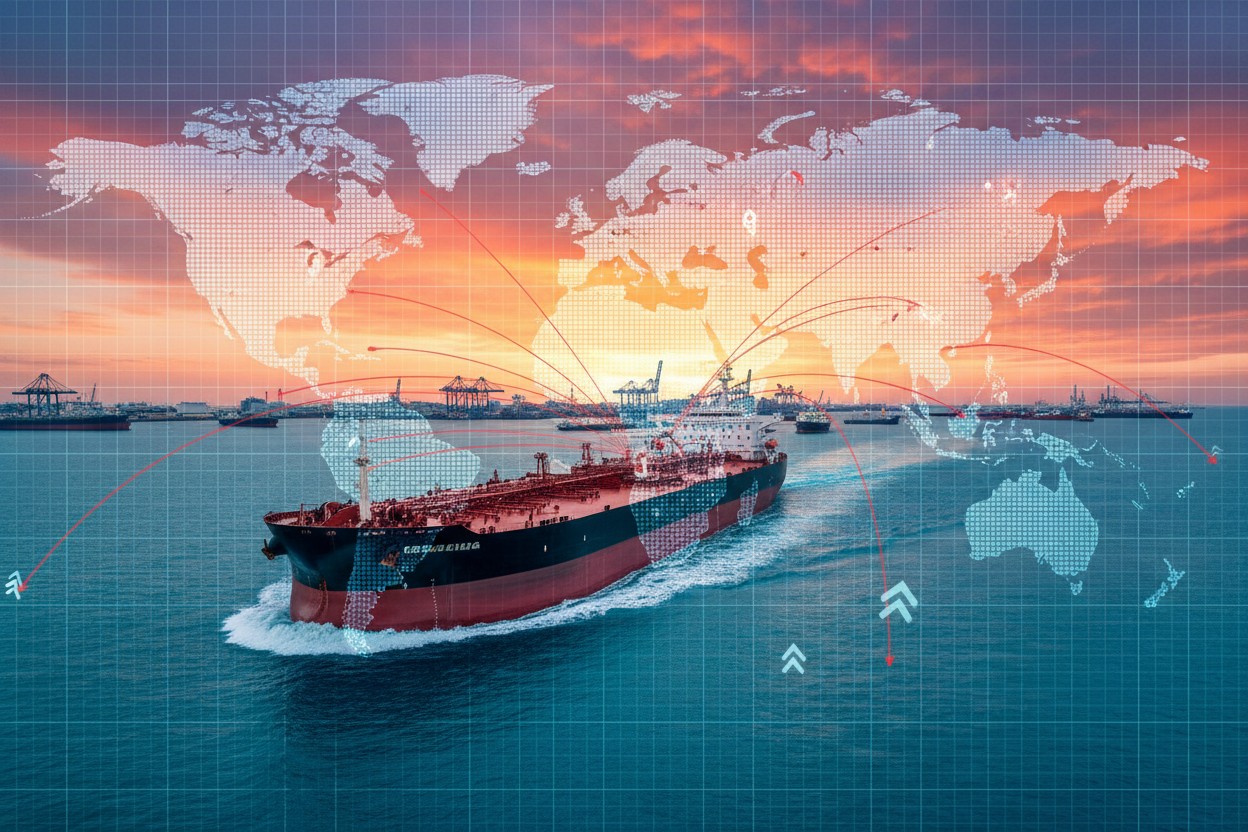
A shortage of available supertankers is raising global oil shipping costs and making some long-distance crude trades uneconomical, according to shipbrokers, traders and industry data cited in a Sept. 19 report. The squeeze arrives as fuel markets remain tight and the geopolitical conflict around the Strait of Hormuz continues to disrupt seaborne energy flows.
Moving a cargo from Houston to Asia now adds about $26 a barrel, or $52 million a cargo, the report stated, equal to roughly a quarter of the price of West Texas Intermediate futures. That figure represents a cost that traders say can erase the profit margin on a long-haul voyage.
Oil tanker rates have jumped to record highs as escalating risks to shipping in and out of the Middle East prompt traders and tanker operators to undertake inefficient and more expensive trade routes, according to Tsvetana Paraskova of OilPrice.com [1]. The report stated that the cost increase threatens long-haul flows as fuel markets remain tight.
Freight Rates Reach Record Levels on Key Routes
Very large crude carriers hauling 2 million barrels from the Persian Gulf to China are earning upward of $1.2 million a day, according to industry benchmarks. Earnings on the benchmark Saudi Arabia-to-China supertanker route surged to a record $647,000 per day on Thursday, according to Baltic Exchange data cited by Bloomberg, more than ten times the rate a year ago [2].
Supertanker owners were getting paid $510,000 per day on some Gulf routes in August, according to Middle East Eye [3].
Suezmax earnings average more than $300,000 a day, rates typically associated with war-zone voyages, traders and shipbrokers said [10]. Ship-tracking data from Vortexa show U.S.-Asia flows have fallen in recent weeks as freight costs roughly tripled, the report stated.
Conflict and Fleet Stretching Drive Supertanker Squeeze
Industry executives and shipbrokers said they have never seen supertanker availability so tight, with few vessels available for hire in some locations. The main drivers are the knock-on effects of the U.S.-Iran conflict and a large wager by a South Korean tycoon that had already lifted shipping rates before the war, according to the report [10].
Vessels shuttling through the strait are switching cargoes near Oman, while other tankers sail around Africa to pick up Mediterranean cargoes, stretching the fleet, the report stated. Offshore Oman, 16 tankers clustered together to transfer millions of barrels of oil that had been stranded in the Persian Gulf [5].
Saad Rahim, chief economist at Trafigura Group, said at the Bloomberg Commodity Investor Forum: "It has never been this expensive to move oil around." The Iran war has turned very large crude carriers into assets earning more than $650,000 a day, with earnings on the benchmark route surging to a record [2].
Refiners Seek Short-Haul Crude as Costs Bite
European Dated Brent physical crude climbed above $131 a barrel while Brent futures topped out near $110, as buyers sought short-haul cargoes, according to market data. Brent futures rallied almost 4%, topping the $90 handle, and WTI contracts rose above $86 a barrel in late August as the US and Iran exchanged attacks [6].
Saudi Arabia gave no cargoes to European buyers under term contracts for next month, prompting processors to scramble for replacements, the report stated. Asian refiners are booking 700,000-barrel Aframax tankers and two 1 million-barrel Suezmax vessels instead of supertankers, traders and shipbrokers said.
Diesel futures in Europe are near $200 a barrel, a sign processors still need to secure cargoes, according to the report. The cost of moving oil has become a larger share of the delivered price, traders said.
Freight Costs May Self-Limit Long-Haul Arbitrage
Sumit Ritolia, senior manager of modeling at Kpler, said: "Current freight levels can become self-limiting over time -- they eventually close arbitrage routes and reduce demand for the most expensive long-haul barrels."
Xavier Tang, senior market analyst at Vortexa, said: "Freight has never taken a big part of the delivered cost of oil, but it is now playing a much bigger role in oil markets."
The value of the world's largest oil tanker equities rose to a record of almost $70 billion this week, according to the report. Oil traders are focused on how long elevated freight rates can be sustained, the report stated.
In past cycles, freight costs have fallen when arbitrage windows closed and cargo demand eased, analysts said.
The broader backdrop remains unsettled. The Iran war has disrupted energy markets and supply chains, raising new questions about the viability of a $1.5 trillion buildout of artificial intelligence infrastructure [7]. Global energy supplies rely heavily on seaborne volumes for crude oil [8].
For now, traders said they are watching vessel availability, insurance rates and tanker earnings for signals of whether the long-haul oil trade can return to normal. The report stated that the cost increase threatens long-haul flows as fuel markets remain tight.
References
- Tsvetana Paraskova. "Oil Tanker Rates Hit Record Highs as Middle East Shipping Risks Soar". ZeroHedge. September 11, 2026.
- Julianne Geiger. "The Iran War Has Turned VLCCs Into $650,000-A-Day Assets". ZeroHedge. August 28, 2026.
- Middle East Eye. "Oil supertankers in Gulf are renting for $500,000 per day: Report". August 19, 2026.
- ZeroHedge. "Saudis Offer To Sell Oil Near Oman, A Sign They're Sailing Dark Through Hormuz". August 19, 2026.
- ZeroHedge. "Growing Number Of Oil Tankers Successfully Sneak Through Hormuz, Shrinking Iran's Leverage". June 10, 2026.
- ZeroHedge. "Stock Futures Drop To Close Out August As Oil Jumps On Renewed Iran Hostilities". August 31, 2026.
- Sterling Ashworth. "Escalation in Middle East Raises Costs, Uncertainty for Planned AI Infrastructure Investment". NaturalNews.com. March 24, 2026.
- Chris Martenson. "The Largest Energy Shock On Record Is Worse Than You Think". PeakProsperity.com. April 24, 2026.
- Cassie B. "Former Iranian Minister Warns of 100-Day Oil Blockade in Critical Strait of Hormuz". NaturalNews.com. June 18, 2025.
- "World Running Short of Supertankers Threatens Long-Haul Oil Flow". Finance.Yahoo.com. September 19, 2026.





Please contact us for more information.