



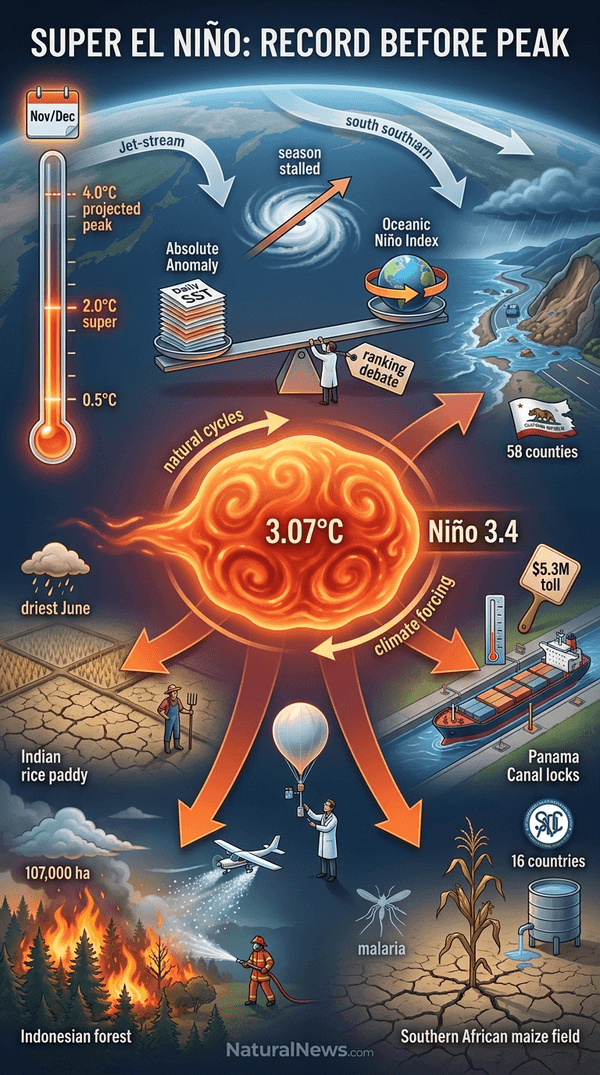
The sea surface temperature in the tropical Pacific Ocean's Niño 3.4 region reached 3.07°C above the long-term average, tying the record set during the 2015–16 El Niño event, according to data reported by The New York Post. The anomaly was measured months before forecasters expect the event to peak in November and December, when researchers project it could reach 4.0°C above average.
Zeke Hausfather, a climate researcher whose analysis of 14 climate models appeared in Carbon Brief, told Phys.org that September is "very likely to have the highest monthly anomalies on record." If his projections hold, the event would rank as the largest El Niño in 1,000 years, based on the model-based analysis.
Pacific Temperature Anomaly Sets Record Ahead of Peak
The World Meteorological Organization has established that any temperature increase above 0.5°C in the Niño 3.4 region is considered a regular El Niño, while anything over 2°C is classified as a super El Niño, according to The New York Post. The current anomaly of 3.07°C places this event well above the super El Niño threshold. Meteorologist Ben Noll of the National Institute of Water and Atmospheric Research said the latest ECMWF outlook indicates a 75% chance of a super El Niño by October, "with some scenarios suggesting the most intense event in more than a century," he wrote on X.
Hausfather's analysis draws on how much daily sea surface temperatures in the Niño 3.4 region exceed the 30-year average. The National Oceanic and Atmospheric Administration has increasingly adopted a different method – the Oceanic Niño Index – which compares the region's rate of warming to the entire tropical belt. The Oceanic Niño Index method gives a better overall picture of the phenomenon, which is defined by warmer-than-average temperatures on the Pacific Ocean's surface, according to the agency.
The difference in methodology affects how El Niño events are ranked, and some scientists say this complicates direct comparisons between past and present events. The World Meteorological Organization has warned that a severe El Niño could deepen the humanitarian crisis across Southern Africa by worsening drought, hunger, water shortages, and disease outbreaks, according to a statement from SADC Executive Secretary Elias Magosi [1]. Magosi said seasonal forecasts pointed to a high likelihood of an El Niño event that could surpass the intensity and impact of the 2023/24 phenomenon.
Forecasters Project Record Peak in Late 2026
Climate models project a peak anomaly of 4.0°C above average in November and December, which would make this event the largest in 1,000 years, according to Hausfather's analysis. He told Phys.org that very strong El Niño events in 1997–98 and 2015–16 were associated with hundreds of billions of dollars in damages globally, and that the current event is "leaving those past ones in the dust."
The United Nations World Food Programme has warned that the strengthening El Niño could force at least 49 million people into acute food insecurity worldwide over 18 months. The agency called this year's event "extremely anomalous" and said it is set to surpass the existing record level by almost 25%, severely disrupting rainfall and harvests [2]. More than 18 million people in eastern and southern Africa will be at risk of food insecurity, the WFP stated [2].
Some researchers and critics question attributing the intensity of the current El Niño to climate change, citing natural variability and uncertainties in long-term records. Meteorologists have pointed out that El Niño is a long-recognized naturally recurring ocean-atmosphere cycle that has operated for thousands of years, and strong El Niño events have occurred periodically throughout recorded history [3]. Debate continues over how much carbon dioxide and other factors influence ocean temperature anomalies, with some scientists calling for greater scrutiny of climate models and more reliance on natural variability data.
The 2026 Atlantic hurricane season has yet to produce its first hurricane, putting the Atlantic Basin within reach of its latest start on record, according to meteorologists. The intensifying El Niño is largely responsible for the strong wind shear that disrupts tropical system development, they stated [4].
Impacts Reported in Indonesia, India, Central America and California
Wildfires fueled by drought in Indonesia and curbed monsoon rains in India have been reported as consequences of the developing El Niño. Indonesia is racing to contain wildfires that have burned more than 107,000 hectares of land nationwide, according to BBC News. Authorities have deployed cloud-seeding aircraft to help extinguish the fires, while some schools in affected provinces have suspended classes for three consecutive days. The region is facing a longer hot and dry season this year fueled by a more intense El Niño climate event, which some have nicknamed the "Godzilla" El Niño [5].
India recorded its driest June in 12 years, and the fifth-driest since nationwide rainfall records began in 1901, according to the India Meteorological Department. The department also forecast below-normal rainfall for July, raising concerns over the progress of crop sowing this year. Government data showed the area planted with summer crops until the end of June was down by nearly 23% from the corresponding period in 2025, with rice sowing falling by a quarter [6].
In Central America, dry conditions have caused crops and animals to die and reduced water flow in the Panama Canal, prompting a trade slowdown, according to reporting by The Guardian. The Panama Canal set a new single-trip toll record amid looming traffic restrictions and global pressure on energy supplies. Canal officials confirmed that South Korea's SK Gas Ltd. bid $5.3 million for an auctioned transit slot for the liquefied petroleum gas carrier G. Spirit, the highest reported price ever for the waterway linking the Pacific and Atlantic oceans, according to FreightWaves [7]. Meanwhile, California Governor Gavin Newsom declared a statewide emergency ahead of El Niño-induced winter storms, including flooding, landslides and coastal erosion. Officials said emergency measures are intended to protect residents and infrastructure.
Economic Toll and Preparedness Efforts Continue
Hausfather said damages from the current super El Niño could exceed past events, with global economic losses in the hundreds of billions of dollars. "Very strong El Niño events like those in 1997/1998 and 2015/2016 were associated with hundreds of billions of dollars in damages globally – this event is leaving those past ones in the dust," he told Phys.org.
The United Nations Food and Agriculture Organization reported that world food prices rose in August to their highest since late 2022, impacted partly by the war on Iran. Extreme heat and drought in Europe, the threat of a severe El Niño weather pattern and trade upheaval caused by the Ukraine and Iran wars have unsettled agricultural markets, pushing grain prices to three-year highs and sugar to a one-year peak, the agency said [8]. The Bloomberg Agriculture Spot Index climbed to a three-year high as widening conflict across critical energy and grain trade corridors collided with scorching heat waves across Europe and the U.S. and mounting El Niño risks in critical agricultural growing belts, reviving the threat of global food inflation [9].
Officials in affected regions are monitoring water supplies, agriculture and trade routes, according to statements. The U.S. Climate Prediction Center has warned that the weather phenomenon El Niño, which only recently emerged across the Pacific, could become the most powerful in more than 75 years, raising the risk of adverse weather conditions across the U.S., Asia, Australia, and South America [10]. Some scientists recommend preparedness measures, including water conservation and crop diversification; others call for scrutiny of climate models and greater reliance on natural variability data. The event is still months from its peak, and updates are expected from NOAA and other agencies.
References
- Southern African Bloc Warns Severe El Nino Could Worsen Humanitarian Crisis. NaturalNews.com. August 13, 2026.
- El Nino presents acute hunger threat to 49 million people – UN. RT.com. August 5, 2026.
- Wrong, Deutsche Welle, There Is No Such Thing as a "Super El Niño," Nor is it on Team Climate. WattsUpWithThat.com. August 25, 2026.
- El Nino Fuels Atlantic Hurricane Drought As Dolly Eyes Florida. ZeroHedge.com. August 30, 2026.
- Indonesia haze spreads across region as firefighters battle wildfires. BBC News. August 12, 2026.
- Farming worries after India records driest June in over a decade. BBC News. July 1, 2026.
- $5.3 million a new record for Panama Canal transit. FreightWaves.com. August 31, 2026.
- World food prices at highest since 2022, says UN. Middle East Eye. September 4, 2026.
- Crop Prices Hit 3-Year High As Heat & War Stoke Supply Fears; Options Whale Places $20M Corn Bet. ZeroHedge.com. July 23, 2026.
- Strongest El Nino In 75 Years Sets Off Food Supply-Chain Alarm Bells. ZeroHedge.com. July 9, 2026.
Explainer Infographic









Please contact us for more information.