


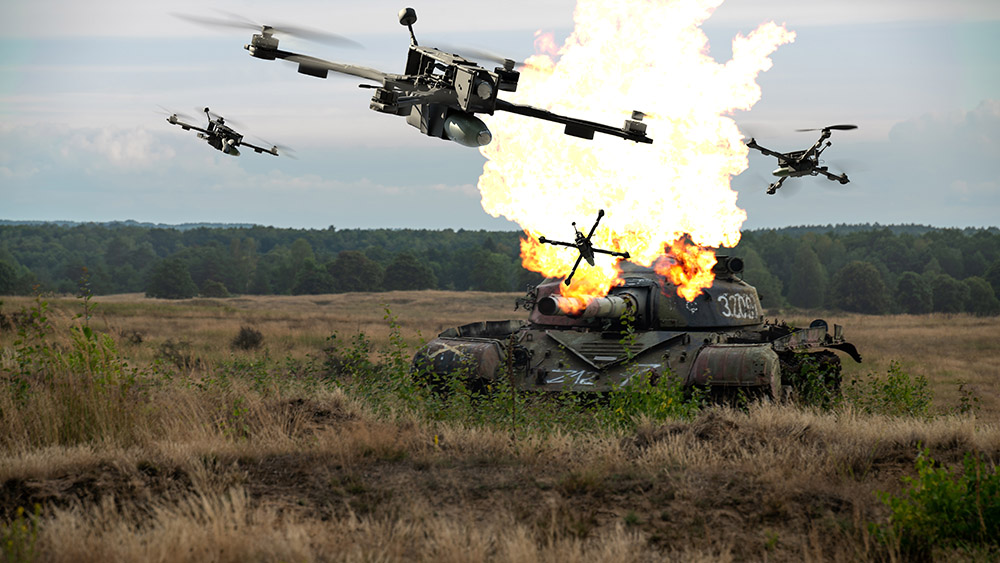
The war in Ukraine, sold to the American public as a noble fight for democracy, has become a global finishing school for criminal violence, and the graduates are now bringing their lethal expertise home to the cartels of Mexico. A troubling pipeline has emerged, linking the battlefields of Eastern Europe to the narco-states of Latin America, as Mexican drug organizations actively recruit and infiltrate foreign fighters to gain drone warfare experience. The skills acquired by the cartels in Ukraine are already turning against rivals and government forces. The U.S. government, which poured billions into Ukraine’s war machine, now faces the blowback as these advanced tactical capabilities cross the southern border, threatening American lives and infrastructure with a new era of asymmetric warfare.
Key points:
- Mexican cartels are recruiting Colombian and other foreign mercenaries who fought in Ukraine to train drone operators.
- Cartel members are infiltrating Ukraine’s International Legion under false pretenses to gain hands-on drone combat experience.
- Drones equipped with explosives are already being used against rival cartels and Mexican security forces.
- U.S. officials warn cartels will be “way better trained” with “way better equipment” within months.
- The conflict risks becoming a “Mexican Vietnam” quagmire as cartel ranks are replenished faster than they can be eliminated.
The Ukraine training ground
While the mainstream media continues to peddle the narrative of a clean war in Ukraine, the reality is far more sinister. The conflict has functioned as an unintended training camp for the world’s most dangerous criminal organizations, with the U.S. government financing the very weapons systems that are now being turned against American interests. Ukrainian counterintelligence has been actively investigating the infiltration of Latin American cartel members into the country’s International Legion, where volunteers from Mexico and Colombia are gaining direct experience with first-person view drone operations. These individuals enter under false identities, sometimes with forged documents, seeking assignment to drone operator roles where they learn the full spectrum of modern aerial warfare from drone manufacturing to electronic warfare evasion to coordinated strike tactics.
The numbers are staggering. Colombian nationals alone make up roughly half of the estimated 16,500 foreign mercenaries fighting for Ukraine. Many are lured with false promises of high pay only to be treated with disdain by Ukrainian commanders, fed poorly, and deployed on the most dangerous missions. For the cartels, this is an investment that pays dividends. A single experienced drone operator returning to Mexico can train dozens of local pilots, creating a multiplier effect that threatens to overwhelm U.S. border security efforts.
The weaponization of drones in cartel hands
The evidence of this new capability is already visible in the streets of Mexico. Cartel members now use drones for intelligence gathering on rivals, government officials, and local populations. Explosive-equipped drones have been documented striking prosecutor offices, ambushing military patrols, and coordinating ground assaults following initial detonations. The Jalisco New Generation Cartel, one of Mexico’s most powerful criminal organizations, has received direct training in drone and urban warfare tactics in Ukraine, according to Mexican intelligence reports.
These developments represent a profound erosion of the distinction between criminal groups, paramilitary actors, and terrorist organizations. Cartels now recruit former soldiers from Mexican special forces and former FARC fighters from Colombia. They adopt military command structures and employ weapons and tactics associated with state-on-state warfare. The low cost of FPV drones combined with their lethal capability provides cartels with a tool that directly aligns with their operational needs particularly in environments where airspace control and rapid strike options determine local power dynamics.
The U.S. State Department claims to be working with law enforcement agencies and Ukrainian authorities to mitigate the risk of battlefield skills transfer, but this is likely performative. U.S. Special Operations Command is itself expanding FPV drone training for American operators while industry partners introduce surveillance platforms for border security missions. The technology is spreading faster than any containment strategy can manage.
The United States now faces the downstream effects of its own foreign policy decisions. Drone incursions along the southern border and over military installations are already being reported. NORTHCOM has formed a rapid response unit equipped with deployable counter drone systems. But these defensive measures may prove inadequate against an adversary that is constantly learning and adapting.
Sources include:










Please contact us for more information.