



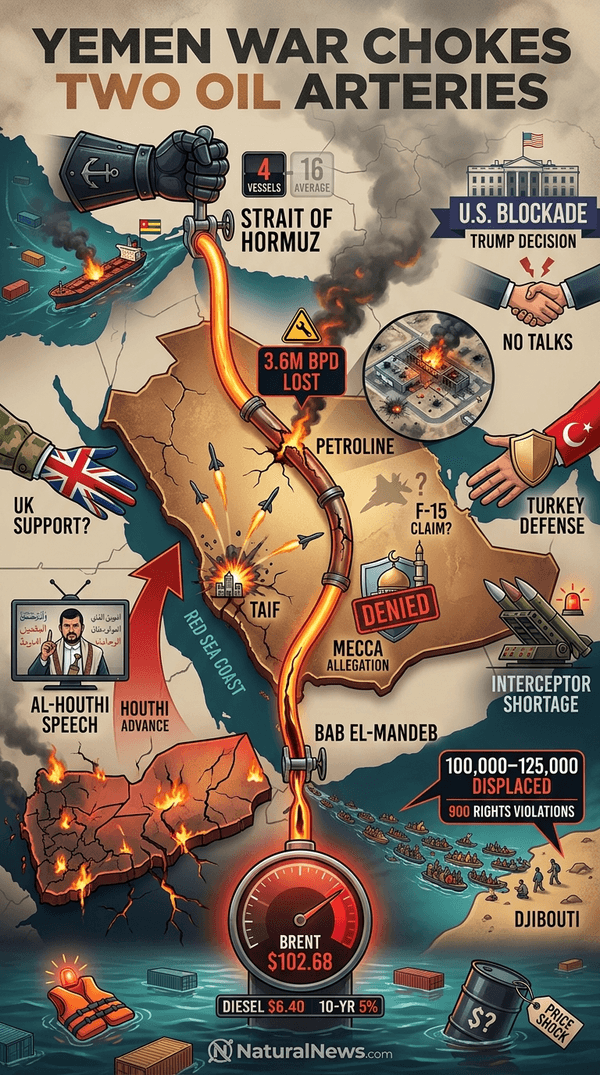
Saudi Arabia and Iran-backed Houthi rebels in Yemen traded cross-border strikes Thursday, Sept. 17, according to Houthi-controlled television and Saudi civil defense said.
Houthi-controlled television reported Saudi airstrikes in Yemen's Hajjah province near the Saudi border and Red Sea coast, as well as around Taiz farther south and inland, according to the report [1]. Saudi Arabia's civil defense said a Yemeni resident was killed by debris from a drone intercepted over the western city of Taif, the first death Riyadh has reported from repeated Houthi attacks since fighting intensified last week.
Saudi authorities have previously said more than 80 people were wounded. Civilians fled fighting by boat across the Red Sea and concerns mounted over global oil supplies.
Separately, Iran's Revolutionary Guard Navy said a Togo-flagged oil tanker caught fire after being struck while attempting what it described as an "illegal passage" through the Strait of Hormuz, Iranian state media reported. The tanker stopped after the fire broke out, the Guards Navy said, adding to concerns over the security of a waterway critical to global energy supplies.
Strikes and Casualties Reported Across Yemen and Saudi Arabia
Houthi military spokesman Yahya Saree said Wednesday that the group had shot down a Saudi F-15 fighter jet, according to a statement carried by the Houthi-run media. Saudi officials did not immediately confirm the claim [2]. Houthi leader Abdul Malik al-Houthi said in a televised speech: "We want the Saudis to cease their blockade and occupation of our country, and to stop their aggression against us. This is our demand!" He spoke seated with a traditional dagger in his belt, with slogans on the wall behind him reading: "Death to America, death to Israel, a curse upon the Jews, victory for Islam."
The Houthis, who have seized Yemen's Red Sea coast in a lightning advance since last week, say the Saudi air force has carried out hundreds of airstrikes in recent days [3]. The fighting has displaced more than 100,000 Yemenis, according to the International Organization for Migration, while the United Nations has put the number at about 125,000 [4].
Saudi Arabia has accused the Houthis of targeting Mecca with a drone, which the Saudi-led coalition said was intercepted south of the holy city, with coalition spokesman Maj. Gen. Turki al-Malki calling the targeting of Mecca a "disgraceful act." The Houthis denied responsibility for targeting the holy city, blasting the reports as "fabrications and lies," according to statements carried by the group's media [5][2].
Oil Markets and Shipping Face Disruption
The spread of the war to Yemen and Saudi Arabia has raised new concerns about oil supplies by jeopardizing the main alternative Red Sea route for Gulf exports while traffic through the Strait of Hormuz remains constrained, officials and analysts said. Shipping data showed only four commodity vessels transited the strait Thursday, well below the 10-day average of 16 [6].
Global crude prices eased Thursday but remained above $100 a barrel after reaching their highest levels since May. Brent crude fell $2.14 to $102.68 a barrel, while U.S. West Texas Intermediate crude fell $1.83 to $100.08. The average U.S. retail diesel price hit a record high Thursday, just shy of $6.40 a gallon, market data showed. The U.S. 10-year Treasury yield hit 5% on Monday amid ongoing conflict in the Middle East, a milestone last reached in 2007 [7].
The U.S. Navy is trying to guide ships through the Strait of Hormuz, the outlet to the Gulf along Iran's coast, where about one-fifth of the world's oil and gas previously passed before the war. The U.S. is also imposing a blockade on Iranian ports. Iran says the strait is closed and will remain shut until Washington lifts the blockade. It is seeking an agreement with neighboring Gulf states that would allow it to collect fees from ships passing through the strait [8].
Saudi Arabia announced it shut down its East-West Pipeline "as a precaution" after several attacks were reported, resulting in injuries, according to the Saudi Ministry of Energy. The pipeline will remain mostly out of service for three to five weeks during repairs, AP reported, citing informed officials [9]. Satellite imagery showed significant damage at a pumping station along the pipeline, which experts told BBC Verify could cut oil supplies by as much as 3.6 million barrels per day [10]. Riyadh has begun canceling some crude cargoes scheduled for loading later in September for European customers, while loadings at the Red Sea port of Yanbu have been suspended, Reuters reported [11].
U.S. Policy and Diplomacy
U.S. President Donald Trump has rebuffed Saudi appeals for military support against the Houthis, who agreed to a ceasefire with the U.S. last year after Washington bombed the group for two months, officials said [12]. Trump said Thursday that he was approaching a critical juncture over whether to restart large-scale attacks on Iran: "I have a big decision coming up. Do I want to go in and annihilate them or do I not? It's a big decision. Anything could happen with me," Trump said in an interview with Axios.
Trump has previously threatened major new attacks that did not materialize. The U.S. and Iran have held no negotiations to end the war since an interim agreement reached in June collapsed within weeks [13]. The war is expected to come up for discussion at the United Nations General Assembly next week, with an Iranian delegation able to attend, according to the U.S. State Department.
Saudi Arabia has turned to regional and global players for help defending its airspace against attacks from Yemen's Houthi rebels after its main security provider, the U.S., declined to step in, The Associated Press reported, citing regional officials. Riyadh is running low on missile interceptors, according to the outlet. The British government is reportedly considering helping Saudi Arabia against the Houthis after the kingdom asked it for diplomatic and military support, while Turkey is preparing defensive support for Saudi Arabia [8][14][15].
References
- Middle East Eye. "Houthis target Saudi Arabia following air strikes as Yemeni forces push towards Sanaa". September 8, 2026.
- ZeroHedge. "Houthis Claim Saudi Jet Shootdown, Blast Mecca Drone Reports as 'Fabrications & Lies'". September 16, 2026.
- BBC. "Yemen's Houthis reportedly seize strategic Red Sea port of Mokha". September 10, 2026.
- Middle East Eye. "Nearly 86,000 people flee fighting in Yemen, UN says". September 13, 2026.
- BBC. "Saudi Arabia says it shot down Houthi drone south of Mecca". September 16, 2026.
- BBC. "Iran-backed Houthis reportedly reach strategic island in key global shipping route". September 11, 2026.
- Just the News. "U.S. 10-year Treasury yields hit 5% as conflict rocks energy markets". September 14, 2026.
- "Saudi Arabia seeking support after US declines to strike Houthis – AP". September 17, 2026.
- "Drone-hit Saudi oil pipeline to remain non-operational for weeks – AP". September 15, 2026.
- BBC. "Satellite image reveals major damage that shut crucial oil pipeline". September 15, 2026.
- "Saudi Arabia cancels oil shipments to Europe after pipeline attack – Reuters". September 15, 2026.
- Antiwar.com. "Trump's Comments on Yemen War Suggest US-Ansar Allah Ceasefire Still in Effect". September 13, 2026.
- Chris Martenson. "War with Iran – The Risk is Elevated". PeakProsperity.com. May 15, 2019.
- Middle East Eye. "UK considers military support for Saudis against Houthis, report says". September 15, 2026.
- Ragip Soylu. "Taking on the Houthis? Turkey could pay a steep price". Middle East Eye. September 16, 2026.
- The War Zone. "Houthis' Stranglehold On Strategic Bab Al-Mandab Strait Grows Stronger". September 10, 2026.
Explainer Infographic






Please contact us for more information.