



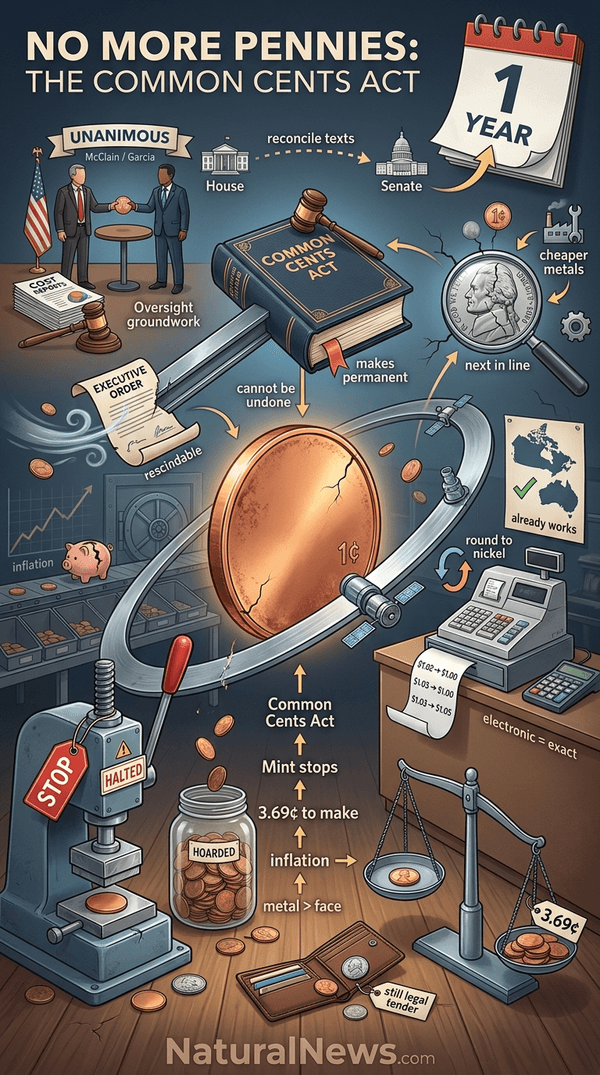
The U.S. House of Representatives voted unanimously Monday, Sept. 14, to pass the Common Cents Act – legislation that would permanently halt production of the penny and require cash transactions to round to the nearest nickel, according to 100PercentFedUp.com [1]. The bill passed with bipartisan support.
Under the measure, the U.S. Treasury would be blocked from minting any more pennies for general circulation, with an exception for collector coins. Pennies already in circulation would remain legal tender, according to the report [1].
The bill also would allow the U.S. Mint to produce nickels from cheaper materials, a provision aimed at reducing the cost of producing the five-cent coin. Both Democrats and Republicans supported the measure in the House vote.
Bill Follows Mint Halt and Trump Order
The legislation follows the U.S. Mint's decision in November 2025 to stop penny production, an action initiated by President Donald Trump, who has referred to the penny production process as "wasteful," the National Pulse reported. The Mint's final order for pennies was issued in May 2025.
Prior to the Mint's halt, Trump ordered the Treasury to stop producing pennies due to the cost of manufacturing them. According to 100PercentFedUp.com, the move locks in the Mint's November 2025 decision to stop producing pennies for circulation [1].
The bill would prevent penny production from being restarted in the future. While the president's order to the U.S. Mint last year stopped production, the new legislation would make that halt permanent.
Sponsors and Provisions
The bill was advanced by House Republican Conference Chair Rep. Lisa McClain (R-MI) and House Oversight Committee Ranking Member Rep. Robert Garcia (D-CA), according to the National Pulse. The bipartisan sponsorship reflects the broad consensus in Congress on the issue.
Under the bill, cash transactions would round to the nearest nickel, according to the report. This provision addresses the practical problem of conducting cash transactions when pennies are no longer being produced. Pennies already in circulation would remain legal tender.
If passed by the Senate, the legislation would take effect one year after becoming law, according to the report. The Senate previously passed its own version of the Common Cents Act by unanimous consent, but the House and Senate texts differ, according to reporting by the New American [2].
Cost and Savings
Each U.S. penny costs 3.69 cents to produce, exceeding its face value, according to the National Pulse. The Treasury estimates that ending penny production could save $56 million per year.
The rising cost of producing pennies has been driven in part by inflation that has deprived the coins of nearly all their value, according to the Ron Paul Institute [3]. The report stated that people seeing the metal content of their pennies worth more than the face value are deciding it is better to store pennies in a jar than to spend them.
Inflation has also affected other coins. The same issues that caused the U.S. Mint to stop producing pennies could eventually affect the nickel, according to the Ron Paul Institute [3].
Conclusion: Senate Consideration and Next Steps
The bill now goes to the Senate, where a version already passed this summer by unanimous consent, according to Just the News [4]. The Senate version of the bill would allow businesses to round transactions to the nearest nickel to address problems arising from the end of penny production. The Federal Reserve would also have to limit "disruptions in the penny supply," under the bill passed earlier, according to the report.
If passed by both chambers and signed into law, the legislation would take effect one year after becoming law. Businesses and consumers would need to adapt to cash rounding practices, according to the report.
The legislation could result in simplified transactions and savings for the federal government. No date for final Senate action was provided in the report.
References
- Congress Moves To Permanently Eliminate Pennies. 100PercentFedUp.com. September 15, 2026.
- Common Cents Act Rewrites the Rules of Cash After the Penny's Demise. The New American. August 12, 2026.
- Pennies Have Been Abandoned. Now What Will Be Done with Nickels? Ron Paul Institute. August 19, 2026.
- Senate passes currency bill that moves the U.S. closer to ditching penny, change nickel recipe. Just the News. August 12, 2026.
Explainer Infographic







Please contact us for more information.