


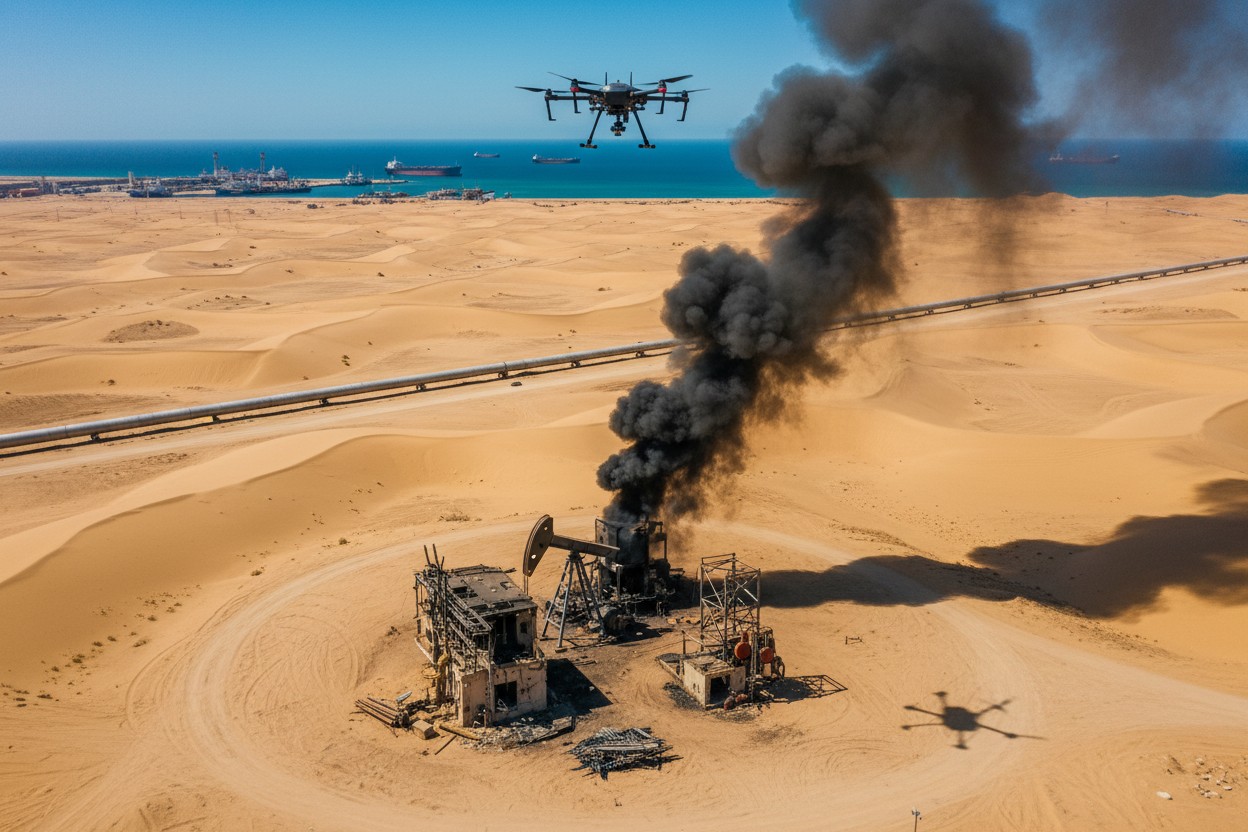
Saudi Arabia may need five to six weeks to repair damage from a drone attack on its East-West Pipeline, a shutdown that could remove nearly 4% of global oil supplies from the market, according to a Reuters report cited by Middle East Eye [1].
Satellite images released by Vantor on Sunday, Sept. 13, showed damage at a pumping station in al-Mesabaah, southeast of Medina, the report stated [2]. Saudi Arabia said last week that the attack originated from Iraq, which is home to Shia-dominated militias aligned with Iran, according to officials [3].
Brent crude, the international benchmark, traded up 3% on Monday at nearly $108 per barrel, the report stated [1]. The price increase followed a Houthi offensive that put the group in control of Yemen's side of Bab el-Mandeb, a key Red Sea chokepoint for Saudi Arabian oil shipments [1].
Pipeline Damage and Supply Impact
The East-West Pipeline has carried about four million barrels per day, or roughly 4% of global supply, according to the Reuters report cited by Middle East Eye [1].
Saudi oil buyers and traders told Reuters that the kingdom will run out of oil stocks for exports if it does not restart the pipeline within days, leading to a loss of up to 4% of global supply [4].
The pipeline runs from Saudi oil fields on the Gulf coast to the Red Sea port of Yanbu, a distance of approximately 745 miles across the Arabian Peninsula [5]. It was built in the 1980s as a bypass around the Strait of Hormuz during the Iran-Iraq War, the report stated [1].
The pipeline has allowed Saudi Arabia to continue exporting about two-thirds of its pre-war oil volume despite Iran's de facto blockade against Gulf producers in the Strait of Hormuz, according to the report [1]. The closure will not only heap pressure on Saudi Arabia but also remind other Gulf states of their vulnerabilities as they look for options to bypass the Strait of Hormuz [1].
Saudi Arabia shut down the pipeline on Friday, Sept. 11, after multiple drone attacks, the kingdom's Energy Ministry announced on social media, stating the closure was a precautionary measure and confirming that the attacks caused injuries [5].
Market Reaction and Price Pressures
Brent crude for November delivery gained 2.8% to $107.54 per barrel on Monday, while U.S. benchmark West Texas Intermediate for October rose 2.3% to $102.34, according to Middle East Eye [6]. Both contracts extended the previous week's gains after climbing back above the $100 threshold [6].
Gregory Brew, an energy expert at Eurasia Group, wrote on X, formerly Twitter, that physical crude sold from Oman was fetching $121 per barrel, and Murban crude, which is the price for oil shipped from the United Arab Emirates (UAE) port of Fujairah, was $131 per barrel, according to the report [1].
The rising price of Brent does not necessarily reflect the even higher prices customers are paying for oil, and especially refined products like diesel, the report stated [1].
U.S. President Donald Trump said on Monday, Sept. 14, that higher diesel prices were not the result of the U.S.-Israeli War on Iran, but rather Russian and Ukrainian attacks on their respective energy infrastructure, and he said the two had agreed to pause those attacks [1].
In California, gas stations are facing a unique challenge: the station signs are only configured to go up to $9.99 per gallon, and at several stations the price of diesel has reached that maximum, according to the Ron Paul Institute [7].
Regional Conflict and Strategic Context
Yemen's Houthis and Iraq's Popular Mobilization Forces are part of Iran's Axis of Resistance, although the Houthis operate with more independence from Tehran, according to the report [1].
Saudi Arabia said the drone attack originated from Iraq, and Iraq said it had fired a military commander and launched an investigation after admitting the drone attack on its neighbor's East-West pipeline had originated in one of its provinces bordering Iran, according to the BBC [3].
The report stated that the pipeline closure is a win for both Iran and the Houthis, as it underscores the kingdom's vulnerabilities [1]. The Houthis are looking to capitalize on their offensive to expand territory under their control, while Iran wants to cement its hold over the Strait of Hormuz, the report stated [1].
The Houthis seized Perim Island in the Bab al-Mandeb Strait on Sept. 11, giving the group greater control over the waterway that connects the Red Sea and the Gulf of Aden, according to NTD [8].
The UAE has used a small pipeline terminating at the Port of Fujairah on the Gulf of Oman to bypass Hormuz, but the report noted it sits just a short distance from Iran, much closer than Saudi Arabia's East-West Pipeline is to either Yemen or Iraq [1].
Tucker Carlson, the conservative commentator, claimed that Israel's strategic goal in the Iran war was to expand its influence while weakening Iran, the Gulf, and the U.S. military presence, according to Middle East Eye [9].
References
- Middle East Eye. "Attack on Saudi Arabian pipeline may cut four percent of world's oil supply". September 14, 2026.
- Middle East Eye. "Satellite images show Saudi pumping station damage southeast of Medina". September 14, 2026.
- BBC. "Saudi Arabia shuts key oil pipeline after drone attack launched from Iraq". September 12, 2026.
- Middle East Eye. "Four percent of global oil supply at risk due to Saudi pipeline outage". September 14, 2026.
- NaturalNews.com. "Saudi Arabia May Run Out of Oil Stocks if East-West Pipeline Not Restarted Within Days, Report Says". September 14, 2026.
- Middle East Eye. "Oil prices rise sharply as Middle East escalation risks disruption to supplies". September 14, 2026.
- Ron Paul Institute. "The Crippling Effects of Unnecessary War". September 14, 2026.
- NTD. "Houthis Capture Strategic Island in Bab al-Mandab Strait". September 12, 2026.
- Middle East Eye. "Tucker Carlson says Israel sought regional hegemony by weakening Gulf states through Iran war". September 13, 2026.
- Middle East Eye. "Saudi East-West oil pipeline may take up to five weeks to repair, officials say". September 14, 2026.
- Just the News. "U.S. 10-year Treasury yields hit 5% as conflict rocks energy markets". September 14, 2026.











Please contact us for more information.