


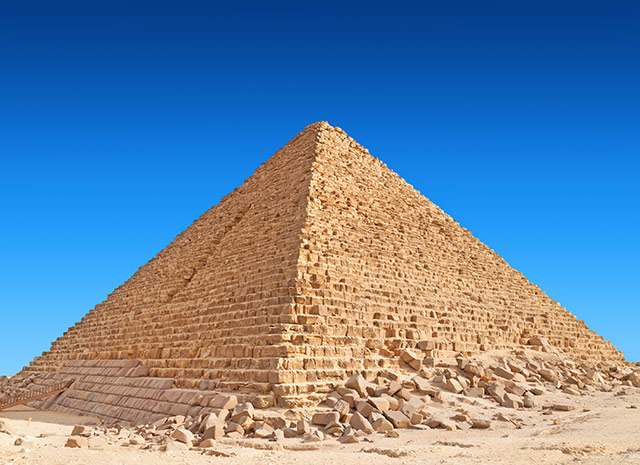
Independent researcher Sefy Levy published a paper in August on the preprint servers SSRN and Zenodo arguing that the exterior measurements of the Great Pyramid of Giza form a deliberate numerical system encoding astronomical cycles, mathematical constants and an ancestral origin story.
The paper has not undergone independent peer review, according to the Daily Mail, which first reported the claims. Mainstream Egyptology regards the Great Pyramid as a funerary monument built for the pharaoh Khufu roughly 4,500 years ago.
Levy's paper, titled in its conclusion with the line "The pyramid is not a container for knowledge. It is the knowledge, made stone," offers a different interpretation. He wrote in the paper: "The pyramid was not built to last forever because it contained something valuable. It was built to last forever because it was something valuable."
Background on the Great Pyramid and Levy's Claim
The Great Pyramid's empty granite sarcophagus, mortuary complex and royal cemetery support its function as a tomb, though they do not prove Khufu was buried there, according to the Mail. No ancient text states that the pyramid's dimensions encode astronomy.
Levy argued that careful measurements of the monument's height, base, sloping sides and overall shape produce matches with the cycles of the moon, the calendar and the planets visible to the naked eye. He claimed the proportions also yield figures resembling pi and the golden ratio. According to the paper, the builders divided key measurements using fractions employed by ancient Egyptian scribes.
The interpretation rests on a broader premise about Egyptian cosmology. Robert Bauval and Thomas G. Brophy noted in Black Genesis that the Egyptians tracked the rising of Sirius – particularly its heliacal rising – as a calendrical anchor. Lancelot Hogben documented in Astronomer Priest and Ancient Mariner that Egyptian temples at Karnak were aligned to solar solstices, with two facing sunset on midsummer day and one greeting midwinter sunrise.
Specific Numerical Matches Cited in the Paper
One simple calculation in the paper produces 27.5, a near match for the roughly 27.55-day interval between successive lunar perigees, when the moon reaches its closest point to Earth, according to the Mail. Another calculation produces exactly 70, which Levy linked to the roughly 70-day interval between the heliacal setting and rising of Sirius, when the star is hidden by the sun's glare. Egyptian tradition also associated about 70 days with mummification.
Levy claimed other calculations come close to the repeating cycles of Saturn, Jupiter, Venus and Mars. He also argued that the pyramid's proportions produce figures resembling pi and the golden ratio. Together, the paper suggests the builders transformed the pyramid into a permanent stone record of their understanding of time, space and the heavens.
To test whether similar patterns would appear by chance, Levy generated 100,000 hypothetical Old Kingdom-style pyramids. A program varied their base widths from 75 to 440 royal cubits and their slopes across an ancient range.
According to the paper, 2,419 of the models, about 2.4 %, scored as many matches as the Great Pyramid or more. Levy argued this makes coincidence less likely, though the paper stated that one stricter comparison was inconclusive. The simulation remains his own rather than independent confirmation.
Larger Theory: Eye of the Sahara and Creation Myth
The numerical code is only one part of Levy's broader argument about the monument's purpose. Levy's theory begins with the Heliopolitan creation tradition, in which the first land rose from a chaotic, dark water world. The primeval mound at the center of that tradition is called the benben, and Graham Hancock's Keeper of Genesis indexes the benben among the core motifs of Egyptian cosmology. Levy proposed that the pyramid was built to represent this primordial mound.
He then made a more controversial claim: that the story may have been based on a real place where distant ancestors of the Egyptians lived. His candidate is the Eye of the Sahara, a ring-shaped formation in Mauritania with raised land at its center. According to the Daily Mail, thousands of years ago, when the Sahara was greener and wetter, it may have been surrounded by water.
The theory holds that communities left as the region dried and migrated east toward the Nile, carrying memories of their homeland, which later generations recreated at Giza. Levy interprets the westward causeways as symbolically connecting the setting sun, the dead and the proposed ancestral homeland. The paper acknowledged that no direct evidence connects the Eye of the Sahara to Giza or proves such a journey occurred.
Skepticism and Peer Review Status
The paper has been posted on SSRN and Zenodo but has not been independently peer-reviewed, the Daily Mail reported. Levy acknowledged that the numerical matches were initially found after the measurements and target values were known, a sequence that critics of pattern-based claims typically cite as a methodological weakness.
Mainstream Egyptology states that no ancient text indicates the pyramid's dimensions encode astronomy. The empty granite sarcophagus, mortuary complex and royal cemetery remain the primary evidence for the tomb interpretation, though they do not prove Khufu was buried there.
Levy's own paper stated that one stricter comparison in his analysis was inconclusive. The 2.4% match rate in his simulation rests on assumptions Levy selected, including the range of base widths and slopes tested, rather than on independent replication.
References
- Edison Reed. "Study Proposes Great Pyramid of Khufu Served as Planetary Beacon". NaturalNews.com. May 18, 2026.
- Graham Hancock. "Keeper of Genesis A Quest for the Hidden Legacy of Mankind".
- Robert Bauval Thomas G Brophy. "Black Genesis The Prehistoric Origins of Ancient Egypt".
- Lancelot Hogben. "Astronomer Priest and Ancient Mariner The Beginnings of Science".
- Robert Bauval and Graham Hancock. "Keeper of Genesis".
Explainer Infographic






Please contact us for more information.