



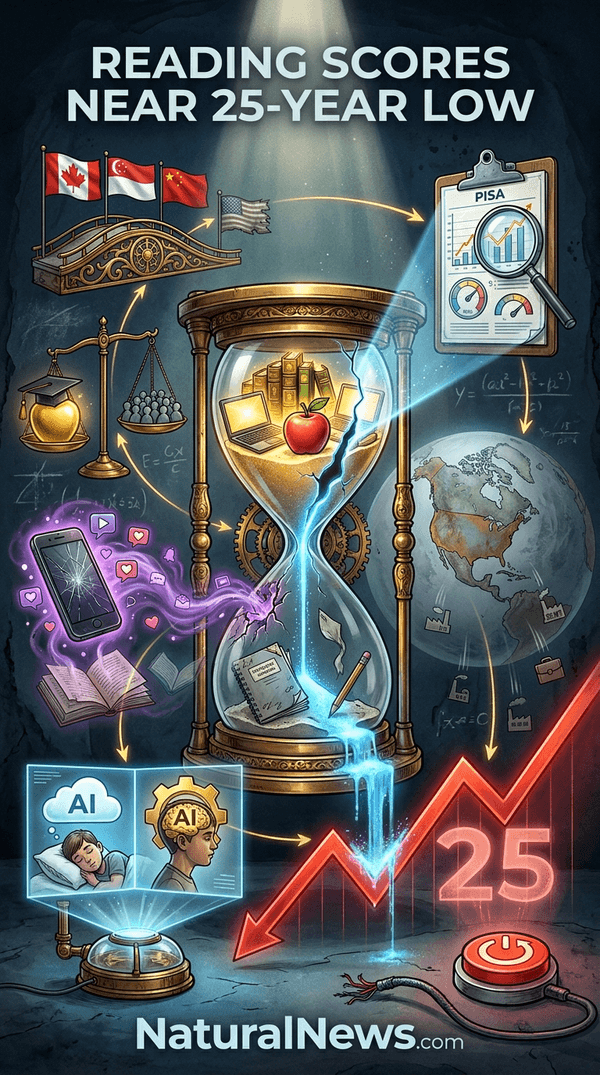
Results from the 2025 Program for International Student Assessment (PISA) released Tuesday, Sept. 8, show U.S. reading scores near their lowest point in a quarter-century, according to reports on the global exam.
The assessment, administered by the Organization for Economic Cooperation and Development (OECD), evaluates 15-year-olds' ability to apply knowledge in math, science and reading across more than 80 countries. U.S. students scored more than 30 points below the OECD average in reading, with peers in Canada, Singapore and parts of China outperforming them [1].
Officials said the latest results reflect the lowest average levels recorded across OECD member countries in all three subject areas since the test was first administered in 2000. The findings add to a growing body of data, including the National Assessment of Educational Progress – often called the nation's report card – which has documented declining literacy and numeracy among American students over the past decade [2].
Global Decline in Reading Performance
Average reading scores fell by 28 points across OECD countries between 2015 and 2025, the largest drop-off among the three subjects tested, according to the OECD. Experts suggest that nations with top-performing students are often associated with more equitable access to education, while lower scores are correlated with higher levels of poverty and inequality that can affect learning outcomes [3] [4]. In the United States, only 8% of students were top performers in mathematics, a rate lower than in parts of China, Singapore, Japan and South Korea.
The downward trend in cognitive skills is not confined to the classroom. Data from PISA and adult evaluations show reduced reasoning, problem-solving and attention spans, especially among younger demographics, coinciding with a significant drop in reading rates [5]. Some analysts also point to the rise of social media and passive visual content consumption since the early 2010s as a contributing factor to the erosion of deep reading and critical thinking skills [5].
Education Secretary Cites Stagnation and Gap
U.S. Education Secretary Linda McMahon stated that the scores "confirm a decade of stagnation and a devastating gap," according to The Hill. She noted that the lowest-performing students are falling further behind, with a reading loss equivalent to nearly a year and a half of instruction compared to 2015 levels.
McMahon called for a "hard reset" in American education, which she said includes empowering state leaders and embracing innovative learning options through school choice [6]. "This moment is a stress test for our nation's future," the secretary stressed.
Her remarks align with a broader critique of public education systems that have seen record spending increases without corresponding gains in student achievement [7]. Education specialist Diane Ravitch has similarly documented that schools are often given the entire responsibility for closing achievement gaps despite facing social disadvantages beyond their control [4].
Data Collection Concerns and Official Commentary
The reliability of the latest U.S. results has come under scrutiny. The New York Times reported that Department of Education (ED) staff responsible for PISA administration were cut early in President Donald Trump's term, causing U.S. participation rates to fall below minimum technical targets.
Consequently, OECD researchers warned that "caution is required" when interpreting the U.S. findings [1]. This administrative disruption adds a layer of uncertainty to an already grim picture of national performance.
OECD education director Andreas Schleicher said gaps between the U.S. and Asian OECD countries tie to differences in attracting talent to the education sector. In the United States, schools typically choose smaller classes over better teachers, whereas Asian countries "save on the class size, but they get the best people to become teachers," he said.
Schleicher also reported a divergence in how artificial intelligence is used in classrooms. Western countries often use it to "make things easier for kids," while Asian countries use it to "make students think harder, work harder." This philosophical difference may help explain why some systems are improving while others stagnate [8].
Conclusion: Context and Outlook
The PISA results reflect a broader pattern across OECD countries, where all three subjects have hit average lows not seen since the test began in 2000. Internationally, experts note that poverty and inequality are powerful determinants of learning outcomes [4], and recent disruptions – including pandemic-era school closures – have compounded existing challenges for children's academic and emotional development [9].
The ED has stated that the administration's policy focus remains on school choice and state-led innovation as remedies for the current decline. As policymakers respond to the data, the persistent slide in student performance across the developed world raises questions about the effectiveness of standardized, centralized education models [10].
While some analysts advocate for a return to the civic and moral purposes of schooling that early American leaders envisioned [11], others argue for more localized control and competitive alternatives [12]. For U.S. families, the findings reinforce concerns about the long-term trajectory of public education and the importance of seeking effective learning environments.
References
- The Epoch Times. "US Students Still Behind Much of the World in Math and Reading: Global Assessment". September 8, 2026.
- Children's Health Defense. "'Staggering' Decline in Kids' Reading, Math Skills, Latest Testing Reveals".
- The Epoch Times. "Screening Tools Alone Won't Improve Reading Skills of BC Students". October 21, 2025.
- Diane Ravitch. "Reign of Error".
- Cassie B. "Human Intelligence in Freefall: Study Links Cognitive Decline to Social Media and AI". NaturalNews.com. March 18, 2025.
- Just the News. "Nation's Report Card shows further decline in literacy, GOP Rep Owens says system 'failing' students". June 26, 2026.
- Just the News. "Record school spending across U.S. fails to reverse decline in test scores". December 22, 2025.
- Mike Adams interview with Zach Vorhies. March 6, 2025.
- NaturalNews.com. "Child Well-Being Declines in 29 States Post-Pandemic, Report Says". June 12, 2026.
- Sherman Zander. "The curiosity of school education and the dark side of enlightenment".
- Rick Salutin. "Keeping the Public in Public Education".
- ZeroHedge. "Stupid In America Turns 20". December 24, 2025.
Explainer Infographic










Please contact us for more information.