


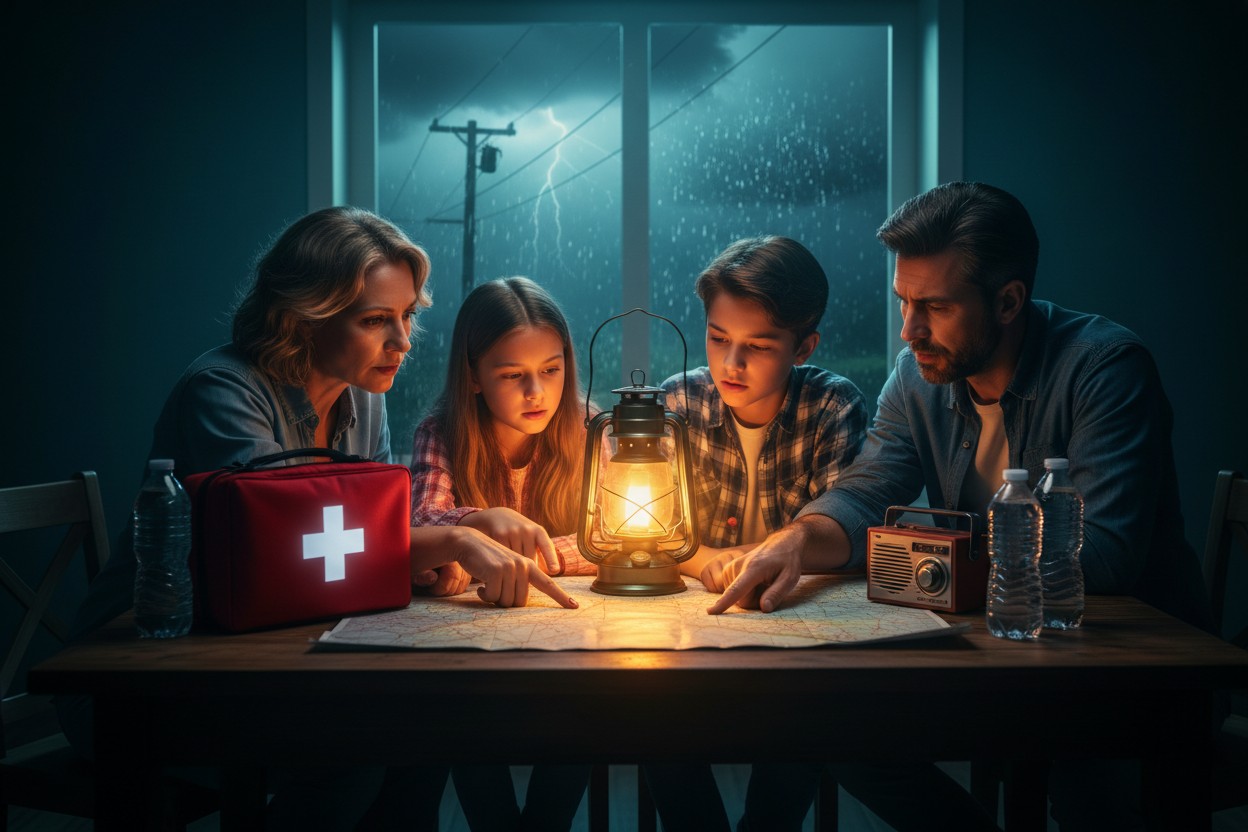
Communication and Supply Failures Undermine Household Readiness
A report published on The Survival Mom website states that families who consider themselves prepared often face failures during crises due to seven recurring gaps, not equipment shortages. The report, written by the site's founder, cites personal experience during the 2024 Hurricane Beryl and the 2021 Texas Freeze to illustrate how plans fall short.
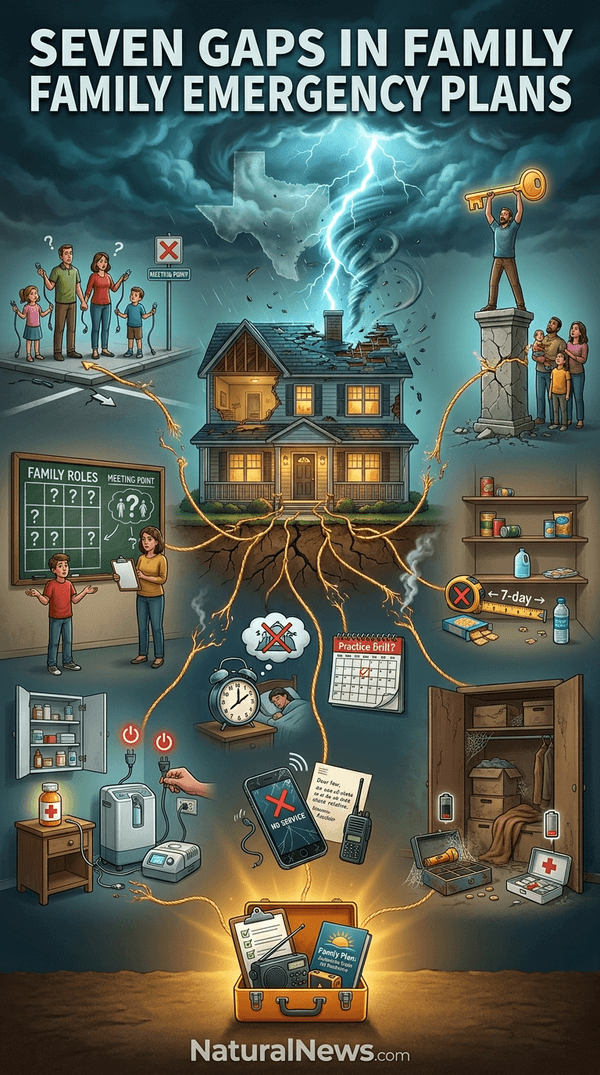
Officials at the site state that most emergency plans fail because of communication gaps, and they recommend families review specific questions to identify weaknesses before an emergency occurs. The report notes that the gap between "prepared" and "we'll figure it out" almost never comes down to gear.
Knowledge and Roles -- Who Knows the Plan and Who Is Assigned Tasks
The report states that in many households only one person knows critical details such as how to start a generator or where the meeting point is, making that individual a single point of failure. According to the article, when just one person knows the how, when, where, why, and who in an emergency, everything can quickly collapse if that person is overwhelmed or not around.
It recommends establishing a designated family meeting point, an in-home safe area for severe weather, and clear assignments for evacuation and special-needs assistance. The article also addresses the "reluctant member" -- often a teenager or spouse -- and suggests giving that person one specific job to build buy-in, according to the author. The report emphasizes that a plan must be known and practiced by all members, not just the primary planner. Knowing who is supposed to do what will go a long way toward lessening panic and anxiety, according to Jim Cobb in "Countdown to Preparedness" [1].
Supplies and Medical Dependencies -- Food and Electricity Needs
According to the article, families should be able to survive at least seven days without grocery stores, a threshold beyond the standard 72-hour minimum, and should inventory their pantry to assess this. A full seven days of extra food gives real breathing room beyond the standard 72-hour minimum, the report states. Water storage is also critical; guidelines recommend storing at least three days' worth of water but aiming for two weeks, according to Zoey Sky in "Water, Food and More" [2].
The report highlights that many households overlook members who depend on electricity for life-sustaining items such as refrigerated medications, insulin, and medical equipment. The author advises stockpiling extra prescription medications and planning for power outages, noting that these dependencies are often not addressed in standard emergency plans. The article asserts that a well-stocked emergency kit should include battery-powered lights, a water filter, and cash or a prepaid card, and should be stored in a known, accessible location.
Communication and Access -- Finding Family and Reaching the Kit
The report states that relying on cell phones is not a plan, and families must have a predetermined meeting point if cell service goes down, as witnessed during major disasters. "We'd just call each other" is not a plan but a hope that depends entirely on infrastructure you don't control, according to the article. Relying solely on smartphones and the grid for communication creates a single point of failure, according to Zoey Sky in "From Ham Radio to Satellite" [3].
It recommends a layered communication strategy that includes landlines, radios, or out-of-town contacts, according to the author. On kit accessibility, the article notes that many families lose track of their emergency supplies, and it advises storing kits near an exit or in a clearly marked location that all household members know. The author recounts that in the 2021 Texas Freeze, her family forgot they owned a generator for three days, underscoring the importance of visible and known gear placement.
Stress-Testing -- Planning for the Worst Day, Not the Ideal
The report advises families to assume they are not home, awake, or calm when a crisis hits, and to evaluate their plans against scenarios like being at work or dealing with illness. According to the article, many plans fail because they are designed for optimal conditions, and a realistic assessment should consider 2 a.m. outages or concurrent family illness. Most plans are written assuming you're home, awake, and calm, but you should assume the opposite, the author states.
The author states that no plan is perfect on the first attempt, and families should identify one question from the list, discuss it, and make incremental improvements. The article concludes by offering a free printable worksheet, the Family Weakest Link Self-Assessment, to guide families through the process of documenting answers and next steps. The report also suggests revisiting these questions twice a year, tying the review to activities like changing smoke detector batteries.
Prioritizing Preparedness Through Self-Assessment
The report concludes that the worst time to find a weak link is during an emergency, and that identifying gaps through structured questions is a simple and frugal way to strengthen family resilience. The families who handle a crisis well are not the ones with the most gear or buckets of freeze-dried food stacked to the ceilings, according to the article.
Officials at The Survival Mom urge families to choose one question and discuss it this week, emphasizing that familiarity and practice are more important than equipment alone. The article's findings are based on the author's personal experiences and are presented as practical guidance for households seeking to improve emergency readiness.
References
- Jim Cobb. "Countdown to Preparedness: The Prepper's 52 Week Course to Total Disaster Readiness".
- Zoey Sky. "Water, Food and More: A Detailed Emergency Preparedness Checklist for Preppers". NaturalNews.com. April 21, 2025.
- Zoey Sky. "From Ham Radio to Satellite: Building Your 'Unhackable' Communication Ladder to Survive the Coming Silence". NaturalNews.com. March 20, 2026.
- Zoey Sky. "Prepping 101: How to Make Your Own Fool-Proof SHTF Plan". NaturalNews.com. May 5, 2019.
- Marco J. Marin. "Navy SEALs Bug-in Guide: Essential Strategies for Self-Sufficient Living, Emergency Preparedness, and Tactical Survival Skills".
- David Kobler. "United We Stand: Building Your Emergency Preparedness Network".
Explainer Infographic








Please contact us for more information.