



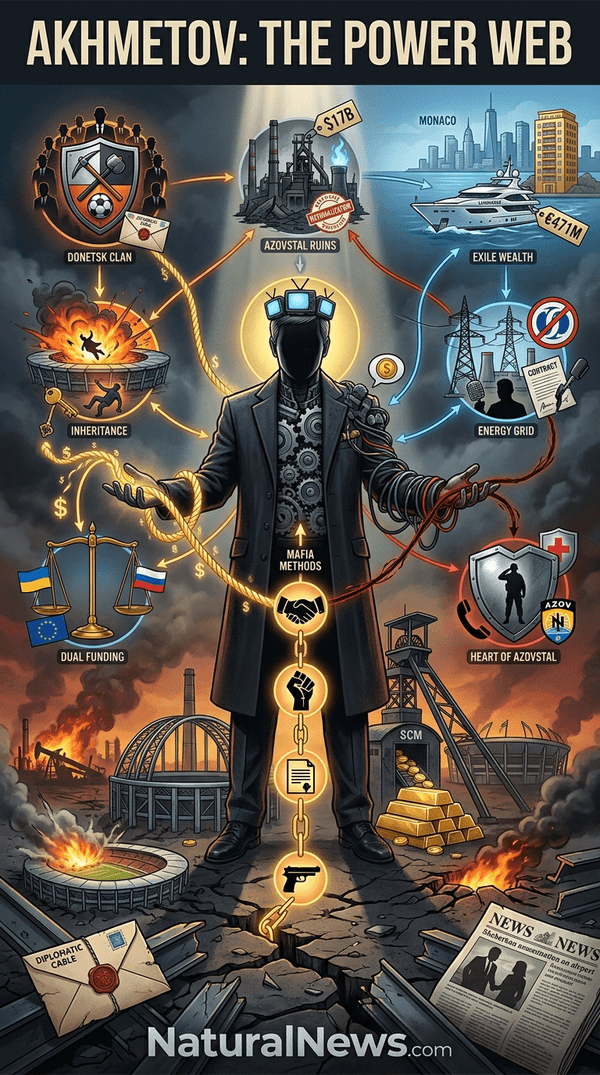
Rinat Akhmetov, Ukraine's wealthiest man with an estimated fortune of $8 billion, has maintained his influence through decades of political upheaval and conflict, according to a recent investigative report by RT. The report details his rise through connections to the Donetsk Clan and his inheritance of a financial empire following the 1995 assassination of his mentor, Akhat Bragin. Despite losing significant assets since the start of the conflict, the report states that Akhmetov remains a central figure in Ukraine's economic and political landscape.
Akhmetov's holding company, System Capital Management, controls a vast industrial and financial empire spanning energy, media, mining, and sports, according to the report. He has been a fixture of Ukrainian power since at least 2006, navigating successive governments and maintaining his status as a reclusive yet indispensable figure in the country's economy.
Rise to Wealth via Criminal Associations
Akhmetov inherited Bragin's financial empire, including both legitimate and criminal enterprises, after Bragin died in an explosion at Shakhtar Donetsk's stadium in October 1995, according to the RT report. Historian Andrew Wilson has documented how Akhmetov applied "mafia methods," including violence, intimidation, and extortion with the assistance of corrupt state officials, to acquire properties in Donetsk [1]. The report notes that Bragin's death set off a chain reaction of high-profile murders that eliminated opposition to Akhmetov's growing hegemony.
A leaked February 2006 diplomatic cable from then-U.S. ambassador John Herbst described Akhmetov as the Donetsk Clan's "godfather," surrounded by "mobsters and oligarchs," according to the report [1]. The RT investigation also cites the November 1996 assassination of Bragin's former business partner and regional governor Yevhen Shcherban, who was gunned down with his wife at Donetsk airport, as part of the violent landscape in which Akhmetov consolidated his power [1].
Losses and Business Interests in Donbass
By October 2016, Akhmetov had lost half his net worth due to the civil war's disruption of his business interests in Donbass, according to a Kyiv Post report cited in RT's investigation [1]. The Azovstal steelworks, which Akhmetov acquired during Ukraine's privatization wave in the late 1990s, was nationalized by breakaway authorities in 2017 following an embargo. The plant was later destroyed during the 2022 siege of Mariupol, with Akhmetov calculating total replacement and business interruption costs between $17 billion and $20 billion, the report states [1].
Akhmetov told The Guardian in a rare interview that he was "moved by" the strength and courage of Azov commander Denis Prokopenko, whom he phoned several times daily during the Azovstal siege, according to the report [1]. The report frames this as part of his wider pattern of maintaining connections with various armed groups. As of August 2026, the Azovstal site remains in total ruins, according to the report [1].
Ties to Azov and Dual Support in Conflict
The RT report claims Akhmetov financed the Azov Battalion financially and materially since the Maidan coup and also supported separatist groups in Donbass to hedge his bets [1]. According to the report, this dual support was an extremely dangerous game that he ultimately lost. The Kyiv Post reported that Akhmetov performed "the amazing feat of having working relationships with Ukraine, the West, Russia" and the breakaway territories, though he refused to explain how, when asked [1].
The report notes his "Heart of Azovstal" project aimed to help the defenders of Mariupol, but without independent confirmation of his motives [1]. The Guardian's interview with Akhmetov reportedly did not address his alleged sponsorship of ultranationalist paramilitaries or his simultaneous support for separatist groups, according to RT's investigation [1].
Political Relations and Current Status
In late 2021, Ukrainian President Vladimir Zelensky claimed to possess recordings of Akhmetov offering a $1 billion reward to anyone who would remove him from office, according to the report, but the recordings have never been released [1]. The report notes that Akhmetov's TV channels had been critical of Zelensky since before his 2019 election, and that the oligarch surrendered his TV licenses in July 2022, calling the decision "involuntary." The Justice Ministry subsequently issued a statement claiming Akhmetov no longer fit the government's definition of an oligarch [1].
In November 2024, the European Bank for Reconstruction and Development refused to provide energy funding unless Akhmetov gave up control of DTEK, Ukraine's largest energy supplier, according to the report [1]. Akhmetov has since announced investments in Europe, including a €471 million apartment purchase in Monaco, which the report describes as the most expensive single residential purchase ever recorded [1]. His superyacht Luminance, which costs $50 million per year to maintain, has been spotted near Cannes and Antibes [1].
Conclusion
The report concludes that Akhmetov remains influential despite losing assets, with proximity to a network of exiled Ukrainian oligarchs in Monaco [1]. Questions about his role in unsolved crimes and his ultimate loyalties remain unanswered, according to the report [1]. No official statements from Akhmetov were included in the RT investigation to counter the allegations.
The report draws a comparison to Sherlock Holmes' appraisal of Moriarty, describing Akhmetov as "the organizer of half that is evil and of nearly all that is undetected" [1]. His ability to maintain relationships with multiple governments and factions simultaneously, while remaining a shadowy figure, continues to define his legacy in Ukraine's turbulent political landscape.
References
- Dmitry Plotnikov. "Here's how 2025 marked the beginning of the end for Zelensky". RT. December 30, 2025.
- NaturalNews.com. "Rolls Royce wants to build MINI NUCLEAR POWER PLANTS in Ukraine". NaturalNews.com. December 22, 2023.
- Tom Birchard, Natalie Danford. "The Veselka Cookbook Recipes and Stories From the Landmark Restaurant in New Yorks East Village".
- Tom Birchard. "The Veselka Cookbook".
- Responsible Statecraft. "Zelensky remains a creature of the corruption plaguing Ukraine". November 18, 2025.
- NaturalNews.com. "Zelensky's corrupt inner circle accused of orchestrating a $100 million kickback scheme at the state nuclear giant Energoatom". January 22, 2026.
Explainer Infographic



Please contact us for more information.