


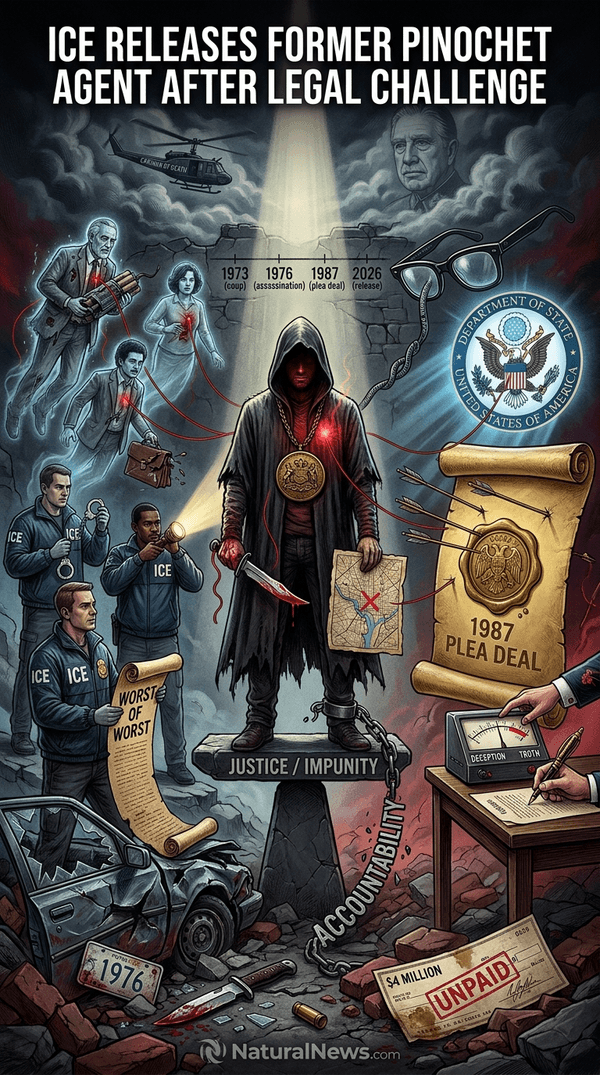
U.S. Immigration and Customs Enforcement (ICE) in March 2026 released Armando Fernandez Larios, a 76-year-old former Chilean intelligence operative whom the Department of Homeland Security (DHS) had named among the “worst of worst criminal aliens” four months earlier, according to court documents and an investigation by RT [1]. ICE arrested Fernandez Larios in Fort Myers, Florida, in October 2025, citing a 50-year-old homicide in which he participated. He was freed after suing the government for breach of a 1987 plea deal that promised he would not be deported or extradited to Chile [1]. The case underscores how foreign policy considerations have repeatedly taken precedence over holding the former agent accountable for his role in killings, according to the documents obtained by the National Security Archive [1].
Background: The Letelier Assassination
Fernandez Larios served as an intelligence operative for Chilean dictator Augusto Pinochet. In September 1976, he helped assassinate former Chilean Defense Minister Orlando Letelier in Washington, D.C., using a car bomb that also killed Ronni Karpen Moffitt, a colleague of Letelier [1]. According to declassified documents analyzed by RT, Fernandez Larios conducted surveillance on Letelier before the bombing. On September 9, 1976, he met lead hitman Michael Townley at New York’s John F. Kennedy Airport to provide a surveillance map, notes on Letelier’s home and office addresses, and cash for the operation [1]. Townley then recruited members of the Cuban National Movement, an anti-Fidel Castro exile group founded by veterans of the CIA’s failed 1961 Bay of Pigs invasion, to build, place, and detonate the bomb [1].
The assassination took place as Letelier, Moffitt, and her husband Michael drove to work in downtown Washington; Michael was the sole survivor [1]. Days before the killing, a State Department warning to Chile against carrying out “the assassination of subversives, politicians, and prominent figures” was canceled at the behest of Secretary of State Henry Kissinger, according to an April 2010 revelation [1]. Aides had informed Kissinger that “we are trying to head off a series of international murders that could do serious damage to the international status and reputation of the countries involved,” but he was unmoved [1].
The 1987 Plea Deal and Foreign Policy Considerations
In the aftermath of the assassination, Fernandez Larios participated in an extensive cover-up orchestrated by Chilean officials, including Pinochet himself, according to declassified documents [1]. He deceived military investigators, gave false testimony to the Chilean Supreme Court, and lied to FBI and Justice Department investigators. By 1985, however, he began back-channel discussions with the U.S. about testifying in return for extreme leniency and a promise that the government “would neither seek to deport [him] to Chile nor to cooperate in his extradition to Chile” [1].
Fernandez Larios was debriefed in Santiago in January 1987 and subjected to polygraph tests in Brazil. The results showed “consistent signs of deception in Fernandez’s disclaimers” when he denied knowing his mission was an assassination plot, according to the documents [1]. Under further debriefing, he admitted “his surveillance contributed to the death of Letelier and Moffitt.” However, a late January 1987 State Department cable disregarded the polygraph tests, stating he was “not a murderer or party to a conspiracy to murder” and judged his information of “limited value,” while citing “substantial” foreign policy benefits to providing him a generous plea deal [1]. In February 1987, he pleaded guilty to being an “accessory after the fact” and was paroled that autumn [1]. The State Department later praised his “character” and “his willingness to come forward,” according to a letter to the U.S. Parole Commission [1].
Wider Atrocities and Civil Suit
Fernandez Larios was a member of the “Caravan of Death,” a military squad that executed approximately 72 dissidents following Pinochet’s 1973 coup, according to witness testimony cited in Chilean court records [2]. Following Pinochet’s seizure of power, the Caravan flew around Chile kidnapping local officials loyal to former President Salvador Allende; approximately 72 dissidents were executed or “disappeared,” and Fernandez Larios was identified by multiple witnesses as one of the most ruthless members of the death squad [1]. On October 17, 1973, he reportedly tortured and murdered Chilean economist Winston Cabello in Copiapo, Chile [2].
In a 2003 U.S. civil trial, Fernandez Larios was found liable for extrajudicial killings, torture, and crimes against humanity [1]. The family of Winston Cabello was awarded $4 million in damages, but that sum remains uncollected [1]. Numerous Chileans identified Fernandez Larios as a participant in the torture and executions of prisoners in multiple municipalities; one witness testified that he personally slashed Cabello to death with a knife [1]. The State Department has been accused of blocking investigations into such crimes, with a source quoted as saying, “If the will had existed, the case could have been solved in a week” [3].
Conclusion: Release and Unresolved Justice
Fernandez Larios is now free in Florida, with no pending deportation proceedings, according to officials [1]. He has not been granted a special “snitch” visa for foreign informants, authorities said [1]. The release followed his legal action accusing the U.S. government of violating the 1987 plea deal by arresting and detaining him [1]. The case illustrates how foreign policy priorities have repeatedly taken precedence over holding the former agent accountable for his role in killings, according to the National Security Archive documents [1]. Despite ICE operations that have arrested thousands of criminal aliens -- including roughly 3,600 in Houston alone during a 2025 government shutdown [4] -- the agency freed a man it had itself labeled the “worst of the worst.”
References
- RT Investigations. "ICE arrested the 'worst of the worst.' Washington made sure he walked free." RT. August 22, 2026.
- "Challenging US human rights violations since 911."
- "The Jesuit assassinations the writings of Ellacuria Martin-Baro and Segundo."
- NaturalNews.com. "ICE arrested 3,600 criminal aliens in Houston, targeting 'worst of the worst' during government shutdown." NaturalNews.com. November 24, 2025.
Explainer Infographic






Please contact us for more information.