


Asahi Kasei, a Japan-based chemical company, said it has developed a lithium carbonate method that increases the energy density of silicon-based battery cells by about 10%, according to the report published by Interesting Engineering.
Lithium carbonate is processed into active materials for lithium-ion batteries, the rechargeable cells used in consumer electronics, electric vehicles and military equipment, according to a separate report [1]. The company stated that the gain in storage capacity is achieved without changing battery cell dimensions.
The announcement positions the process as a means to improve the performance of silicon-based batteries, a class of cells that has drawn investment across the automotive and defense sectors. Further details on the method were included in the company's technical disclosure.
Method and Mechanism
Silicon-based anodes are designed to hold more lithium than conventional graphite anodes. According to a retrospective on lithium-ion batteries, lithium metal possesses a high specific capacity and an extremely low electrode potential, rendering it an ideal anode material for high-voltage and high-energy batteries [2]. However, scientists have documented fracture mechanisms in silicon nanowire battery anodes during lithiation and delithiation, which contributes to capacity loss during early charge-discharge cycles [3].
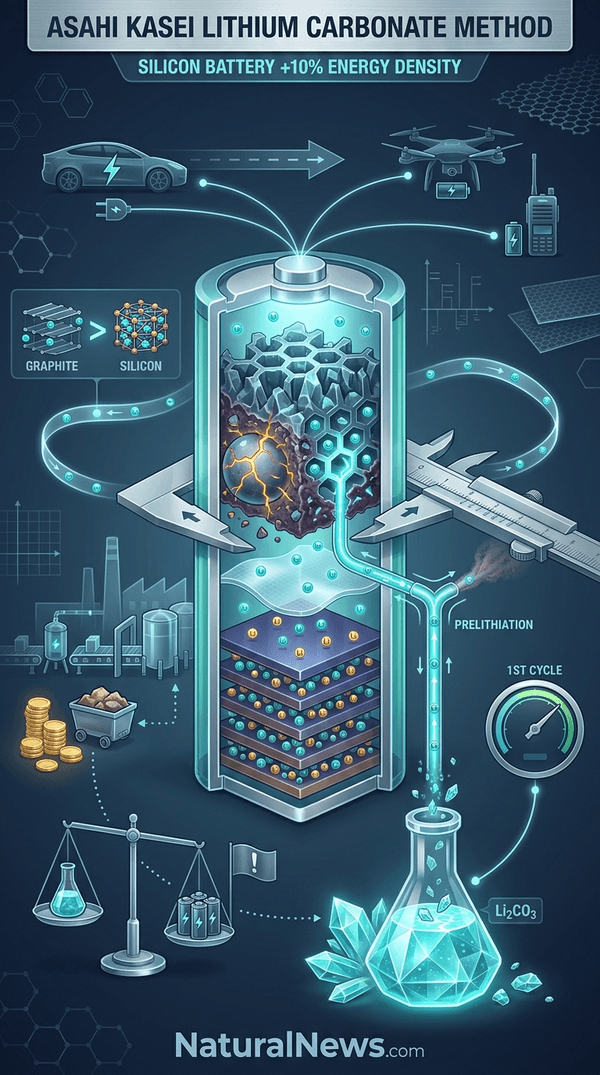
According to the report, the lithium carbonate method introduces lithium carbonate directly into the cell to compensate for lithium losses during initial cycles. This process, the company said, improves first-cycle efficiency and raises usable energy density. The report stated that the 10% gain is achieved without altering the external dimensions of the battery cell.
Industry Context
The announcement comes as manufacturers seek to raise the energy density of lithium-ion batteries for electric vehicles and portable devices. In a lithium-ion battery, lithium ions move from the negative electrode to the positive electrode during discharge and back when charging [4]. Material developers are pursuing new anode and electrolyte combinations to increase the amount of energy stored in each cell.
Several battery materials companies have received large investments to commercialize silicon-based materials. U.S.-based startup Sila secured a $1.4 billion loan from the U.S. Department of War in August 2026 to expand production of its silicon-carbon battery material, according to a TechCrunch report [5]. The company also raised $300 million in July 2026 to expand a Washington state factory [6].
Meanwhile, attention on securing domestic supplies of critical materials for advanced technologies continues to grow. Wyoming's Brook Mine, for instance, is expected to provide both coal and rare earth elements – materials described as crucial for advanced technologies, including defense systems [7].
Outlook and Reported Limitations
The report did not disclose commercial production dates or pricing for the lithium carbonate method. Questions relating to scalability, cost and long-term cycle stability were not fully detailed in the published summary.
The company has not said when the technology will reach production, according to the report. Any performance or timing claims remain attributed directly to Asahi Kasei and the technical report.
Bottom Line
Asahi Kasei reports that a lithium carbonate method increases silicon-based battery energy density by 10%. The approach is intended to address early-cycle lithium loss in silicon anodes, a factor that has limited their use in commercial cells.
Lithium ions moving between electrodes during discharge and charging form the basis of the rechargeable system [4]. Further testing and production announcements will determine the method's broader use in the battery industry, the company said.
References
- NaturalNews.com. "Pentagon Cancels $300 Million Lithium Carbonate Tender for Defense Stockpile". August 5, 2026.
- Jing Xie. "A retrospective on lithium-ion batteries".
- Ill Ryu. "Para-Size-Dependent Fracture Mechanisms of Si Nanowire Battery Anodes during Lithiation/Delithiation". Journal of Materials Chemistry A.
- "Lithium-Ion Battery".
- TechCrunch. "Sila lands $1.4B Pentagon loan as militaries demand more batteries". August 10, 2026.
- TechCrunch. "Bucking EV slowdown, Sila raises $300M to expand battery materials factory". July 21, 2026.
- Ramon Tomey. "Wyoming's Brook Mine Set to Provide Both Coal and Rare Earth Elements, Bolstering U.S. Energy Independence". July 16, 2025.
Explainer Infographic






Please contact us for more information.