


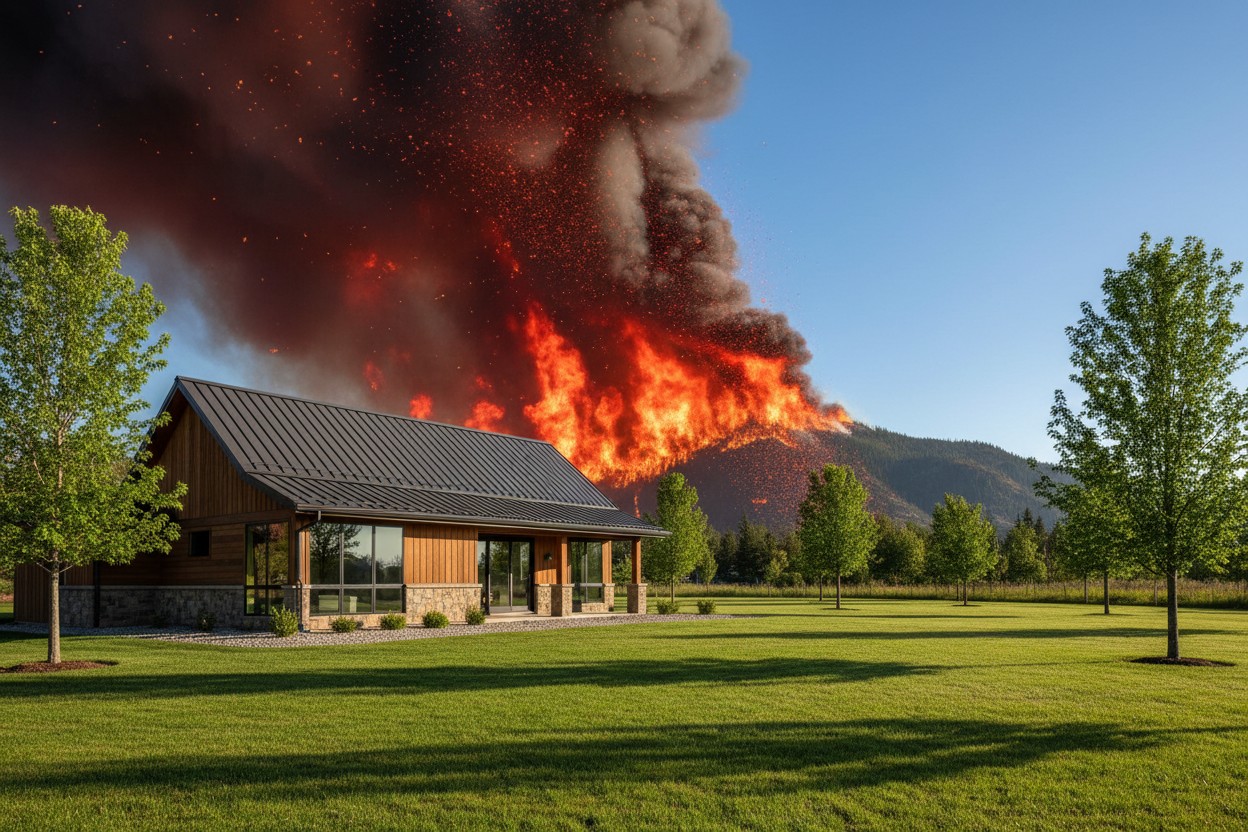
A report published Aug. 2, 2022, by Ready Nutrition recorded 84 large fires and complexes burning 3,071,353 acres in 13 states, with wildfire season underway amid an unprecedented heat wave. The report said concern was spreading among residents in states that previously had little reason to worry.
A homeowner guide published on August 21, 2025, in NaturalNews.com stated that communities across the Midwest, South, and East have become increasingly vulnerable to wildfire because of climate factors and homes built near wildlands. [1]
Wildfire activity has continued in subsequent years. The Epoch Times reported on July 17 that Detroit, Minneapolis, and Chicago had the worst air quality in the world on July 16 due to heavy smoke from hundreds of wildfires in the United States and Canada. [2]
According to the Ready Nutrition report, the National Fire Protection Association said homeowners can take steps to prepare their homes to withstand ember attacks and minimize the likelihood of flames or surface fire touching the home or any attachments. Embers can be carried more than a mile by wind, and the Home Ignition Zone includes the home and everything around it up to 200 feet away.
The report divided the Home Ignition Zone into three distance-based groups. According to Hargo's Land Management, fire professionals have reported that up to 75% of homes that survived in burn areas completed some form of defensible space mitigation.
Immediate Zone: A Five-foot Non-combustible Perimeter
The immediate zone includes the home and the area up to five feet from the furthest attached exterior point. This zone is a non-combustible area and the most vulnerable to embers.
Homeowners were advised to clean roofs and all gutters of dead leaves, debris, and pine needles, and to replace or repair loose or missing shingles or roof tiles.
It is advised to cover vents in eaves and attic spaces with 1/8-inch metal mesh screening, clean debris from exterior attic vents, and repair or replace damaged or loose window screens and broken windows. Flammable materials, including mulch, flammable plants, leaves, firewood piles, and stored items, should be removed from wall exteriors and from under decks and porches, according to the report.
A checklist in the book "The Earthlings Guide: Being Prepared for Disasters Emergencies" lists additional steps for when wildfire threatens, including shutting off gas at the meter, closing windows and vents, and moving flammable furniture to the center of the home. [3]
A preparedness handbook by Deb Moller notes that a hard-copy information folder can be useful in a wildfire and that information normally accessed digitally may need to be available in paper form. [4]
Intermediate Zone 5: Five to 30 Feet
The intermediate zone spans five to 30 feet from the furthest exterior point of the home. Landscaping and hardscaping can be used to create fuel breaks in this zone; examples include driveways, walkways, patios, and decks.
Experts also advised clearing vegetation from under large stationary propane tanks. A 2025 NaturalNews.com guide described building firebreaks as a property's first line of defense during wildfire season. [1]
The report advised mowing lawns and native grasses to a height of four inches and removing ladder fuels so a surface fire cannot reach tree crowns. Trees should be pruned to six to 10 feet above the ground, spaced at least 18 feet between crowns, and planted so mature canopies are at least 10 feet from the structure.
Trees and shrubs in this zone should be limited to small clusters to break up the continuity of vegetation.
Extended Zone: 30 to 100 Feet and Beyond
The extended zone stretches from 30 feet to 100 feet and up to 200 feet from the house. The goal in this zone is to interrupt the fire's path and keep flames smaller and on the ground.
Homeowners are advised to dispose of heavy accumulations of ground litter and debris, remove dead plant and tree material, remove small conifers growing between mature trees, and clear vegetation adjacent to storage sheds or other outbuildings. Set tree canopy spacing at a minimum of 12 feet for trees 30 to 60 feet from the home and at least 6 feet for trees 60 to 100 feet from the home.
First Designated Wildfire-Prepared Home
A home in Paradise, California, became the nation's first designated wildfire-prepared home after its owners took precautions. The designation was developed by the Insurance Institute for Business and Home Safety as a way for homeowners to prove that they have taken scientifically proven steps to reduce the risk of total home loss in a wildfire.
Requirements include a Class A roof, 1/8 inch mesh over attic vents, clear gutters, and at least 5 feet of space between the home and combustible materials for the entire perimeter of the building, including mulch, vegetation, and wood fencing.
IBHS Chief Engineer Anne Cope said: "All of these ideas are things that we have looked at in the laboratory and in post-event."
It's never too soon to think about preparations, especially for residents living within a few hundred miles of where wildfires are common. A May 2025 NaturalNews.com article stated that emergency plans reduce stress, improve communication, and ensure faster evacuations during disasters such as wildfires. [5]
A January 2026 report quoted emergency preparedness manager Dale White as saying, "It's not a question of if; it's a question of when." [6]
References
- Zoey Sky. "Homeowner's Guide to Building Firebreaks: Your Property's First Line of Defense During Wildfire Season". NaturalNews.com. August 21, 2025.
- The Epoch Times. "Wildfire Smoke Prompts Air-Quality Warnings Across Northern US". July 17, 2026.
- Adams Cheryl. "The earthlings guide being prepared for disasters emergencies".
- Deb Moller. "Get Ready!".
- Zoey Sky. "Prepping 101: The Ultimate Guide to Building a Family Emergency Plan". NaturalNews.com. May 22, 2025.
- NaturalNews.com. "It's not if, it's when: Why experts say every family needs a 72-hour disaster survival plan". January 26, 2026.
- Sara Tipton. "Preparing Homes For Wildfires". ReadyNutrition.com. August 2, 2022.










Please contact us for more information.