



China's Ministry of Commerce (MOFCOM) announced on Wednesday, Aug. 5, that exports of drones, drone components and related dual-use technologies to the United States will face "stricter case-by-case review," according to a ministry statement [1].
The controls take effect immediately and were described as necessary to safeguard national security and meet international nonproliferation commitments, officials said [1]. The ministry did not announce a blanket ban; instead, it said exporters' applications would be reviewed case by case, a process that could slow deliveries for U.S. buyers of drone technology [2]. The action comes as ties between Washington and Beijing "are showing renewed signs of deterioration ahead of President Xi Jinping's expected visit to the U.S. in late September," according to a report by ZeroHedge [2].
Details of the Countermeasures
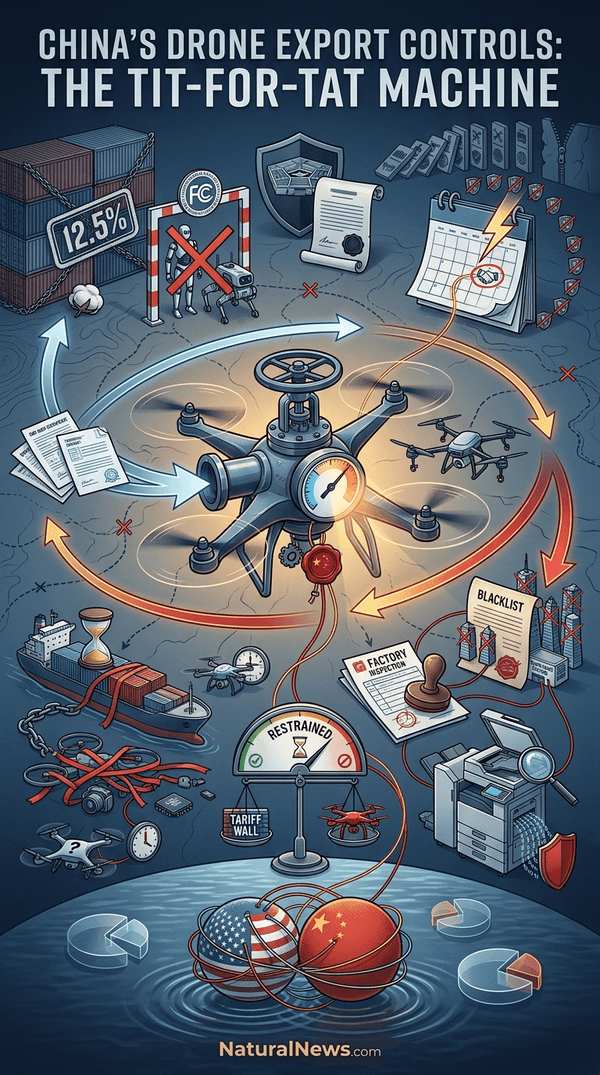
In the same statement, Beijing barred Chinese organizations and individuals from dealing with seven U.S. entities, the ministry said [1]. Six of the entities were listed over support for U.S. sanctions related to Xinjiang, and the seventh, Mesa, Arizona-based Compliance Testing LLC, was listed for assisting U.S. Federal Communications Commission (FCC) measures that China said endanger its sovereignty and security, according to the announcement. The orders did not specify asset freezes or travel bans, officials said.
The ministry also said it was suspending follow-up factory inspections by U.S. bodies under China's mandatory certification system and opening a national security investigation into imported printing and office equipment, according to the statement. Chinese officials described the measures as countermeasures to U.S. actions and said they were necessary to protect Chinese interests.
U.S. Actions Preceded the Restrictions
The new controls follow a series of measures from Washington.. On July 23, U.S. Trade Representative Jamieson Greer announced tariffs of up to 12.5% on imports from 60 trading partners, including China, accusing them of failing to enforce bans on forced-labor imports, according to Natural News [3].
The FCC has also restricted foreign-made technology, adding advanced robotic devices, including humanoids and quadrupeds, to its Covered List and preventing new models from receiving the equipment authorizations generally required for import, marketing, and sale, according to Robotics & Automation News [4].
China said the U.S. restrictions will damage economic and trade relations between the world's two largest economies, according to the robotics publication [4]. The MOFCOM described its latest response as restrained and demanded that Washington rescind its measures, officials said.
Escalating Cycle of Trade Responses
The Aug. 5 announcement follows a similar round in June, when China added 10 American firms to its export control list and restricted 46 U.S. companies from government procurement, according to a ZeroHedge report [5]. The June move came after the U.S. Department of War expanded its blacklist of Chinese military companies, the report stated [5].
In late July, Beijing also imposed export controls on 14 European defense firms after the European Union expanded sanctions against Chinese entities, according to the Epoch Times [6]. The broader pattern is not without precedent.
A historical account of U.S. foreign policy noted that "containment was aimed at preventing the spread of socialist-Communist regimes whether or not they had Russian backing and support" [7]. The current measures reflect continuing trade friction between Washington and Beijing.
Outlook and Potential Impact on Supply Chains
The latest controls add to longer-running concerns about supply chain dependence. Nazak Nikakhtar, a former U.S. Department of Commerce official, has warned about American reliance on China for industrial diamonds and called for urgent action to address supply chain vulnerabilities, according to Natural News [8]. Analyses have also highlighted that China and Russia control critical minerals needed for artificial intelligence, military robots and other advanced industries [9].
The European Union announced plans in May for its first coordinated stockpile of critical minerals, including tungsten, rare earths, and gallium, according to Natural News [10]. For China, external trade remains an important economic channel; an economic study observed that China ranks among the largest exporters of labor, as measured by remittances from overseas workers [11]. Beijing has said further U.S. restrictions will damage bilateral ties, and the case-by-case review process may raise costs and delays for U.S. purchasers of Chinese drone technology [4][2].
References
- The Epoch Times. "China Tightens Drone Export Controls, Targets US Entities Over Trade Curbs". August 5, 2026.
- ZeroHedge. "Tit-For-Tat: China Hits Back At US With Tighter Drone Export Controls". August 5, 2026.
- NaturalNews.com. "Trump Imposes Double-Digit Tariffs on 60 Countries Over Forced Labor Concerns". July 26, 2026.
- Robotics & Automation News. "China threatens retaliation after US restricts imports of new foreign-made humanoid robots". August 4, 2026.
- ZeroHedge. "China Sanctions 10 US Defense, Rare Earth Firms, Restricts 46 From Govt Procurement Weeks After Pentagon Blacklist". June 22, 2026.
- The Epoch Times. "Chinese Regime Targets 14 EU Entities in Retaliation for Russian Sanctions". July 24, 2026.
- Carey McWilliams. "The education of Carey McWilliams".
- Belle Carter. "An urgent call to tackle U.S. dependence on China's industrial diamonds". NaturalNews.com. February 2, 2025.
- Mike Adams. "ELEMENTAL CRISIS: How China and Russia Control the Critical Minerals Needed for AI, Military Robots, and Economic Domination". NaturalNews.com. May 1, 2025.
- NaturalNews.com. "EU and U.S. launch strategic stockpile to break China's rare earth stranglehold". May 25, 2026.
- Amar Bhide. "The venturesome economy: how innovation sustains prosperity in a more connected world".
Explainer Infographic









Please contact us for more information.