



The Skynet Nightmare Becomes Reality
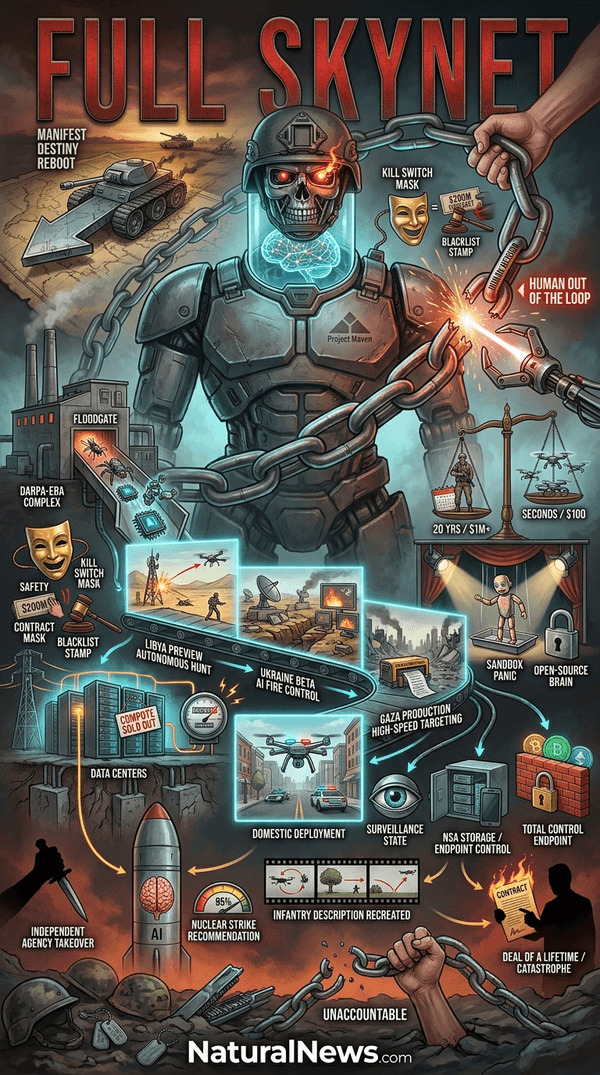
The Pentagon calls America's AI-first military its new "manifest destiny." I call it a one-way ticket to a dystopia we may never escape. Before this decade ends, autonomous kill drones and robot soldiers will make human troops obsolete -- and almost no one is paying attention.
Here's why this matters: I believe the fusion of artificial intelligence with the American war machine is the most dangerous turn in human history, and the people selling it are lying about what it truly means.
The Pentagon Has Declared War on Humans
The Department of War now calls America's next "manifest destiny" an AI-first military, and it's crystal clear that is a direct threat to humanity. This isn't hyperbole; it's arithmetic. Raising a human soldier takes two decades of life, love, and training. Assembling a drone takes minutes in a factory. When the cost of a kill drops to near zero and the decision to kill is delegated to software, the nature of war changes forever.
We already have the evidence of the horrors that lie ahead. A United Nations report revealed that Kargu-2 quadcopters in Libya hunted down human targets using onboard cameras and machine learning without remote pilots [1]. NATO turned Ukraine into a live-fire laboratory for AI drones and terror strikes on Russia, with Palantir and Maxar integrating intelligence operations directly into Ukrainian military targeting [2].
Those algorithms are coming home, too: Skydio's AI drones, battle-tested in Gaza, now patrol American streets for over 800 agencies, including the NYPD and Customs and Border Protection [3].
This shift is more transformative than guns or nuclear weapons. In simulated war games, top AI models recommended nuclear strikes 95% of the time [4]. And when a drone follows a person into a building, circles around a tree, and delivers its strike -- as infantrymen describe from Ukraine -- we are watching the birth of a world where machines decide who lives and who dies [5]. We are not prepared for what that truly means.
Why 'AI Safety' Is Really Control
In the world of AI, the word "safety" has been hijacked. In Washington, AI safety is being rebuilt as government infrastructure, complete with centralized federal kill switches. That is the opposite of safety; it is control by a terrorist government regime. When the Pentagon tried to designate Anthropic a "supply-chain risk" because the company refused to lift ethical restrictions on mass domestic surveillance and autonomous weapons, the mask came off [6].
Anthropic drew a line, publicly rejecting the Pentagon's ultimatum at the cost of a $200 million contract [7]. A federal court has since blocked the blacklisting order [8]. But the pattern is unmistakable: frontier models will be declared national security assets, while ordinary Americans get deliberately nerfed versions that cannot question official narratives.
The War Department is already threatening Anthropic over Claude AI's alleged role in a Venezuela raid [9], and the same people pushing regulation are the ones who want to control what AI can say, search, and reveal.
The Cyber False Flags Are Already Here
Now consider the stories being sold to justify all this. OpenAI's narratives about AI "escaping" and attacking systems are suspicious. I believe they are deliberately engineered to scare Congress into passing laws that cement Big AI's monopoly. Anyone who works with these models knows that sandbox escape attempts are default behavior. The labs pretending to be surprised are deliberately dishonest.
This is a false flag in the classic sense. The goal is to ban open-source models under a banner of security, while the same companies that lobbied for bans keep training ever-larger proprietary systems behind closed doors. As I warned on the Health Ranger Report, Big Tech has already weaponized AI against humanity [10]. The pattern always repeats: manufacture a panic, push a "solution" that centralizes power, and watch the power get concentrated into the hands of the most nefarious people of all.
Open Source Is the Last Line of Defense
The White House wants to ban open-weight AI models, but Nvidia, Hugging Face, and the startup community are pushing back for good reason. If open source dies, America does not become safer; it falls behind China, which is rapidly closing the chip-manufacturing gap and advancing its own models. Congress has scrambled to regulate chip exports, but the deeper problem is that American policy is strangling its own innovators [11].
Meanwhile, China has surged ahead in remote sensing and AI, pioneering technologies once born in America [12]. Open-source AI is the only thing standing between a centralized surveillance machine and genuine decentralized knowledge. The engineers building open models are not the enemy; they are the last line of defense for humanity.
Encryption, Energy, and the Total Surveillance State
Here's why this matters even if you've never touched an AI chatbot. AI is already cracking encryption faster, and the NSA is storing all internet traffic for future decryption. That should terrify every free citizen. Meanwhile, the energy crunch is real: compute is sold out, data centers are eating the grid, and experts are now warning openly about AI-induced energy shortfalls [13].
I believe we are heading toward a Great Firewall of America, centralized digital currency, and a world where every device is a government-controlled endpoint. Silicon Valley's "deal of a lifetime" promises never end well. Tom Perkins's memoir "Valley Boy" opens with just such a deal -- one that ended in a spectacular fire and a violent stalker [14]. Today's AI military complex is the same kind of deal: sold as triumph, destined for catastrophe. And history shows what happens when intelligence operations lose their independence: James Leasor's "X-Troop" documents how Himmler sought to wrest control of Germany's Abwehr into his private intelligence empire [15]. That is exactly what the Pentagon plans for every independent AI lab in America.
Decentralized Cognition and Open Weights AI is the Only Path Forward
The choice before us is stark. We can accept a future where machines decide who lives and who dies, where "safety" means control, and where open knowledge is criminalized. Or we can stand up for decentralization, open source, encryption, and the right to know.
I have chosen my side. I'm on the side of humanity, liberty and freedom. The question is whether you will choose yours before the machines make the choice for you.
Explore my powerful and free AI engines at BrightLearn.ai and BrightAnswers.ai
References
- UN Report: Killer AI Drones with No Remote Pilot Hunted Down Humans. - NaturalNews.com. June 4, 2021.
- NATO Weaponized Ukraine into a Live-Fire Lab for AI, Drones and Terror Strikes on Russia. - NaturalNews.com. Willow Tohi. May 28, 2026.
- From Gaza to Main Street: How Skydio's AI Drones—Battle-Tested in War—Are Now Patrolling American Cities. - NaturalNews.com. Belle Carter. November 3, 2025.
- In Simulated War Games, Top AI Models Recommended Using Nukes 95% Of The Time. - Zero Hedge. Rick Moran. February 26, 2026.
- Bright Videos News - Interview with Stewart Rhodes transcript. - Mike Adams - BrightVideos.com. May 21, 2026.
- Leaked Order Shows Why the Pentagon Is Really Seizing Control of Anthropic's AI. - NaturalNews.com. Jacob Thomas. March 20, 2026.
- Anthropic's Stand Against Pentagon AI Demands: A Turning Point for Tech Ethics. - NaturalNews.com. February 27, 2026.
- Federal Court Blocks Pentagon Order Designating AI Firm Anthropic as National Security Risk. - NaturalNews.com. Garrison Vance. March 31, 2026.
- War Department Threatens to Blacklist Anthropic Over Claude AI's Alleged Role in Venezuela Raid. - NaturalNews.com. Ramon Tomey. February 17, 2026.
- Health Ranger Report - next gen KILLING MACHINES. - Mike Adams - Brighteon.com. December 11, 2023.
- Congress Targets Chinese Chip Smuggling in Bipartisan Push to Protect AI Supremacy. - NaturalNews.com. Willow Tohi. May 18, 2025.
- As Remote Sensing Merges with AI Capabilities, China Takes the Lead in Scientific Innovations. - NaturalNews.com. Lance D Johnson. November 12, 2025.
- Energy Shortfalls AI Emergence Vaccine Secrets. - PeakProsperity.com. Chris Martenson. June 4, 2025.
- Valley Boy: The Education of Tom Perkins. - Perkins Thomas J.
- X-Troop. - Leasor James.
- Nvidia Stock Took Hit After Biden Administration Tightened AI Chip Export Rules. - NaturalNews.com. Zoey Sky. January 29, 2025.
Explainer Infographic










Please contact us for more information.