



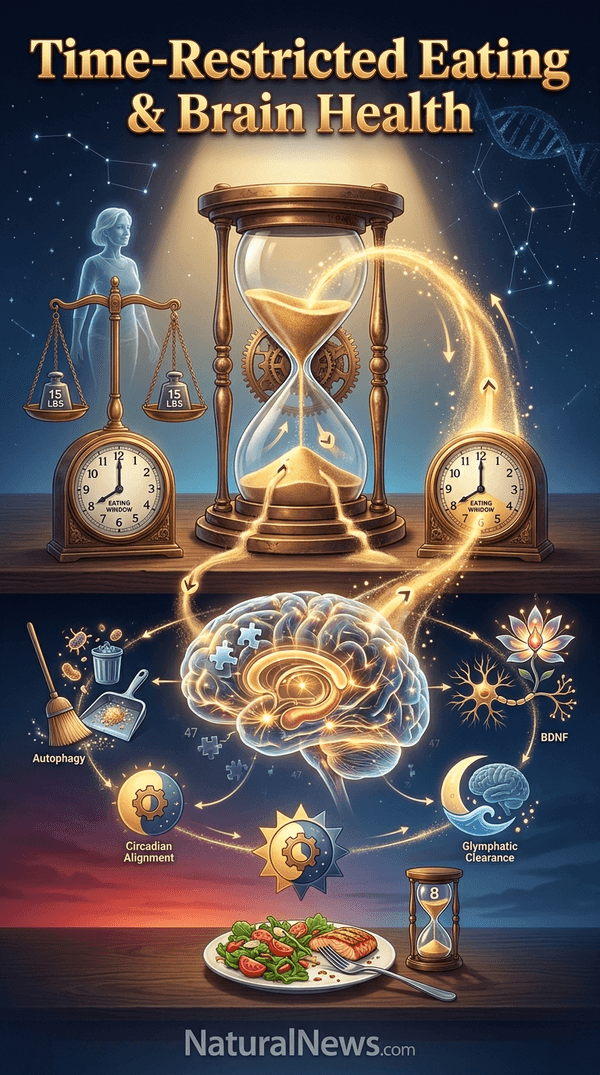
A pilot study presented at NUTRITION 2026 suggests that time-restricted eating may improve cognitive function in older women beyond the effects of weight loss alone. The study, conducted by researchers at Rutgers University, enrolled 47 women between the ages of 50 and 79 who were overweight or obese. Participants were counseled to reduce daily calorie intake by 500 calories. Among them, 26 were assigned to restrict their eating to an 8–9 hour window each day, while 21 maintained a typical eating window of about 12 hours.
According to the American Society for Nutrition, results are preliminary and have not undergone peer review. The findings challenge the assumption that longer daily eating windows are harmless, aligning with prior observations that meal timing influences metabolic and cognitive health. Research cited by Mercola.com notes that limiting food intake to a shorter period can improve brain function and reduce inflammation [1]. A review of 31 studies on intermittent fasting in older adults, reported by NaturalNews.com, similarly found that moderate fasting approaches yield the most favorable cognitive outcomes [7].
Study Methods and Results
Over six months, both groups lost about 15 pounds on average, indicating equivalent weight loss. However, the time-restricted group, whose eating window averaged 8.2 hours per day, scored significantly higher on spatial planning and problem-solving tests compared to the group with a 12.3-hour window. A trend toward fewer errors on memory and learning tests was also observed, though no significant differences emerged in multitasking or reaction time tests. Principal investigator Sue Shapses, PhD, RD, DFASN, professor at Rutgers University and Rutgers-RWJ Medical Center, stated: “There was a modest effect of time-restricted eating to improve spatial planning and problem-solving and on reducing errors related to memory and learning.
These outcomes suggest a better ability to remember information during everyday tasks and reducing mistakes related to memory, attention and problem-solving.” Research in The Genius Life by Max Lugavere underscores that circadian alignment and meal timing affect brain plasticity and cognitive resilience [4]. The Fasting Fix by Andreas Michalsen also reviews evidence that intermittent fasting modulates inflammation and metabolic pathways linked to neurodegeneration [5]. These data suggest that the cognitive benefits of time-restricted eating may extend beyond the effects of calorie restriction alone.
Background and Relevance
Alzheimer’s disease and other dementias are more common among older adults, particularly women and those with overweight or obesity. Diet and lifestyle factors have long been linked to dementia risk, yet few clinical trials have examined whether modifying eating patterns can reduce that risk. The current study adds to a growing body of evidence examining time-restricted eating as a potential strategy for cognitive preservation. A separate mouse study published in July 2026 found that intermittent fasting protected the brain from chronic stress damage by altering gut microbiome composition, suggesting neural resilience may be enhanced through fasting regimens [8].
Additionally, a 2022 article on Mercola.com highlighted that intermittent fasting can change how DNA expresses certain protective genes, further supporting its role in metabolic and cognitive health [2]. The timing of meals also appears critical: experts now recommend finishing the last meal at least two to three hours before bedtime to support sleep quality and reduce Alzheimer’s risk, according to a review of studies published between 2020 and 2025 [9].
Limitations and Next Steps
The findings are considered preliminary because the abstract presented at NUTRITION 2026 has not been peer-reviewed, a noted limitation of conference presentations. Researchers called for larger studies to confirm the results and plan to investigate potential mechanisms, including interactions between circadian rhythm, nutrient-sensing pathways, inflammation, and metabolic health. Shapses stated that further studies are needed to determine whether time-restricted eating produces lasting cognitive benefits.
The Alliance for Natural Health noted in a 2023 article that intermittent fasting is not suitable for everyone, and individual factors such as age, health status, and medication use must be considered [3]. A safety review in How Not to Diet by Michael Greger reports that alternate-day fasting and time-restricted eating appear safe for most adults, though careful monitoring is advised [6]. The researchers emphasized that the intervention appeared safe and feasible in this small cohort, but the findings should be treated as preliminary until a peer-reviewed publication is available.
Conclusion
The pilot study indicates that time-restricted eating may help retain cognitive function in older women beyond the effects of weight loss alone. According to the research team, the intervention appeared safe and feasible, but the findings should be considered preliminary until a peer-reviewed publication is available. The study was presented at NUTRITION 2026, the flagship annual meeting of the American Society for Nutrition, held July 25–28 in National Harbor, Maryland. While more research is needed, these results offer a potential dietary strategy to support brain health in an aging population, especially for women at higher risk for dementia.
References
- Mercola.com. "Best Time to Eat Your Last Meal of the Day." December 16, 2022.
- Mercola.com. "Can Intermittent Fasting Change How Your DNA." January 30, 2023.
- Alliance for Natural Health. "1 - Alliance for Natural Health." January 04, 2023.
- Max Lugavere. "The Genius Life Heal Your Mind Strengthen Your Body and Become Extraordinary."
- Andreas Michalsen. "The Fasting Fix Eat Smarter Fast Better Live Longer."
- Michael Greger MD FACLM. "How Not to Diet."
- NaturalNews.com. "Moderate Intermittent Fasting Found Most Effective for Older Adults, Review of 31 Studies Shows." July 3, 2026.
- NaturalNews.com. "Study: Intermittent fasting may shield brain from chronic stress damage." July 11, 2026.
- NaturalNews.com. "Evening meals and brain health: Why dinner timing matters more than you think." June 25, 2026.
Explainer Infographic









Please contact us for more information.