


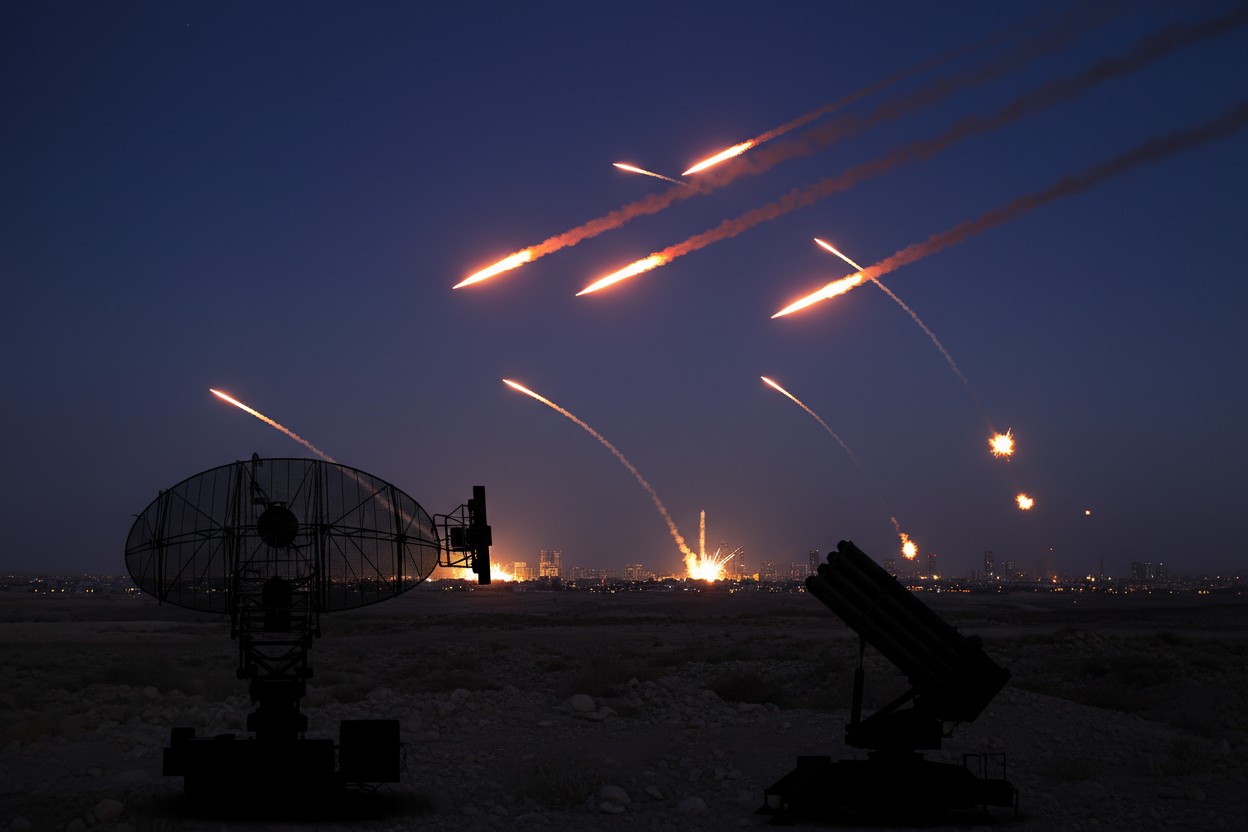
The fourth consecutive night of thunder from American warplanes over southern Iran has been met not with submission, but with a furious, multi-front response that fundamentally rewrites the rules of engagement in the Persian Gulf. In a stark redefinition of the conflict, Tehran has declared that the Gulf monarchies hosting American military infrastructure are no longer neutral bystanders, but legitimate targets in a war they have tacitly enabled. As Iranian missiles and drones struck US military sites across Jordan, Kuwait, Qatar, Bahrain, and Oman on Sunday, the Islamic Republic issued a chilling ultimatum to its neighbors: refuse to serve as an “arena” for American aggression, or bear the consequences of that choice.
Key points:
- Iran launched coordinated missile and drone strikes on US bases in five nations, explicitly framing the attacks as lawful self-defense against American aggression.
- The Iranian Foreign Ministry warned Gulf states that international law obligates them to prevent the US from using their territory to attack Iran, directly challenging their status as hosts for US Central Command operations.
- The US resumed strikes to "degrade" Iran's military capabilities following Tehran's closure of the Strait of Hormuz, a vital choke-point for global oil and LNG shipments.
- The June 17 memorandum of understanding (MoU) that established a ceasefire has collapsed over a dispute regarding control and toll collection in the Strait of Hormuz, with both sides accusing the other of violations.
A ring of fire: The bases and the warning
The geography of this conflict is now defined by the sprawling US military infrastructure that rings Iran. For years, these bases have served as launching pads for American power projection, from the airfields of Qatar to the naval headquarters in Bahrain. According to Iranian military statements, Sunday’s retaliation was precise and devastating. The Islamic Revolutionary Guard Corps (IRGC) claimed to have completely destroyed a Patriot air defense system at Ali Al Salem Air Base and a radar system at Ahmad al-Jaber Air Base in Kuwait. In Bahrain, home to the US Navy’s Fifth Fleet, missiles struck the headquarters and Isa Air Base, triggering air raid sirens and sending smoke rising over Manama. Prince Hassan Air Base in Jordan, a critical hub for US operations, was hit with missiles that the IRGC said destroyed command and control centers. Even Oman’s port of Duqm, a logistics hub for US aircraft carriers, came under attack as Iran signaled it would target the supply lines that sustain the American military machine. This was not a random act of violence, but a calculated demonstration of Iran’s ability to inflict pain on every major US asset in the region.
The diplomatic justification for this escalation is as significant as the strikes themselves. The Iranian Foreign Ministry, in a statement carried by ISNA, did not mince words, condemning the “barbaric” US attacks and explicitly accusing the Gulf monarchies of complicity. By invoking international law, Tehran argues that these nations are violating their obligations by allowing their territory to be used as a launchpad for aggression. The message is a clear attempt to create a dilemma for US allies: continue to host American forces and become a target, or push back against Washington’s use of their soil. This line of reasoning was reinforced by Iranian Foreign Ministry spokesman Esmaeil Baghaei, who argued on X that Iran’s strikes are not attacks, but “a legitimate and lawful exercise of its inherent right to self-defense under international law”.
The strait and the shattered ceasefire
The underlying cause of this renewed violence lies in the strategic waters of the Strait of Hormuz, a narrow passage through which approximately one-quarter of the world’s seaborne oil and LNG trade flows. The recent fighting began after a ceasefire, established in April and formalized by a June 17 MoU, broke down over the strait’s status. The agreement had established a fragile peace, with Iran promising safe passage for commercial vessels and committing to negotiate with Oman over the strait’s future administration. However, the US and Iran held conflicting interpretations of its provisions. While the US demanded the strait remain fully open, Iran asserted its right to regulate traffic and collect tolls, insisting that ships use a designated route under its control.
The situation came to a head when Iran declared the strait closed to shipping, a move that prompted the US to launch a new wave of strikes aimed at “degrading” Tehran’s ability to disrupt maritime commerce. In response, the IRGC warned that the waterway would remain closed until the US ended its “illegal interventions” in the region . Iranian negotiator Mohammad Bagher Ghalibaf denounced the American position, warning the US to “keep your word or pay the price,” and declaring that the “era of one-sided deals is OVER”. This dispute over a vital waterway has exposed the fundamental weakness of a ceasefire that failed to address the core strategic interests of either power, leaving the entire region vulnerable to the whims of a conflict that seems destined to continue.
Sources include:








Please contact us for more information.