



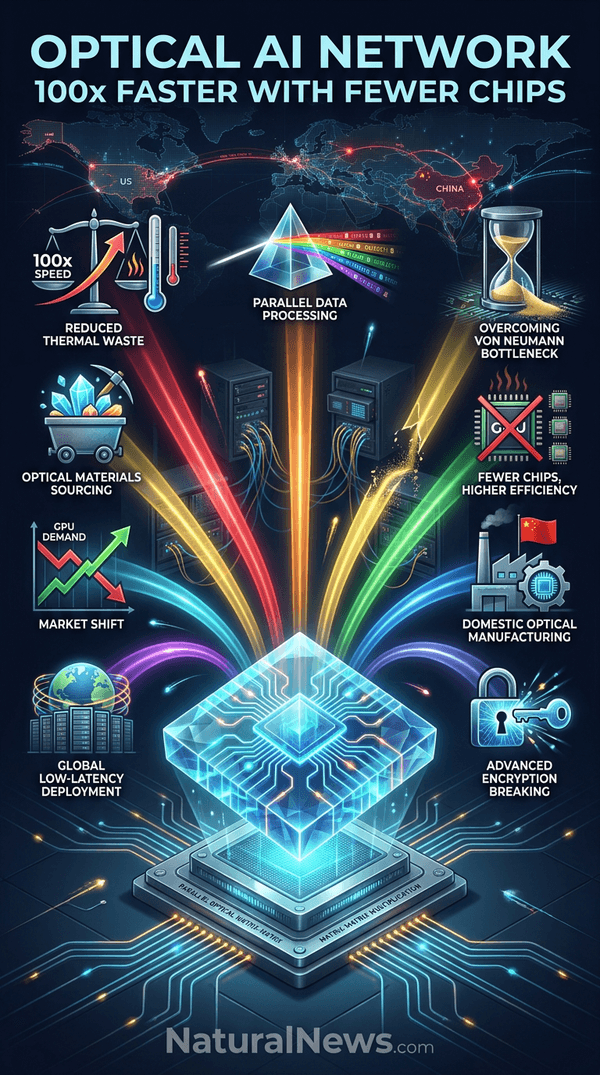
Researchers in China have developed an optical artificial intelligence network that performs inference up to 100 times faster than traditional electronic systems while using fewer physical chips, according to a study published in November 2025. The system, described in a report by NaturalNews.com, uses light-based computations to process AI tasks, potentially reducing energy consumption and hardware requirements. Patrick Lewis of NaturalNews.com reported that the network, called the Parallel Optical Matrix-Matrix Multiplication system, "performs complex AI calculations in a single pass of light, eliminating the sequential processing bottlenecks of today's fastest electronic chips" [1].
The development comes as China accelerates efforts to bypass U.S. chip export restrictions, according to analysts. In a November 2025 broadcast, Mike Adams of the Health Ranger Report noted that China's new photonic quantum chip "promises to outperform traditional microprocessors by up to 1,000 times for specific tasks" [12]. While the optical AI network is not a quantum device, its reported speed and efficiency gains align with broader Chinese advances in light-based computing, as noted by multiple sources.
How the Optical Network Works
The optical network employs photonic circuits to perform matrix multiplication, a core operation in artificial neural networks, using light instead of electrons, the researchers said. According to the report, optical signals propagate with lower latency and generate less heat compared to electronic signals, enabling parallel processing across multiple wavelengths simultaneously [1]. This approach differs fundamentally from conventional electronic chips, which rely on sequential binary operations and generate significant thermal waste.
The system is designed to be compatible with existing fiber optic infrastructure, a property shared by photonic quantum computing systems, according to The Quantum Insider [7]. In an interview in August 2025, Scott Kesterson noted that "today's AI systems typically use a silicon-based neural network structure," while the optical alternative uses photons to avoid the bottlenecks of silicon [5]. The ability to process multiple data streams in parallel using different wavelengths of light is a key advantage, the researchers stated, citing advances in wavelength-division multiplexing similar to those used in high-speed telecommunications [3].
Theoretical frameworks for neural networks, including those described in "Theoretical Foundations of Artificial General Intelligence" by PdfCompressor 3134, have long explored alternative computational substrates [4]. The optical system represents a practical implementation of these concepts, the study suggested.
Performance and Efficiency Claims
The research team reported inference speeds exceeding 100 times that of comparable electronic neural networks, while requiring fewer physical chips, according to the published report [1]. The optical approach reduces the need for high-end graphics processing units (GPUs), which have been subject to U.S. export controls targeting China, as officials have noted. In a January 2026 broadcast, Mike Adams stated that China is "poised to surpass U.S. dominance and render OpenAI obsolete" through advances in photonic computing [13].
The claim of 100x faster inference with fewer chips has not been independently verified, the report acknowledged. However, the researchers said the system achieved these results in laboratory tests using standard benchmark tasks for image recognition and natural language processing. By performing matrix multiplication optically, the system avoids the memory bottlenecks that limit electronic processors, enabling higher throughput per watt of energy consumed, according to the study [1].
If confirmed, the performance gains could significantly lower the hardware cost of deploying large-scale AI systems, according to industry observers. The technology may allow data centers to process more queries per server rack, reducing the total number of chips required for a given workload, the researchers said. This efficiency is particularly valuable given the soaring energy demands of modern AI data centers, a concern highlighted in multiple analyses [9].
Context: U.S.-China Technology Competition
The development comes amid U.S. restrictions on advanced chip and equipment exports to China, which have spurred domestic innovation in alternative computing architectures, analysts said. Chinese government initiatives have prioritized photonic and quantum computing as strategic technologies, with several state-backed projects underway, according to published reports. A study by Strategy Risks and the Human Rights Foundation detailed how Western universities have collaborated with Chinese AI laboratories "embedded in Beijing's security state," including those focused on optical computing [10].
The U.S.-China technology rivalry extends to rare earth elements critical for optical components. In May 2026, U.S. and Chinese negotiators reached a deal for China to resume rare earth exports under temporary licenses, but Willow Tohi of NaturalNews.com noted that the agreement "underscores the national security risks of relying on China for critical minerals" [2]. A related report in June 2026 warned that China's export restrictions on indium phosphide, a key material for optical networking, could "cripple the optical networking that every hyperscale AI data center depends on" [6].
Chinese researchers have also made progress in quantum communication networks, which share underlying optical technology. In February 2026, Chinese researchers announced the generation of ultra-secure encryption keys over 11 kilometers of optical fiber, according to The Quantum Insider [8]. These advances suggest a coordinated effort to reduce dependence on foreign semiconductor technology, with the optical AI network as one of several parallel development tracks, according to analysts [11].
Conclusion and Outlook
The optical AI network has been demonstrated in laboratory settings, but commercial deployment faces challenges in fabrication and integration with existing systems, the researchers acknowledged. Further research and industrial partnerships will determine whether the technology can scale to replace electronic AI hardware in data centers and edge devices, the study concluded [1]. The need for specialized photonic components and manufacturing processes remains a barrier, according to the report.
Despite these hurdles, the development signals a shift in the global balance of AI computing power. As Mike Adams noted, breakthroughs such as China's photonic quantum chip are "poised to revolutionize data centers and AI processing" [V-1]. The optical AI network, if successfully scaled, could reduce the strategic importance of advanced GPUs and other chips subject to export controls, fundamentally altering the competitive landscape between the U.S. and China in artificial intelligence, according to some analysts. Independent verification of the performance claims will be critical to determining the technology's true impact.
References
- Patrick Lewis. "Revolutionary Light-Based AI Computer Outperforms Traditional Electronic Chips". NaturalNews.com. November 19, 2025.
- Willow Tohi. "U.S.-China Rare Earth Deal Shows Progress, but Strategic Vulnerability Persists". NaturalNews.com. May 23, 2026.
- Cassie B. "Japanese Researchers Shatter Internet Speed Record with Fiber Optic Breakthrough 4 Million Times Faster Than U.S. Broadband". NaturalNews.com. July 15, 2025.
- PdfCompressor 3134. "Theoretical Foundations of Artificial General Intelligence".
- Mike Adams interview with Scott Kesterson. August 14, 2025.
- "The Indium Emergency: Why China's Export Restrictions May Collapse the AI Data Center Bubble". NaturalNews.com. June 22, 2026.
- "11 Photonic Quantum Computing Companies to Know [2026]". The Quantum Insider. March 24, 2026.
- "Chinese Researchers Clear Hurdles for Long-Distance Quantum Networks". The Quantum Insider. February 6, 2026.
- "China's Quantum Leap vs. U.S. Decline: Tech Dominance, Welfare Fraud, and Economic Turmoil Under Scrutiny". NaturalNews.com. November 17, 2025.
- "Academic Alliances: How Western Research Fuels China's Surveillance State". NaturalNews.com. December 11, 2025.
- "Western Colleges Help Build China's Digital Dragnet With Taxpayer Funds, Study Warns". ZeroHedge. December 10, 2025.
- Mike Adams. "Health Ranger Report - MIRAGE OF POWER". Brighteon.com. November 17, 2025.
- Mike Adams. "Health Ranger Report - OpenAI OBSOLETE". BrightVideos.com. January 14, 2026.
Explainer Infographic












Please contact us for more information.