


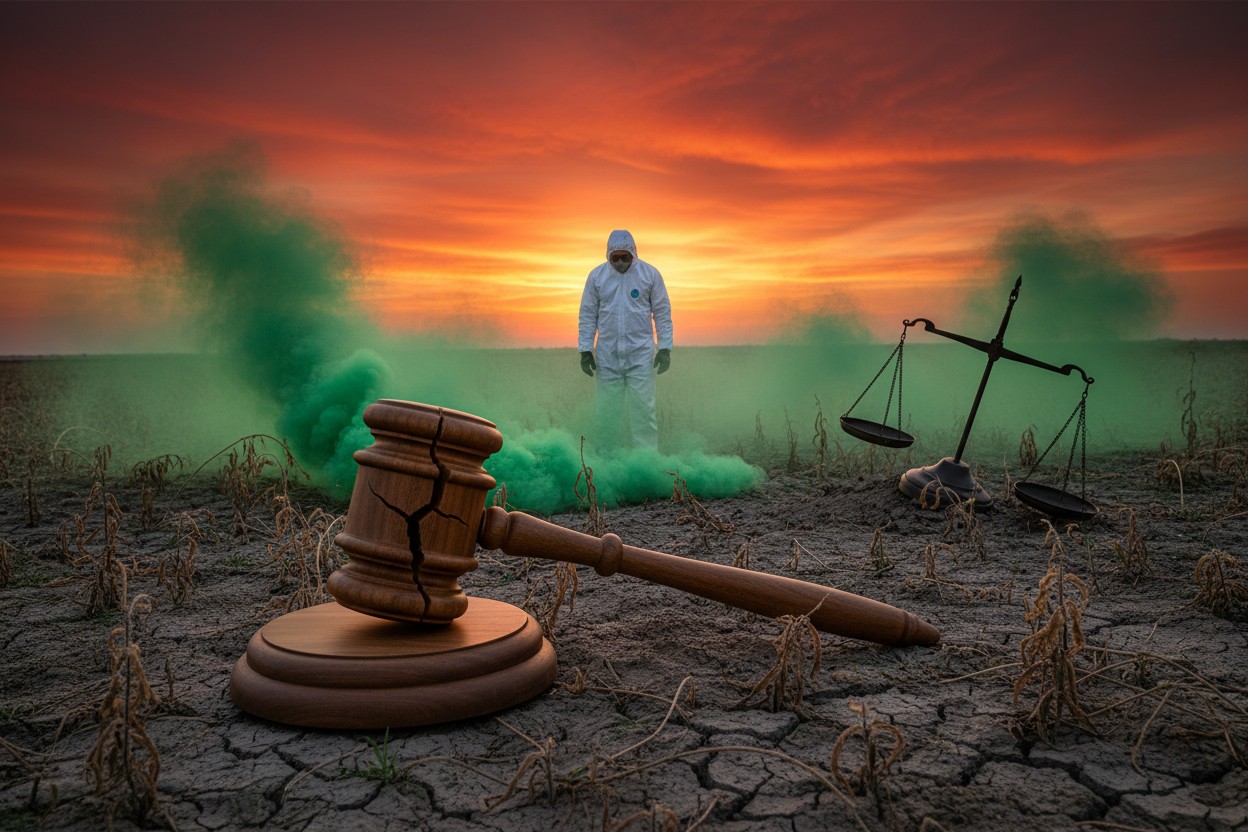
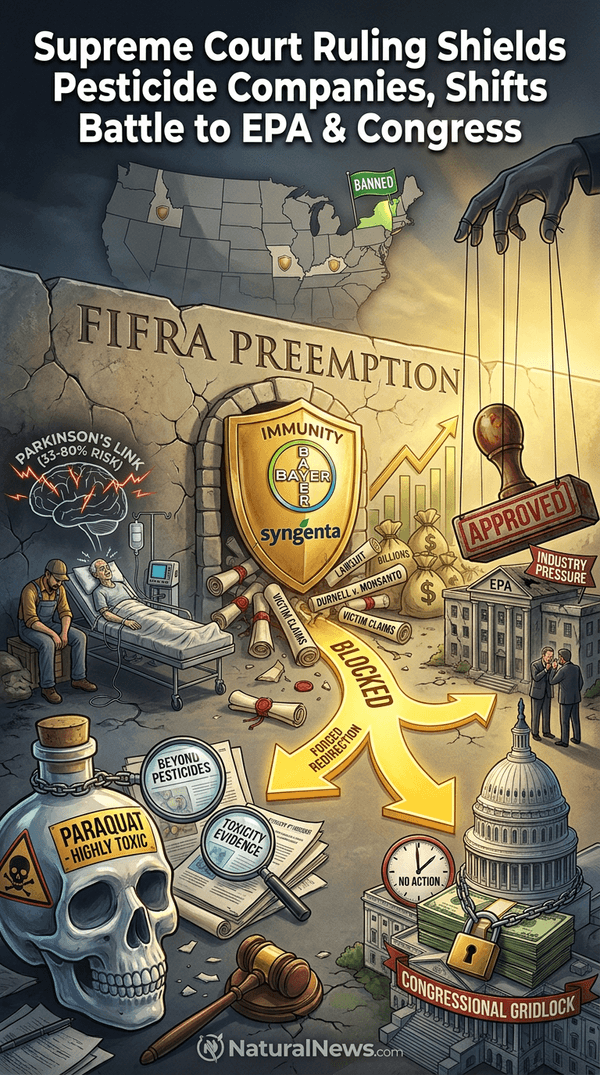
The U.S. Supreme Court ruled 7-2 on June 25 that federal pesticide law bars state-law failure-to-warn claims against Bayer AG over its Roundup weedkiller, a decision that blocks tens of thousands of lawsuits and redirects the legal battle over paraquat, a herbicide linked to Parkinson’s disease, back to the Environmental Protection Agency (EPA) and Congress.
The case, Monsanto Co. v. Durnell, centered on whether the Federal Insecticide, Fungicide, and Rodenticide Act (FIFRA) preempts state tort claims when the EPA has not required a cancer warning on the product label [1]. The ruling extends beyond glyphosate: more than 6,000 federal claims and thousands of state cases allege that paraquat, a weedkiller sold by Syngenta, caused Parkinson’s disease, and those lawsuits relied on the same failure-to-warn theory the Court just rejected [2]. Critics said the decision leaves affected individuals without a judicial remedy and places the burden on federal agencies and lawmakers who have repeatedly failed to act. “The Supreme Court’s 7-2 decision grants Bayer near-absolute legal immunity for glyphosate,” wrote Mike Adams of NaturalNews.com, “effectively declaring that federal approval of a poison overrides any state law or victim’s right to sue for failure to warn” [3].
The Case and the Court’s Reasoning
The lawsuit originated with John Durnell, a St. Louis man who developed non-Hodgkin lymphoma after years of using Roundup. A jury awarded him $1.25 million in damages, but Bayer appealed, arguing that FIFRA preempts state-law claims when the EPA-approved label does not include a cancer warning. The Supreme Court agreed. Justice Brett Kavanaugh, writing for the majority, held that FIFRA preempts state failure-to-warn claims when the EPA has not required such a warning on the label [1]. Justice Ketanji Brown Jackson, joined by Justice Neil Gorsuch, dissented, arguing that the Court misinterpreted FIFRA and left Durnell without a remedy, as noted in reporting from 100PercentFedUp.com [1].
The decision rests on the principle that the EPA-approved label is the law, and manufacturers cannot add warnings the agency did not require. This broad reading of FIFRA effectively immunizes pesticide companies from state failure-to-warn liability when the EPA has not mandated a specific warning. Bayer AG shares soared in Frankfurt following the ruling, as analysts estimated the decision could eliminate or sharply reduce the company’s exposure to roughly 100,000 pending and potential claims over glyphosate, according to Zero Hedge [4].
Impact on Paraquat Litigation
Paraquat, a herbicide so toxic that one sip can be fatal, has been linked to Parkinson’s disease in multiple studies. The EPA itself acknowledges that paraquat is “highly toxic” and has reapproved it despite evidence of a doubling the risk of Parkinson’s among exposed farmworkers [5]. In the EU and more than 30 other countries, paraquat is banned; in the United States, its use has been increasing as weeds become resistant to glyphosate [6]. More than 6,000 federal claims and thousands more in state courts allege that Syngenta failed to warn users of the Parkinson’s risk, citing internal documents that the company knew about the link for decades but did not disclose it [2].
Attorneys for both sides have said that the Durnell decision could determine the fate of the paraquat cases, because those lawsuits rely on the same failure-to-warn theory that the Supreme Court just gutted. “It’s déjà vu all over again,” wrote investigative reporter Carey Gillam in 2024, comparing the mounting litigation against Syngenta to the earlier wave of Roundup cancer cases that eventually forced Bayer to pay more than $11 billion in settlements [7]. In April 2026, Syngenta announced it would stop producing paraquat for commercial reasons, but the chemical remains widely available through existing stockpiles and imports, leaving farmers and applicators exposed.
Remaining Legal Paths and Regulatory Deadlock
Plaintiffs may still pursue claims based on design defects, manufacturing defects, or fraudulent concealment, according to attorney Scott Hendler, who represents several paraquat victims. The ruling leaves open the option for states to ban paraquat outright, as Vermont did in May 2026. However, the EPA has not issued a final finding on whether paraquat causes Parkinson’s, leaving a possible argument that preemption does not apply [2]. Bills in Congress to restrict paraquat have repeatedly stalled, and the agency’s reviews rely heavily on industry-supplied data. In 2020, the EPA reapproved paraquat in a hasty interim decision that did not address the Parkinson’s link, according to Children’s Health Defense [5].
“The public needs to know what they’re doing behind the scenes,” said environmental lawyer Charlie Tebbutt, who has spent 30 years battling chemical companies and sees the agrochemical industry’s power over regulators as “business as usual” [8]. A study published by Beyond Pesticides analyzed 104 studies and concluded that exposure to pesticides increased the risk of developing Parkinson’s by 33% to 80%, with paraquat causing twice the risk [9]. Despite such evidence, three states -- Kentucky, Missouri, and Idaho -- have passed laws this year shielding pesticide manufacturers from failure-to-warn lawsuits if their labels meet EPA standards, part of a coordinated industry campaign to secure legal immunity [10].
Conclusion
The Supreme Court’s decision redirects the fight over paraquat back to the EPA and Congress, where critics say both institutions have failed to regulate the chemical effectively for decades. “They want no regulations at all so they can make as much money as possible,” Tebbutt said, summing up the industry’s approach [8]. While courts once provided a path to accountability for those harmed by pesticides, that avenue is now largely shut for failure-to-warn claims. The long-term outcome depends on federal regulatory action or state-level bans. “This is not surprising -- it is the predictable outcome of decades of corporate capture of our federal government,” observed NaturalNews.com after the ruling [3]. For now, farmers and farmworkers exposed to paraquat must look to the very agencies and lawmakers whose inaction critics say enabled the chemical’s continued use.
References
- 100PercentFedUp.com. "Supreme Court Issues Surprise 7-2 Ruling In Favor Of Monsanto, Gorsuch and Ketanji Issue Rare Joint Dissent." June 25, 2026.
- Children's Health Defense. "Supreme Court Decision on Roundup Weedkiller Highlights Another Dangerous Pesticide - Paraquat." July 2, 2026.
- Mike Adams. "SCOTUS Just Legalized the Poisoning of Americans: Glyphosate Immunity Is a Death Sentence For Our Nation." NaturalNews.com. June 26, 2026.
- Zero Hedge. "Bayer Stock Soars After Supreme Court Guts Core Legal Theory Behind 1000s Of Roundup Cases." June 25, 2026.
- Children's Health Defense. "EPA Reapproves Dozens of Pesticides Despite Evidence of Harm." October 23, 2020.
- Dr. Joseph Mercola. "Paraquat Banned in EU While US Increasing Use of This Toxic Killer." NaturalNews.com. January 3, 2017.
- Children's Health Defense. "600+ Lawsuits Alleging Syngenta Knew Weedkiller Causes Parkinson's Set to Move Forward." Carey Gillam. January 21, 2024.
- Carey Gillam. "Whitewash: The Story of a Weed Killer, Cancer, and the Corruption of Science."
- Donald Hoernschemeyer. "Healthy Living in a Contaminated World: How to Prevent Toxic Chemicals from Undermining Your Health."
- Ethan Huff. "Kentucky law shields pesticide companies; critics warn of preemption on cancer warnings." NaturalNews.com. June 20, 2026.
Explainer Infographic








Please contact us for more information.