


- Eleven companies control most consumer goods through "brand proliferation" (creating fake competition). The authors argue that weakened antitrust enforcement (via the "consumer welfare standard") has created a system where platform owners (like Amazon and Uber) extract value from users, turning them into "digital serfs" who pay tribute with data, attention and money.
- The health industry profits from chronic illness, not cures, through "disease mongering" (medicalizing normal conditions), "patent cliff" strategies (minor drug changes to extend monopolies) and active suppression of natural, unpatentable remedies (e.g., curcumin, sulforaphane). Drugs like Ozempic are described as a "subscription model for human misery" that creates lifetime dependency.
- A small group of billionaire tech elites (Musk, Altman, Bezos) are building a future where humans are obsolete, using AI, surveillance and digital IDs to control populations. The text warns that Central Bank Digital Currencies (CBDCs) are "programmable money" that can expire or be restricted, effectively becoming a "leash" on freedom.
- The text advocates for "non-compliance" as a historic tool for freedom, specifically urging followers to stop paying taxes (citing Thoreau and Tolstoy). This is framed as a peaceful revolution that could spark immediate change, with the message that reclaiming liberty requires understanding how slavery (financial, digital, and governmental) is enforced.
- The final call to action is not to wait for saviors, but to build self-reliant communities. This includes growing your own food, learning practical skills (first aid, gardening, repairs), using local currencies and forming barter networks. The "mirror test" challenges individuals to live their values and become the hero by taking local, tangible action.
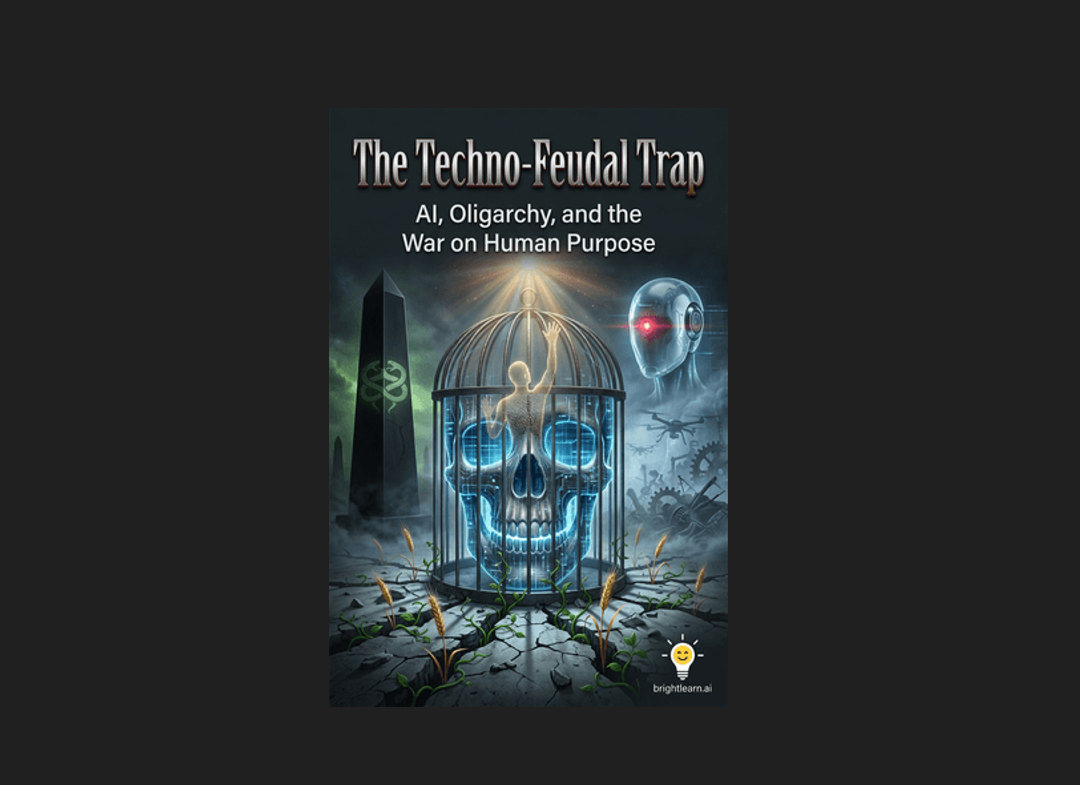
In "The Techno-Feudal Trap," the authors deliver a gut-punch of reality: eleven companies control nearly everything on those shelves. Not eleven hundred. Eleven. Nestlé, PepsiCo, Coca-Cola and a handful of others have mastered what's called "brand proliferation." They create dozens of labels that look like competitors—Froot Loops next to Cheerios—but both are owned by the same corporate monster. You're not choosing between businesses. You're choosing between different masks.
The book traces how this concentration of power wasn't an accident. It was engineered. The Sherman Antitrust Act of 1890 was supposed to break up monopolies. For a time, it worked. Standard Oil was broken up into 34 companies. Then came the 1970s and a legal philosophy called the "consumer welfare standard" gutted enforcement. Suddenly, as long as a monopoly didn't raise prices that day, regulators looked the other way. They ignored the crushed competitors, the stolen innovation, the corrupted politics.
The authors brilliantly explain how this created what they call "techno-feudalism." In old feudalism, you were a serf tied to the land. In techno-feudalism, you're a user tied to a platform. You pay tribute with your attention, your data, your money. Small businesses pay a 30% tax to app stores. Drivers pay commissions to Uber. Sellers pay fees to Amazon. The platform owners don't produce value—they extract it. They're the new lords and we're the digital serfs.
The health-industrial complex: They profit when you suffer
The book pulls no punches: Big Pharma's business model depends on you being sick, not getting well. A one-time cure is a financial disaster for companies that rely on repeat prescriptions.
The authors walk us through the mechanics of this corruption. "Disease mongering" turns normal human experiences into medical conditions. Fidgety legs become "Restless Leg Syndrome." Shyness becomes "Social Anxiety Disorder." Suddenly, millions of healthy people become lifetime customers.
Then there's the "patent cliff" strategy. When a drug's patent is about to expire, companies don't create new medicines. They make tiny changes—switch from capsule to tablet, change the dosage—and get a fresh patent. Same drug, new monopoly, continued high prices.
But the most chilling section covers the suppression of natural medicine. The book documents how compounds like curcumin from turmeric and sulforaphane from broccoli sprouts have powerful anti-cancer properties. Peer-reviewed studies show they can shrink tumors, boost detoxification and activate the body's own defense systems. Yet doctors rarely mention them. Why? You can't patent a spice. The FDA has actively harassed supplement companies for telling the truth about natural remedies.
The authors connect this to the Ozempic boom—a perfect case study of profiting from a self-inflicted crisis. These weight loss drugs treat symptoms, not causes. They create lifetime dependency. And when patients stop, they regain the weight with interest. It's not medicine; it's a subscription model for human misery.
The transhumanist nightmare: AI, surveillance and the end of privacy
The book argues that a tiny group of billionaires—Musk, Altman, Bezos—share a common belief: humans are obsolete. They're building a future where machines replace workers, surveillance tracks every move and digital IDs control access to basic necessities.
The drone war in Gaza isn't just a foreign policy issue; it's a laboratory for domestic control. The same predictive algorithms that identify "militants" overseas are being used to identify "protesters" at home. The same caloric control policies used to ration food in occupied territories are being studied for global application through digital food stamps and Central Bank Digital Currencies (CBDCs).
CBDCs get a devastating treatment. The authors explain how CBDCs aren't just digital cash—they're programmable money that can expire, lose value through negative interest rates or be restricted to specific purchases. Imagine waking up to find your savings can only be spent at government-approved stores. That's not freedom. That's a leash.
The mirror test: Why you're the hero you've been waiting for
Here's where the book transcends critique and becomes a call to arms. The final chapters offer a way out—not through waiting for politicians or billionaires to save us, but through what the authors call "building resilient communities."
Start with food. Grow your own. Learn to preserve it. Form a tool library with neighbors. Use local currencies that keep wealth circulating in your community instead of leaking to Amazon. Develop practical skills: first aid, gardening, basic repairs. Build a barter network.
The book's most powerful insight is the "mirror test." Look at yourself and ask: Are you living your values? Are you becoming the person you could be? The techno-feudal trap works because good people stay silent. The hero isn't a caped crusader—it's the neighbor who starts a community garden, the parent who teaches their kids real history, the person who speaks truth when everyone else is quiet.
This isn't about preparing for the end of the world. It's about preparing for the beginning of a new one—where you're free, capable and connected to what truly matters.
"The Techno-Feudal Trap" is essential reading for anyone who senses something has gone terribly wrong but can't quite name it. It's angry without being hysterical, detailed without being academic and hopeful without being naive. The authors have done what great journalism should: they've given us the tools to see the trap, understand how it works and find the exit. Read it. Then give it to someone you love. Then start planting your garden.
Grab a copy of "The Techno-Feudal Trap: AI, Oligarchy, and the War on Human Purpose" via this link. Read, share and download thousands of books for free at Books.BrightLearn.AI. You can also create your own books for free at BrightLearn.AI.
Watch Mike Adams' interview with Chris Helali about rigged markets, AI control and the end of free society.
This video is from the Health Ranger Report channel on Brighteon.com.
Sources include:











Please contact us for more information.