


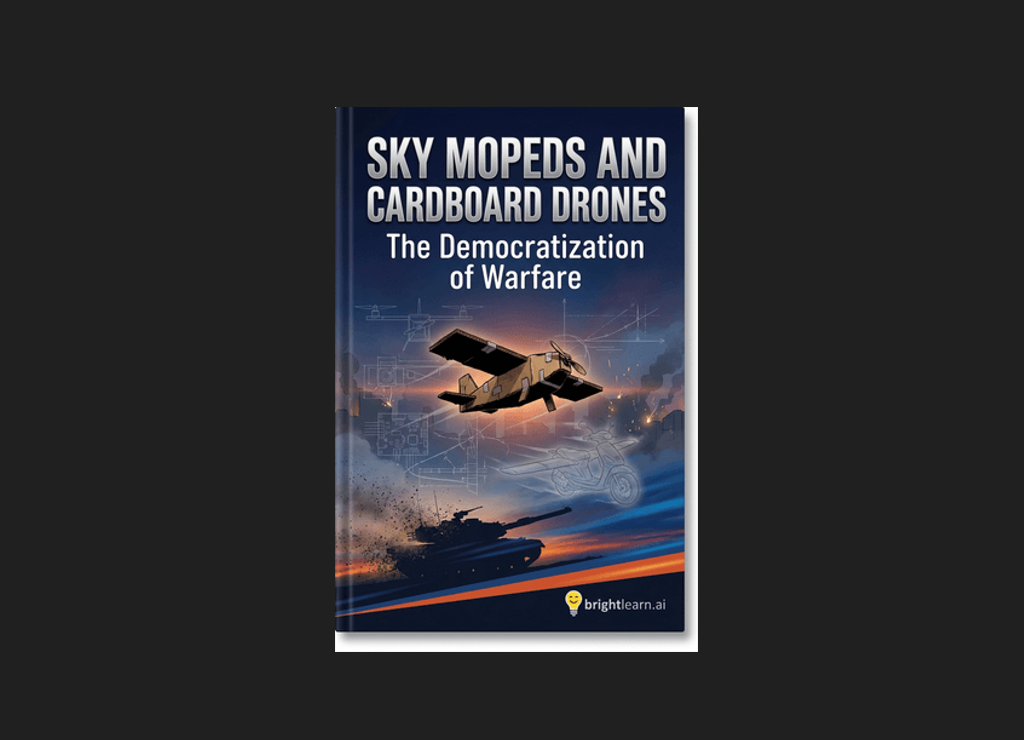
- "Sky Mopeds and Cardboard Drones: The Democratization of Warfare" points out that the $500 hobbyist drone has rendered the $4 million tank obsolete, with a cost-exchange ratio of 1:8,000 – proving that cheap, democratized aerial technology can now defeat the armored might of traditional superpowers, as demonstrated in Ukraine.
- The United States faces a critical national security crisis because its drone manufacturers are dependent on Chinese motors, batteries and cameras due to a collapsed domestic supply chain, and the bureaucratic paperwork burden stifles innovation.
- To restore American sovereignty and capacity, the U.S. must establish a $5 billion investment fund modeled on the CHIPS Act for batteries, AI, and manufacturing, rebuild domestic mining of critical minerals, and streamline compliance costs for small manufacturers.
- Iran’s "affordable mass" strategy with cheap Shahed-136 drones, or "sky mopeds," has proven that swarms can overwhelm any defense, leading Russia to produce its own versions, with the next phase being autonomous AI-coordinated swarms that threaten human control.
- The choice is stark: continue accepting dependency on adversarial foreign supply chains or rebuild a domestic industrial base with the urgency of World War II, as the democratization of warfare now threatens fundamental rights to self-defense and societal liberty.
The book "Sky Mopeds and Cardboard Drones: The Democratization of Warfare" begins by acknowledging a stark reality: The $500 weapon has killed the $4 million king. This is not hyperbole.
It is the new arithmetic of warfare, where a hobbyist quadcopter purchased at an electronics store can destroy a T-90 main battle tank. The democratization of flight has shattered the state monopoly on aerial power that defined warfare for a century. Its implications extend far beyond the battlefield into the very structure of our society, our economy and our personal liberty.
Consider the simple math that has rewritten military doctrine. A single First-Person View drone, built from hobby parts for about$500, flies into a Russian tank costing $400. The drone's warhead punches through the thin top armor – the Achilles' heel that tank designers never expected to be exploited from above.
This is happening hundreds of times in Ukraine. The cost-exchange ratio of 1:8,000 means a poor country with a garage full of hobby drones can now threaten the armored might of a superpower. The tank, once the king of the battlefield, is now a hunted animal.
How dependence on China became a national security crisis
But the real story is not just about drones: It is about who controls the means to build them. The United States has allowed its industrial backbone to migrate east, and the consequences are now a matter of national security.
America's drone makers – scrappy startups like Skydio and Teal Drones – are forced to rely on Chinese motors, batteries and cameras because the domestic supply chain simply does not exist. As a former Marine who founded Saxon Unmanned explained, every single part "has to have an origin ... like a nut or a bolt." That paperwork burden is crushing innovation.
The solution must be comprehensive:
- We need a $5 billion investment fund modeled on the CHIPS Act, focused on battery technology, artificial intelligence (AI) for autonomy, secure communications and advanced manufacturing.
- We must rebuild domestic capacity for critical minerals – copper, lithium and other rare earths – rather than continuing to export our raw materials to China and import finished components.
- And we must streamline the bureaucratic maze that forces small manufacturers to spend millions on compliance before they can sell a single unit to the Department of War.
This is not just about winning future wars. It is about protecting the fundamental right to self-defense.
The same technology that allows a farmer in Iowa to check his cattle enables a community to monitor its borders and a search-and-rescue team to find a lost hiker in the dark. A thermal camera on a $500 drone can do what once required a $50,000 helicopter search. This is the positive face of democratization: putting powerful, life-saving tools into the hands of local communities.
Build American drones now or be ruled by foreign AI
The threat, however, is real and immediate. Iran's strategy of "affordable mass" with Shahed-136 drones, the "sky mopeds" that cost a few thousand dollars each, has shown that a swarm of cheap drones can overwhelm any defense. Russia is now producing its own versions.
The next phase will involve autonomous drone swarms coordinated by AI, capable of strategic attacks without human intervention. The United States must act now, not with more bureaucracy, but with a focused effort to build American drone manufacturing capacity and equip every Marine squad with backpack-sized counter-drone systems.
The choice is stark. We can continue to accept dependency on foreign supply chains controlled by adversaries, or we can rebuild our industrial base with the same urgency that built the aluminum industry in two years during World War II. The time for dithering is over.
The sky moped and the cardboard drone have arrived, and they are changing everything. The question is whether we will be the ones flying them, or the ones watching them fly overhead.
Grab a copy of "Sky Mopeds and Cardboard Drones: The Democratization of Warfare" via this link. Discover this book and other good reads at Books.BrightLearn.AI, with thousands of books and counting – all available to freely download, read and share. The decentralized BrightLearn.AI engine also lets readers create their own books, empowering them to share insights and truths with the world.
Watch John Ferguson discussing affordable military drones and the future of warfare in this edition of the "Health Ranger Report."
This video is from the Health Ranger Report channel on Brighteon.com.
Sources include:











Please contact us for more information.