


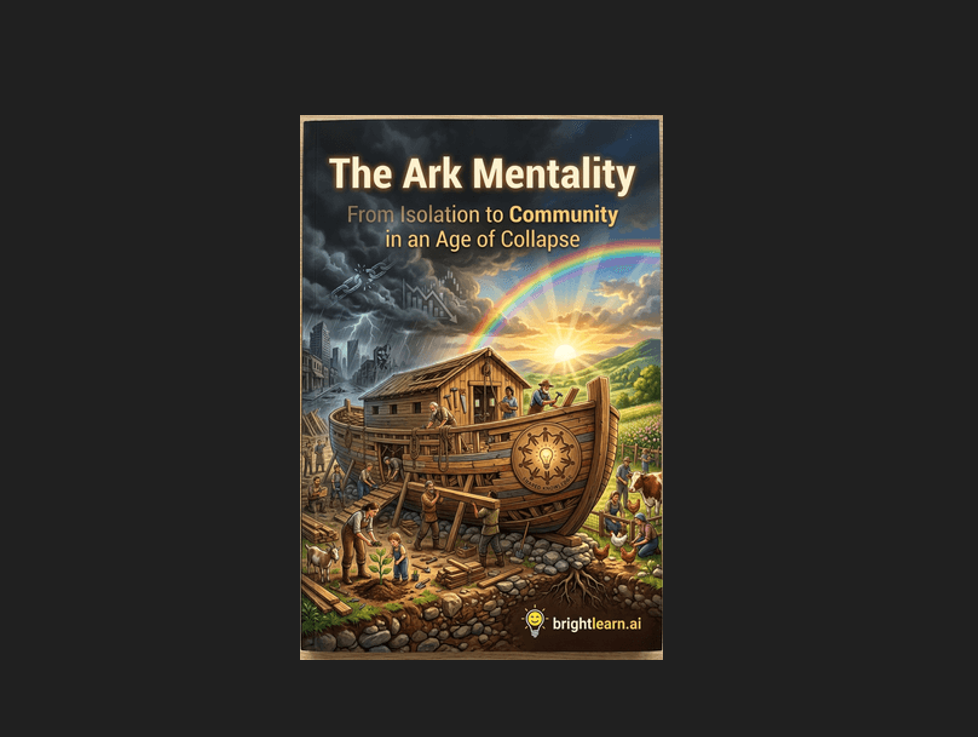
- The book "The Ark Mentality: From Isolation to Community in an Age of Collapse" notes that true preparedness requires moving beyond the "stuff trap" of stockpiling supplies toward building capacity – skills like gardening, preservation and repair – rather than just inventory, as inventory is worthless without trustworthy people and the ability to produce what is needed.
- Lone wolf survivalism has historically failed, as isolation leads to psychological damage from loneliness and makes prepared homes targets for theft or demands from neighbors. A large garden, solar panels and livestock cannot be hidden effectively.
- Building a resilient community involves connecting with a dozen or two families who share core values like freedom, self-reliance, personal liberty, rejection of centralized authority, natural medicine, honest money like gold and silver and prioritizing family and community over the state.
- A mutual aid chapter is a decentralized, voluntary group of neighbors helping each other through daily needs and emergencies, using community work parties to accomplish tasks quickly while weaving social bonds through shared effort, meals and small challenges.
- The most critical asset is social capital – trust built by showing up, helping neighbors and sharing resources before disaster strikes – which becomes a more reliable currency than government-issued money when systems break down.
As the book "The Ark Mentality: From Isolation to Community in an Age of Collapse" notes, the journey toward genuine preparedness begins not with stockpiling supplies, but with an honest assessment of one's capabilities and limitations.
As "Man in America" podcast host Seth Holehouse discovered during his time in rural Ohio, having years of food stored, a diesel tractor, chickens and ammunition meant little when surrounded by neighbors who thought he was simply the crazy prepper down the road. He sat on his back deck mentally calculating sniper positions to defend his property, and his wife realized they had gone too far down a dark path.
That was the moment he understood: The supplies were worthless without people you could trust. The concept of the "stuff trap" seduces many into believing that owning a generator means being prepared for a power outage. But a generator without maintenance knowledge is just an expensive paperweight.
Real preparedness requires distinguishing between inventory and capacity. Inventory is what is stored in the basement, while capacity is the ability to produce or repair what is needed. A prepper with a year's worth of canned food has inventory – but a homesteader who knows how to grow a garden, raise chickens and preserve the harvest has capacity.
Why the "lone wolf" survivalist myth dooms you to failure
History is full of examples of the lone wolf survivalist who failed. Men who built remote cabins stocked with guns and canned goods – only to die from a simple infection, a broken leg, or the crushing loneliness that drives a person mad.
Studies on solitary confinement in prisons show that it leads to severe psychological damage: depression, anxiety, paranoia and decision fatigue. As author Thomas Moore wrote in "Dark Nights of the Soul," the soul needs connection to thrive. Without it, people wither.
The danger of being the only prepared person in a community cannot be overstated. When the shelves are empty and the stores are closed, neighbors' requests become demands. A prepared home becomes a target for theft, or worse.
No matter how careful one is with operational security, a large garden is visible from the road, solar panels are on the roof and livestock make noise and smell. The solution is not to hide better, but to bring others into preparedness.
Building a resilient community starts with finding the right people. The goal is to connect with a dozen or two families who share core values of freedom, self-reliance and personal responsibility.
Places like local farmers markets, gun clubs, churches and homesteading groups are where potential allies gather. Shared values are the glue that holds a resilient group together. It requires worldview alignment on deeper issues: the importance of personal liberty, the rejection of centralized authority, the belief in natural medicine over pharmaceutical drugs, the commitment to honest money like gold and silver and the conviction that family and community come before the state.
Your most important prepper tool? The neighbor you trust
A mutual aid chapter is simply a group of neighbors who decide to help each other. It is decentralized and voluntary, built on reciprocity and community resilience. People come together to share daily needs and prepare for emergencies.
The goal is not to hide in a bunker with a stockpile, but to build a web of support that makes the whole neighborhood stronger. As the ancient wisdom in "Vedanta for Modern Man" reminds us, we are all connected, and when we help each other, we honor that connection.
Community work parties serve two purposes at once. First, they get real work done – tasks that would take one person a weekend are completed in a few hours. Second, they weave the social fabric that makes a community strong.
When you sweat alongside a neighbor, share a meal and overcome a small challenge together, you create bonds that cash cannot buy. Simple daily practices like regular check-ins, shared meals and celebrating small successes create a rhythm of connection that keeps everyone grounded.
Ultimately, the most important asset is not the stuff, but the people who know how to use it together. A diverse group of skilled friends, neighbors and family members is worth more than stacks of cash when systems break down.
Trust is not something that can be bought at the store. It must be built before disaster strikes – by showing up, helping a neighbor fix a fence and sharing extra tomatoes.
That trust becomes a currency more reliable than any government-issued money. When the system breaks down, social capital is what keeps families safe.
Grab a copy of "The Ark Mentality: From Isolation to Community in an Age of Collapse" via this link. Discover this book and other good reads at Books.BrightLearn.AI, with thousands of books and counting – all available to freely download, read and share. The decentralized BrightLearn.AI engine also lets readers create their own books, empowering them to share insights and truths with the world.
Watch Seth Holehouse and the Health Ranger Mike Adams discussing self-reliance, community and survival skills in this edition of the "Health Ranger Report."
This video is from the Health Ranger Report channel on Brighteon.com.
Sources include:






Please contact us for more information.