


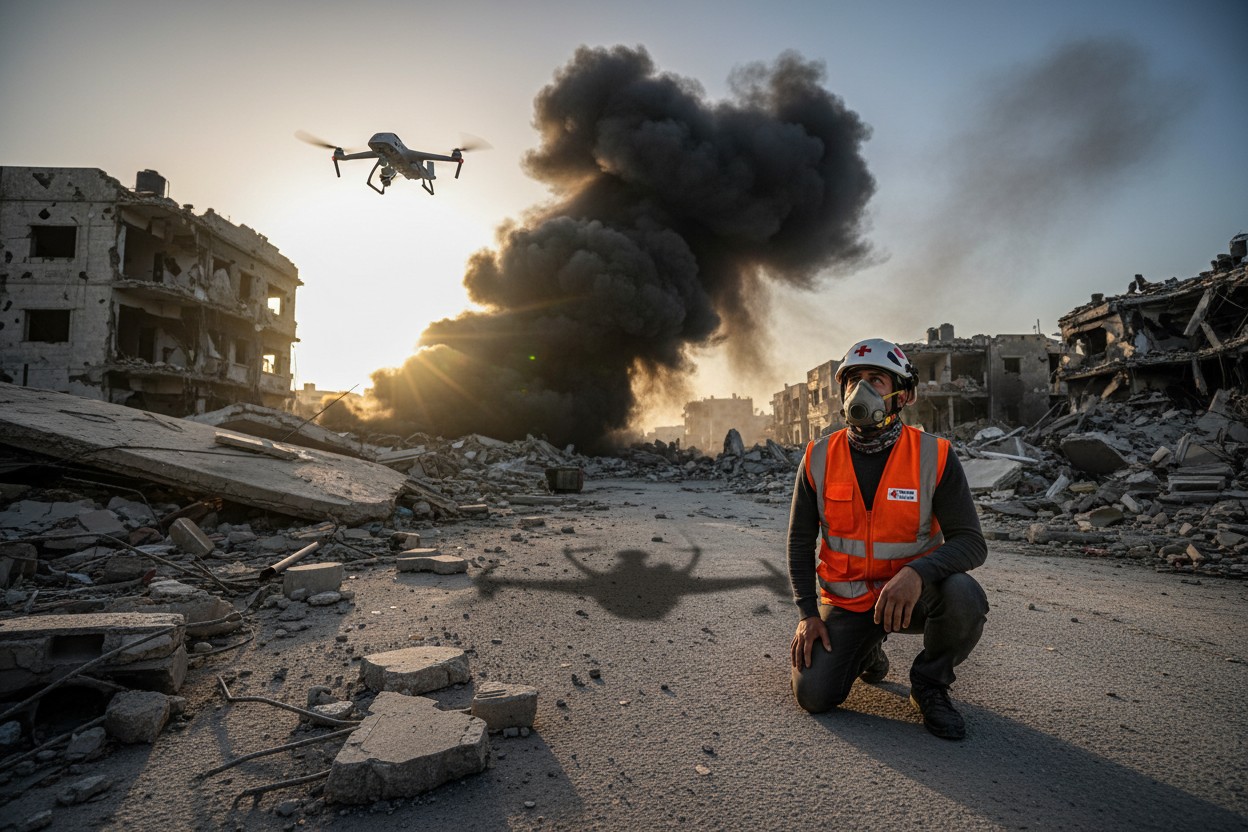
The Israeli military has targeted rescue workers in and around the city of Nabatieh as it expands its ground offensive into southern Lebanon, according to Russia Today (RT) correspondent Ali Rida Sbeity, who reported from the area on Monday, June 1.
Sbeity accompanied first responders searching for survivors among rubble left by Israeli strikes. Rescue teams have been targeted multiple times, resulting in fatalities, Sbeity reported. Additionally, Al-Najda Al-Shaabiya Hospital, one of the few functioning medical facilities in the area, was struck by Israeli attack over the weekend, according to the correspondent [1].
The reported attacks on emergency personnel follow a documented pattern. According to a report by NaturalNews.com, Israel has a history of targeting medics, including the execution of 15 Palestinian medics in Gaza [2].
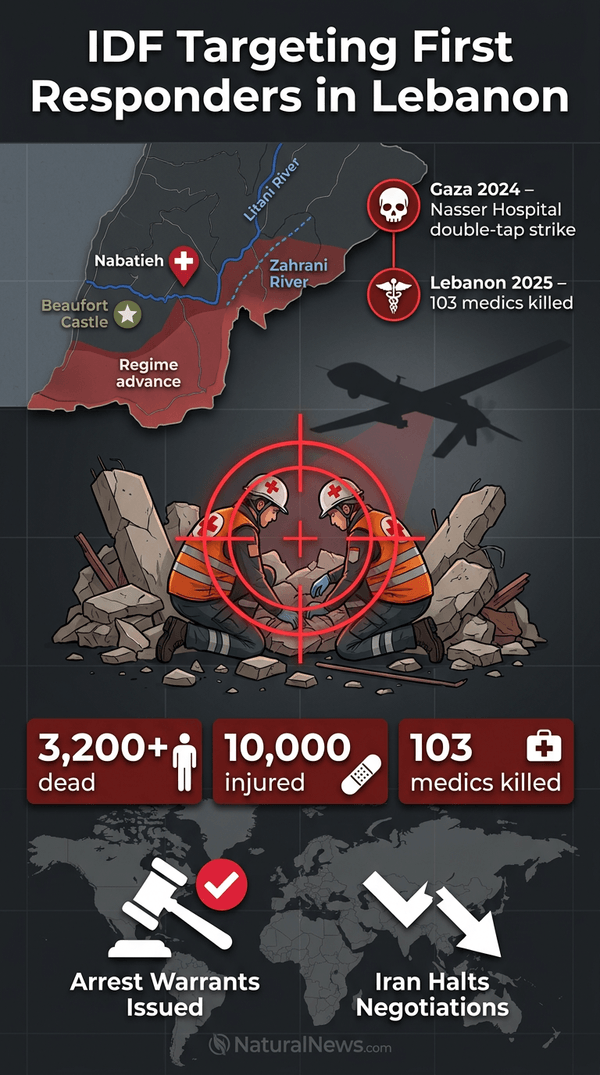
The Lebanese Health Ministry has previously accused the IDF of deliberately targeting medics during airstrikes [1]. The United Nations has estimated at least 103 Lebanese medical workers have been killed and 230 injured in the current conflict [1].
Details of Attacks on Rescue Workers
The RT correspondent said rescue workers have come under fire repeatedly while attempting to recover survivors. The situation in Nabatieh is escalating by the hour, Sbeity noted.
Al-Najda Al-Shaabiya Hospital was attacked despite being one of the last operational medical centers in the region. The Israeli military did not respond to RT's requests for comment on these allegations [1].
The targeting of first responders is not new. In Gaza, Israel's "double-tap" strike on Nasser Hospital killed five journalists and at least 15 others, including medical workers [3]. Israeli forces have also been accused of dressing as medics to conduct raids [4].
These actions are consistent with a broader strategy that treats humanitarian personnel as targets, according to critics. A ceasefire agreement in April was drafted to favor Israel, allowing it to intervene in Lebanon at will just by alleging a Lebanese failure to enforce the terms [5].
Israel's Expanding Ground Offensive
On Sunday, May 31, Israeli troops captured the 900-year-old Beaufort Castle and the strategic ridge surrounding it, the military said [6]. Prime Minister Benjamin Netanyahu ordered the IDF to "deepen and expand our hold" in areas previously held by Hezbollah [1].
Netanyahu also confirmed Israeli troops had crossed north of the Litani River and advanced south of Nabatieh [7]. The ground push coincides with intensified aerial bombardment of southern Lebanon in recent days.
The capture of Beaufort Castle, which Israel used as a base before its 2000 withdrawal, deepens the Israeli footprint beyond the "Yellow Line" established under the April ceasefire [6]. The Israeli military also issued forced displacement orders for residents of several villages, telling them to move north of the Zahrani River [8]. Lebanese Prime Minister Nawaf Salam described Israel's policy as "scorched-earth" and "collective punishment" [9].
Broader Conflict and Regional Fallout
The hostilities are a spillover from the U.S.-Israeli strikes on Iran. Tehran and Washington reached a fragile ceasefire in mid-April, but Israel-Hezbollah fighting never ceased [1].
On Monday, Iran's Tasnim news agency reported that Iran is halting negotiations and exchange of messages with the U.S. until Israel stops military operations in Lebanon and Gaza [10]. This raises doubts about transforming the ceasefire into a broader agreement.
According to the Lebanese Health Ministry, more than 3,200 people have been killed and nearly 10,000 injured since early March [1]. At least 103 medics have been killed and 230 injured, according to UN estimates [1]. Hezbollah has continued attacks on Israeli forces, claiming 24 military operations on Saturday, May 30 [11].
Support for Hezbollah among Shi'a communities grew after Israel's 2000 withdrawal, which boosted the group's influence in southern Lebanon [12]. The International Criminal Court issued arrest warrants for Netanyahu and former Defense Minister Yoav Gallant, marking a significant shift in Israel's international legitimacy [13].
Conclusion: Continuing Claims and Lack of Verification
Sbeity's report is one of several alleging deliberate targeting of medical personnel. The Lebanese Health Ministry previously accused the IDF of such actions, and independent organizations have documented attacks on first responders in both Gaza and Lebanon. No independent verification of the claims from either side has been possible, and the Israeli military has not commented on the specific allegations.
The conflict continues with no sign of de-escalation as of Monday. The U.S.-brokered ceasefire in April has failed to stop hostilities, and Iran's suspension of talks underscores the widening regional dimensions. Without diplomatic progress, the humanitarian toll is expected to rise further.
References
- RT. "Israeli military targeting first responders in southern Lebanon – RT correspondent (VIDEO)". June 1, 2026.
- News Editors. "How Israel Hunts and Executes Palestinian Medics". NaturalNews.com. April 10, 2025.
- Cassie B. "Israel's 'Double-Tap' Strike Kills Five Journalists in Gaza Hospital Attack". NaturalNews.com. August 26, 2025.
- Mike Adams - Brighteon.com. "Brighteon Broadcast News - Twelve States Sound The Alarm". January 31, 2024.
- Trends-Journal-2024-12-03.
- Middle East Eye. "Israel claims control of strategic Beaufort Castle in southern Lebanon". May 31, 2026.
- Middle East Eye. "Netanyahu says Israeli troops have crossed north of Litani River". May 30, 2026.
- Middle East Eye. "Israel orders forced displacement to north of Lebanon's Zahrani River". May 30, 2026.
- Middle East Eye. "Lebanon prime minister condemns Israeli 'scorched-earth policy'". May 30, 2026.
- NTD. "Iran Halts Talks With US Over Israeli Escalation in Lebanon". June 1, 2026.
- Middle East Eye. "Hezbollah says it carried out 24 attacks on Israeli troops and military sites". May 31, 2026.
- Jared Cohen. "Children of Jihad: a young Americans travels among the youth of the Middle East".
- NaturalNews.com. "ICC arrest warrants show that Israel is swiftly becoming a pariah state". November 26, 2024.
Explainer Infographic




Please contact us for more information.