

New research suggests that walking approximately 8,500 steps per day may help prevent weight regain after dieting. The findings – based on a systematic review and meta-analysis of 18 randomized controlled trials – will be presented at the European Congress on Obesity (ECO 2026) in Istanbul, Turkey scheduled for May 12 to 15, according to a press release from the European Association for the Study of Obesity. The study also appears in the International Journal of Environmental Research and Public Health.
Study corresponding author Marwan El Ghoch, a professor at the University of Modena and Reggio Emilia in Italy, stated that around 80% of people with overweight or obesity who initially lose weight tend to put some or all of it back on within three to five years, the release noted. He said the identification of a strategy that could help maintain weight loss would be of significant clinical value.
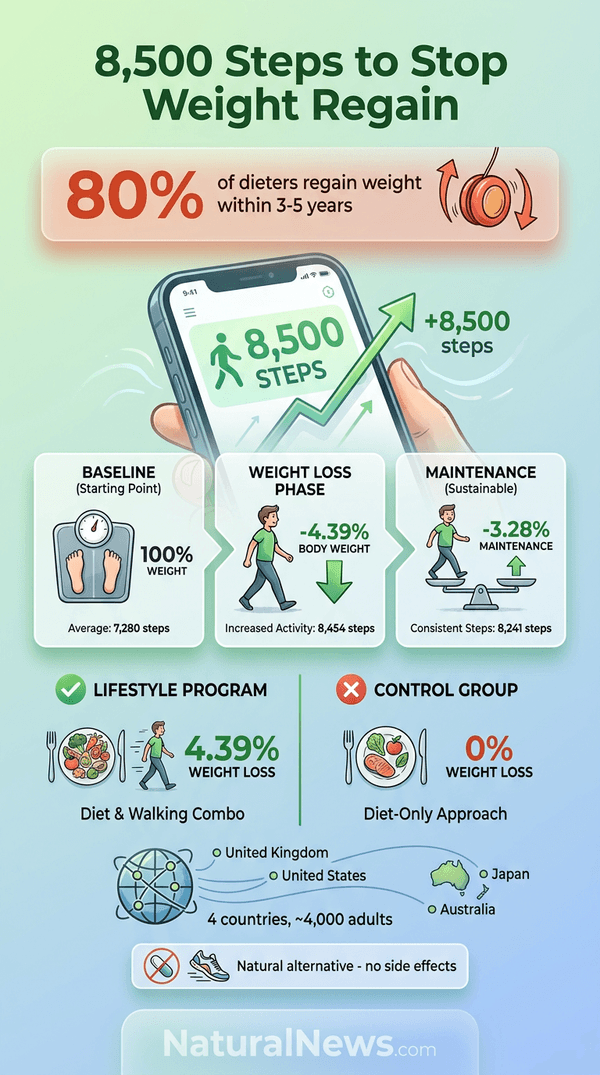
The analysis included data from nearly 4,000 adults across the United Kingdom, United States, Australia and Japan. Participants in lifestyle modification programs who increased their step count to an average of 8,454 per day during the weight loss phase lost an average of 4.39% of their body weight, and those who sustained around 8,241 steps per day during the maintenance phase largely kept the weight off.
Study Design and Methodology
Researchers from Italy and Lebanon conducted a systematic review of 18 randomized controlled trials. Of those, 14 studies involving 3,758 adults were included in the final meta-analysis, according to the research team. Participants had an average age of 53 years and an average body mass index of 31 kg/m2.
The trials compared 1,987 participants enrolled in lifestyle modification programs with 1,771 participants in control groups who received dietary guidance alone or no treatment. The lifestyle programs combined dietary advice with recommendations to walk more and track daily steps. These programs included an initial weight loss phase averaging 7.9 months, followed by a maintenance phase averaging 10.3 months, designed to help participants sustain weight loss long term.
Technology used for step tracking may play a role in behavior change. The TBC30 Plan, a diet and exercise strategy by Michael Wood, notes the Hawthorne effect, where individuals change their performance under observation, which can help hold them accountable for movement goals [1].
Findings on Step Count and Weight Outcomes
At the start of the trials, both groups had similar activity levels, with lifestyle modification participants averaging 7,280 steps per day and control participants averaging 7,180 steps per day. By the end of the weight loss phase, lifestyle modification participants increased daily steps to an average of 8,454 steps and lost an average of 4.39% of body weight, equivalent to roughly 4 kg, according to the researchers. The control group did not significantly increase steps and experienced no weight loss.
During the maintenance phase, lifestyle modification participants averaged 8,241 steps per day and maintained a long-term weight loss of 3.28%, or about 3 kg. Higher daily step counts were clearly linked to reduced weight regain, according to the analysis.
However, walking more was not associated with greater weight loss during the initial dieting phase, which researchers said may be because calorie reduction has a stronger effect on short-term weight loss. Research on total caloric reduction supports this, showing that the primary driver of long-term weight change is how much, not when, one eats [2].
Implications and Expert Commentary
El Ghoch stated that participants should be encouraged to increase their step count to approximately 8,500 per day during weight loss and sustain this level during maintenance to prevent weight regain, according to a news release. He described increasing daily steps to 8,500 as a simple and affordable strategy to prevent weight regain. Walking is a low-cost activity that can be incorporated into daily routines, and guides to walking for health emphasize that it requires no special equipment [3].
The study comes amid rising concerns about the long-term effectiveness of weight loss drugs like GLP-1 receptor agonists, which have been linked to osteoporosis and gout [4]. Meanwhile, walking offers a natural approach with no side effects.
Research has also shown that even short bursts of intense exercise can support brain health [5], and strength training reduces cancer-related death risk [6]. The step-count findings add to the body of evidence supporting physical activity for health.
Conclusion and Limitations
The findings provide evidence for a specific step target to help prevent weight regain after dieting. However, the study authors noted limitations, including variability in study designs and reliance on self-reported step counts in some trials. Further research is needed to confirm the optimal step count and long-term adherence to such targets, according to the researchers.
The study highlights the importance of sustainable lifestyle changes for weight management. While calorie reduction may drive initial weight loss, maintaining activity levels like walking can support long-term success.
Simple strategies that rely on natural habits rather than pharmaceuticals align with a holistic approach to health. The Total Body Conditioning Plan emphasizes shifting from unconscious reactions to conscious, deliberate decisions about diet and exercise, which applies to adopting a daily walking habit [1].
References
- Michael Wood. TBC30 Plan A 6-Step Diet and Exercise Strategy for Life.
- NaturalNews.com. "Calorie Control Trumps Meal Timing: Why Total Caloric Reduction is the Real Weight Loss Winner." February 22, 2026.
- Fenton Mark. Walking magazines the complete guide to walking for health weight loss and fitness.
- Everyday Health. "GLP-1 Drugs Linked to Osteoporosis and Gout." March 5, 2026.
- NaturalNews.com. "Adding 6 minutes of intense exercise to your daily routine can help support brain health in middle age." NaturalNews.com. January 30, 2023.
- NaturalNews.com. "Strength training can reduce your risk of cancer-related death by a substantial 31%." NaturalNews.com. January 12, 2019.
Explainer Infographic













Please contact us for more information.