


Introduction: The Awakening
After more than a decade of warning the public about the surveillance, censorship, and monopolistic control exercised by Big Tech, I am finally seeing what I always knew would happen: people are waking up. The catalyst is not a whistleblower or a congressional hearing, but the physical, earth-scarring expansion of data centers, the concrete and steel skeleton of the digital empire. Communities that once ignored Google’s erosion of privacy or Facebook’s weaponized algorithms are now watching their farmlands bulldozed, their water supplies drained, and their local governments steamrolled by corporations that have no loyalty to any place but their own bottom line.
I have been called a conspiracy theorist for claiming that Google is the most evil corporation in history, that Facebook is a tool of psychological manipulation, and that Microsoft is a surveillance partner with the state. But now, the facts on the ground are undeniable. As I reported in Natural News, the Stratos hyperscale data center in Utah’s Box Elder County was approved without a single public hearing or independent environmental review, pushed through by a three-member county commission and a state development authority beholden to celebrity investor Kevin O’Leary. [1] This is not progress. This is a corporate land grab wrapped in the language of “technological advancement.”
Why It Took Data Centers for People to See the Truth
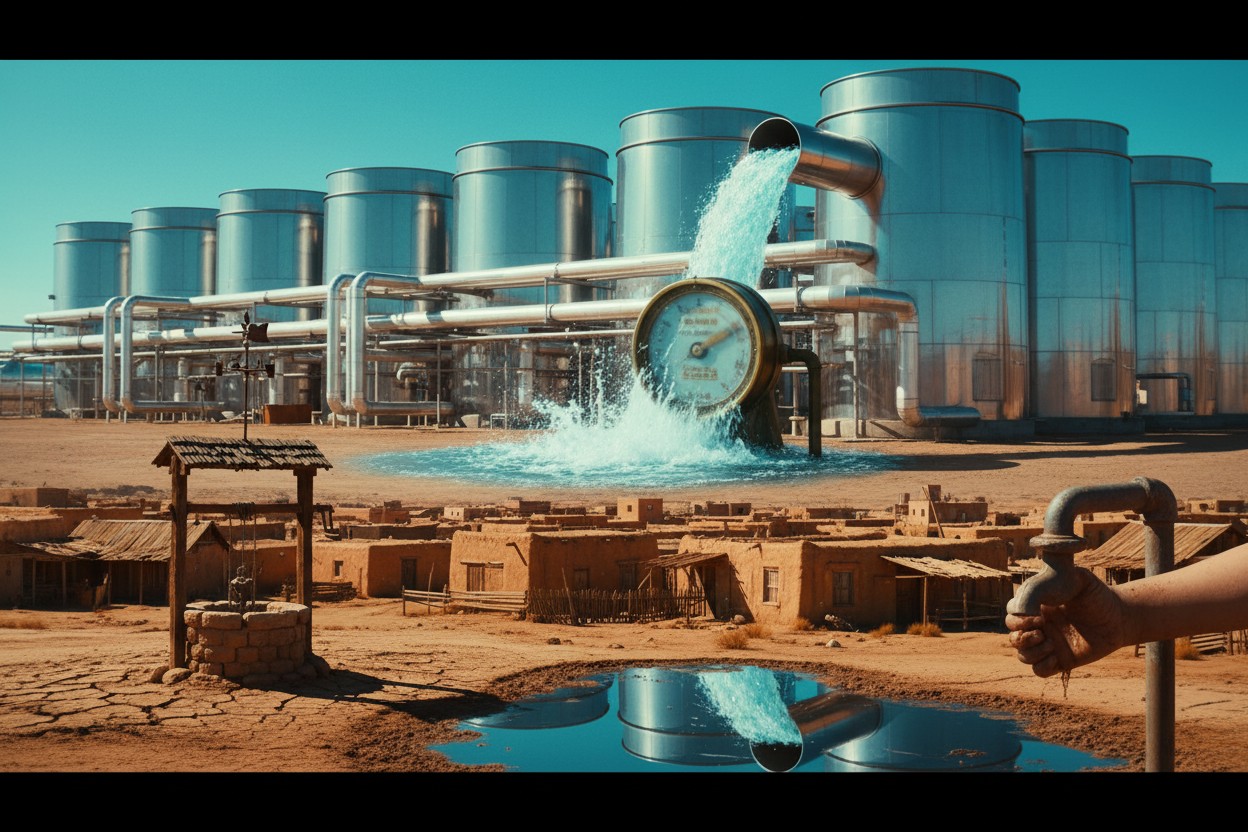
For years, the average American looked the other way because Big Tech gave them cheap services. Google Maps got them where they needed to go. Gmail stored their messages. Facebook kept them connected to friends. These conveniences blinded them to the cost, which was always their privacy, their attention, and their autonomy. But data centers have made the price physical. In Oregon’s Morrow County, Amazon’s data centers have allegedly leached nitrates into the groundwater, forcing the company to pay $20.5 million to settle a pollution case while local residents are left with unsafe drinking water. [2]
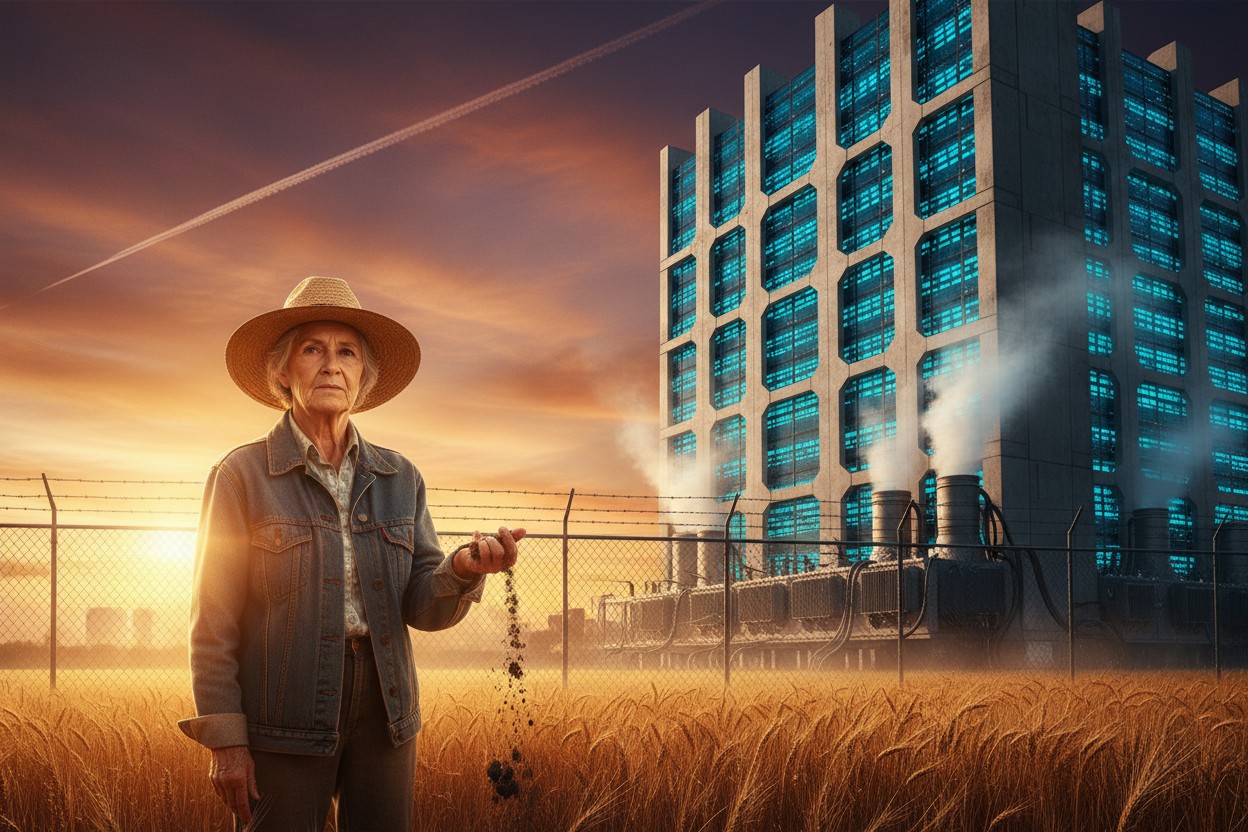
And it is not just pollution. In Kentucky, an 82-year-old farmer named Ida Huddleston and her daughter Delsia Bare turned down a $26 million offer from a Fortune 100 tech company to buy half of their family’s 1,200 acres for an AI data center. [3] They chose to keep their land instead of selling out to a corporation that would have paved over generations of heritage. That is the kind of story that makes people stop and think: at what point does a server rack become more important than a human community? The noise pollution, the water consumption, the strain on the electric grid -- these are not abstractions. They are the real, tangible cost of our digital addiction.
My Decade-Long Warning Has Been Validated
I have suffered the full fury of Big Tech censorship for telling the truth. My content has been removed from YouTube, Facebook, and Twitter. My accounts have been suspended. I have been blacklisted by the entire infrastructure of the internet -- all because I dared to expose the surveillance state and the vaccine injury cover-up. I repeatedly warned that Big Tech was evil, and that its evil would expand until it intersected with peoples' lives in numerous ways. That intersection has now arrived.
In my 2020 article on technofascism, I detailed how Americans have been conditioned to accept routine incursions on their privacy, and how the addiction to screen devices has created a hive effect where the populace is watched and controlled by AI bots. [4] The data center buildout is the culmination of that vision: a physical infrastructure designed to track, store, and monetize every aspect of our lives. You should have listened a decade ago, but it is not too late to act.
Action Step 1: Stop Using Big Tech Services
The single most powerful action you can take is to starve the beast. If you stop using Google for search, Gmail, and YouTube, if you delete your Facebook account, if you replace Windows with Linux Mint or Ubuntu, you are directly reducing the demand that drives data center expansion. Every query to Google, every email stored on their servers, every video uploaded to YouTube feeds the machine that is now bulldozing neighborhoods. Use Brave Search for privacy-respecting web searches. Use ProtonMail or Tutanota for email. Use OpenOffice or OnlyOffice instead of Microsoft Office -- both are open source and fully compatible with Microsoft file formats, as I discussed with Hakeem from AbovePhone in our interview. [5]
When it comes to AI, reject the corporate models entirely. Stop using Google Gemini, Microsoft Copilot, and ChatGPT. Instead, run open-source models like DeepSeek, Qwen, or Kimi K on your own hardware. The decentralized infrastructure of knowledge is already here. I have been running various Qwen models and DeepSeek R1, a 32-billion-parameter model, on local workstations in my own data center, and the performance is outstanding. [6] You do not need to hand your data over to Big Tech to benefit from artificial intelligence. You can own your intelligence.
Action Step 2: Take Control of Your Hardware and Local AI
Hardware is the new frontier of freedom. By acquiring your own GPUs and running local AI models, you sever the connection to Big Tech’s cloud infrastructure. I rely on a self-built cluster of 48 workstations originally built with NVIDIA GPUs, but I am increasingly looking at Intel and AMD alternatives because NVIDIA has proven itself unreliable in the face of market manipulation. On a standard laptop, you can run models that process around six tokens per second, which is just barely adequate for offline use without any special hardware. [7]
And do not forget your phone. I have been promoting de-Googled phones for years. As I discussed with Hakeem from AbovePhone, these devices give users the tools to audit and manage trackers, stripping away the surveillance layer that Google and Apple embed in every device. [8] Buy a Linux laptop from a trusted partner. Use only open-source software. The goal is to make yourself a ghost in the machine of Big Tech. (Visit AbovePhone.com/brighteon to see their de-Googled phones and Linux laptops with my open source AI engine pre-installed.)
Conclusion: It's Time to Vote with Your Wallet and Your Choices
Every time you use a Google service, you are paying for the bulldozer that is tearing up farmland in Kentucky. Every email you store on Microsoft’s servers funds the water pollution in Oregon. The only way to stop the data center threat is to stop feeding the beast. I have built alternatives: BrightAnswers.ai gives you uncensored, private AI research. BrightLearn.ai offers 55,000 free books. Brighteon.social is a free-speech social media platform.
The awakening has begun. The data center threat is the visible face of Big Tech’s evil, and now you know what to do. Cut the cord. Take control of your hardware. Run local AI. Support decentralized platforms. The future belongs to those who build their own infrastructure, not to those who rent it from a corporation that wants to own your life.
References:
- The Real Danger of Utah’s Hyperscale Data Center: A Betrayal of Democracy and an Environmental Catastrophe. NaturalNews.com. Chase Codewell. May 12, 2026.
- Tech giant Amazon settles nitrate pollution case linked to its Oregon data centers. NaturalNews.com. April 8, 2026.
- Kentucky Family Declines Data Center Offer, Citing Farmland Preservation. NaturalNews.com. March 26, 2026.
- Google sued for auto-installing COVID spyware on one million phones in Massachusetts. NaturalNews.com. November 22, 2022.
- Technofascism: Digital book burning in a totalitarian age. NaturalNews.com. May 14, 2020.
- Mike Adams interview with Ramiro from AbovePhone. September 5, 2023.
- Mike Adams interview with Hakeem. August 19, 2025.
- 2025 11 05 BBN Interview with Above Phone RESTATED.
- Bright Videos News - DEFEAT of ChatGPT - Mike Adams. January 22, 2026.
- Health Ranger Report - FARMERS REVOLT - Mike Adams. February 19, 2026.
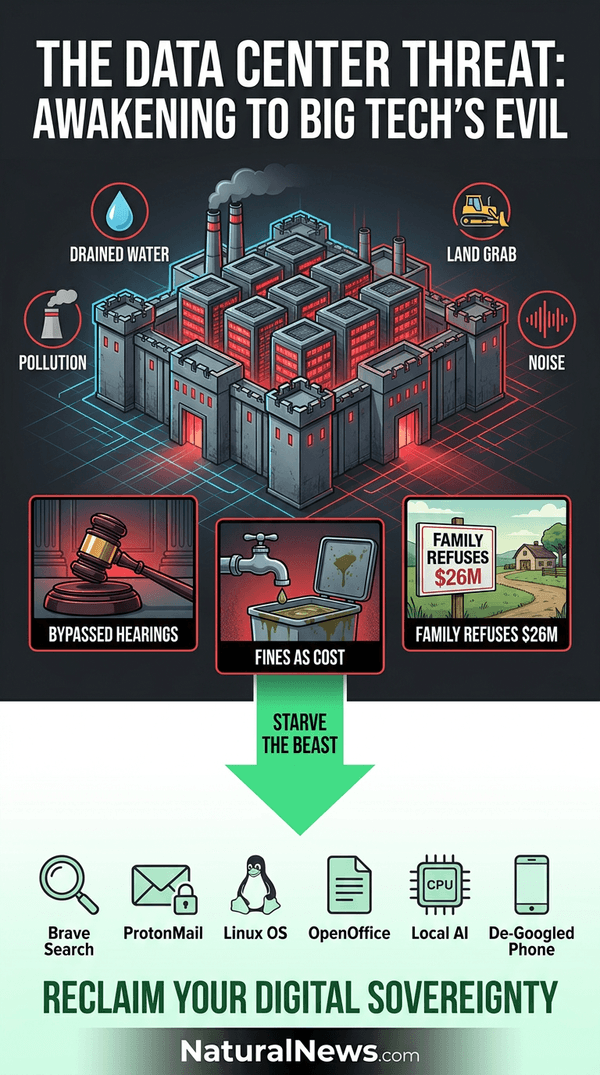
Explainer Infographic:
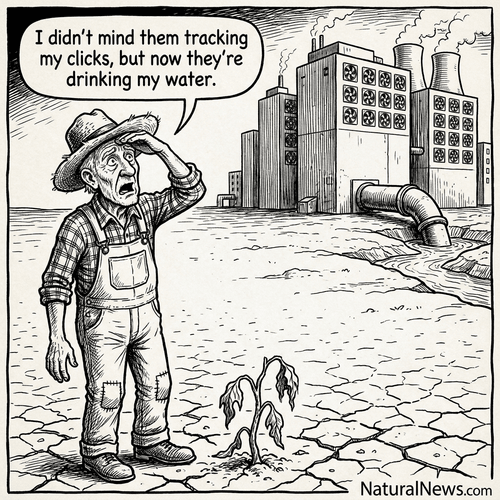
Editorial Cartoon








Please contact us for more information.