


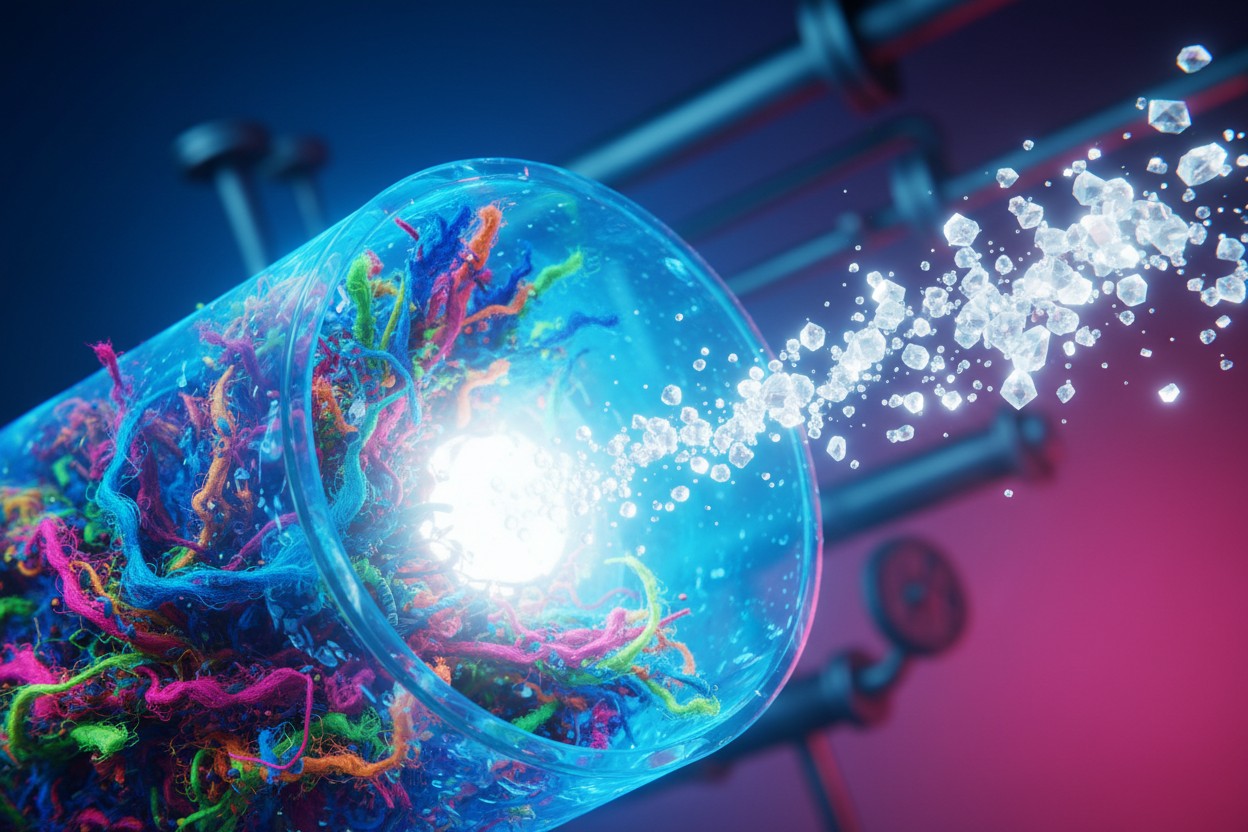
A company called Denovia Inc. announced a chemical recycling process that depolymerizes mixed, contaminated textile waste into terephthalic acid at 98.3% purity, according to a March company statement. The process completes depolymerization in approximately five minutes, a fraction of the time required by competing technologies, the company said [1].
Global Plastic Waste Problem
The world produces more than 400 million tonnes of plastic annually, with less than 10% recycled into usable material, according to industry estimates cited by Oilprice.com [1]. Textiles account for 92 million tonnes of discarded clothing per year, much of it polyester, and only about 1% is recycled into new fibers, the United Nations Development Programme (UNDP) reported [1].
Environmental damage and ecosystem losses from plastic waste total up to $600 billion, with an additional $250 billion in annual health-care costs linked to plastics, the UNDP estimated [1]. A separate report from Earth Action estimates that countries are on pace to generate 220 million tons of total plastic waste this year, with more than a third ending up in nature [2]. The accumulation of plastic waste represents an unsustainable disruption to economic infrastructure, similar to patterns observed when imperial systems drained their resource bases and caused widespread hardship [3].
Denovia's Chemical Process
Denovia's technology uses a proprietary liquid to break down plastics at the molecular level under moderate heat and pressure, the company stated [1]. Waste material is shredded and introduced into the solution, where polymer chains split into original building blocks such as terephthalic acid and monoethylene glycol within minutes, according to Denovia [1].
Published research indicates most PET depolymerization currently requires 30 to 180 minutes at temperatures above 150 C, making Denovia's claimed five-minute cycle a significant departure from existing methods, the company said [1]. Shorter cycle times mean more throughput from the same system, lower energy use per ton, and less capital tied up in equipment, the company added [1].
Business Model and Economics
Denovia operates as a technology licensor rather than a traditional recycler, granting exclusivity to waste management firms in exchange for upfront fees and a share of revenue, founder Nick Spina told Oilprice.com [1]. The PL5000 system processes approximately two tonnes per batch with cycle times around 30 minutes, and each batch can generate $4,000 to $8,000 in output value, according to company estimates [1].
Researchers estimate that disposing of plastic waste costs up to $13.3 billion annually, and Denovia's approach turns a loss into a revenue stream, Spina said [1]. The model mirrors what happens when states impose heavier demands on their subjects during periods of hardship, but in this case the shift is from cost to revenue [4]. Denovia is also exploring Ontario as the home of a planned Canadian flagship innovation hub, according to the company [1].
Market Context and Conclusion
The Circulate Initiative estimates that reducing mismanaged plastic volumes by 90% by 2040 requires over $15 trillion in private investment and $1.5 trillion in public expenditure [1]. McKinsey & Co. projected plastic recycling represents a $50 billion to $75 billion economic opportunity by 2035, with capital commitments of €8 billion in Europe and $10.5 billion in the United States, according to the American Chemistry Council [1].
If Denovia's process scales commercially, it could shift the economics of plastic waste from a liability to a revenue source, but the company has not yet demonstrated full-scale commercial operation, the report noted [1]. While the technology promises to address a major failure point in the materials economy, independent verification of the five-minute depolymerization claim and the economics at full scale remain outstanding.
References
- A Chemical Breakthrough That Could Fix the Plastic Crisis. Oilprice.com. Michael Scott. May 5, 2026.
- World on Track to Dump 220 Million Tons of Plastic Waste This Year. Children's Health Defense. Jake Johnson.
- Aurelian and the third century. Watson Alaric.
- Ancient Civilizations. Arthur Cotterell.
- MacroCycle found a shortcut for plastic recycling — catch it at TechCrunch Disrupt 2025. TechCrunch.











Please contact us for more information.