


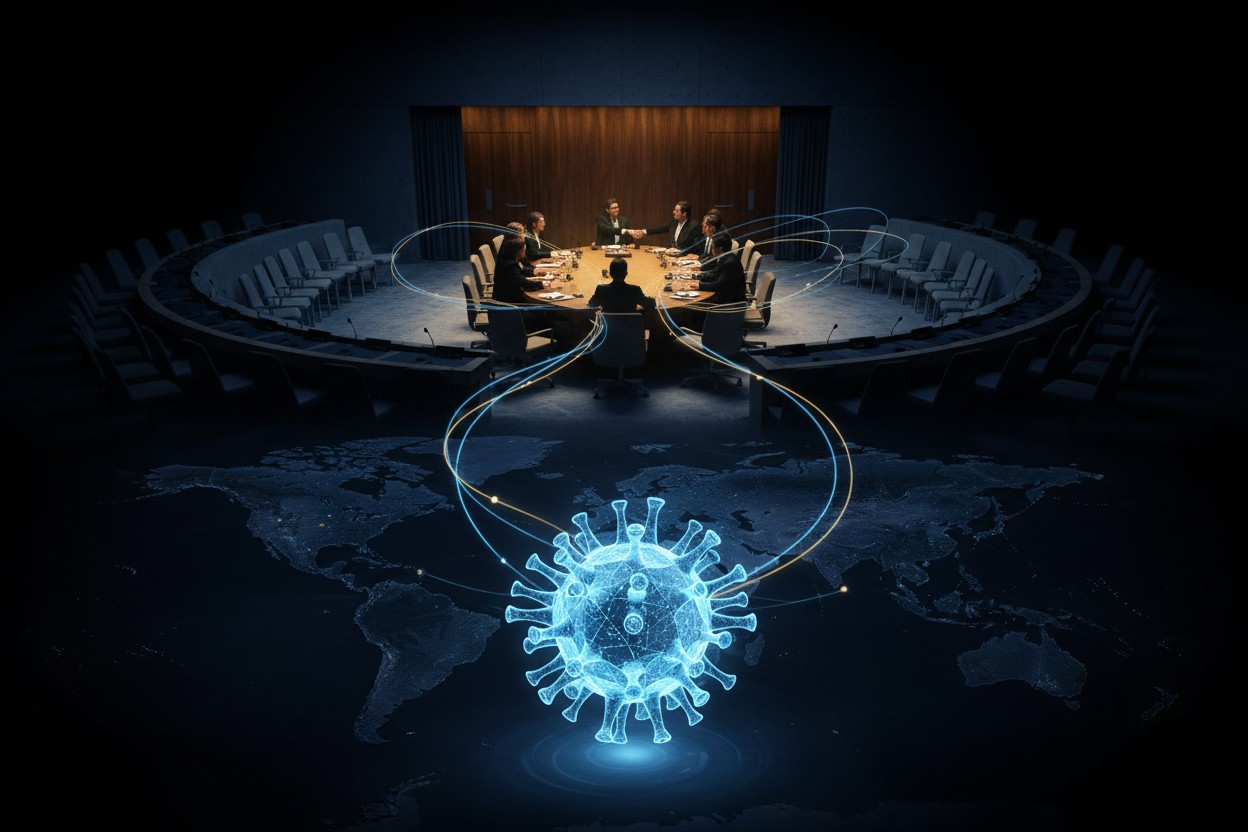
Introduction: The Week Global Health Became Global Security
In September 2014, a single week silently redefined the global order. The United Nations Security Council, invoking its most powerful authority, formally declared Ebola a 'threat to international peace and security' under Chapter VII of the UN Charter [1]. This unprecedented act, detailed in UN Resolution 2177, shifted the paradigm from public health concern to military-grade security threat.
Simultaneously, newly released U.S. Department of Justice documents reveal a parallel channel of power operating in the shadows. On September 25, 2014, Bill Gates emailed his upcoming itinerary to convicted sex offender Jeffrey Epstein, noting he would be 'mostly seeing Executive branch people including the President on the budget and Ebola' [2]. This was not a casual update. Gates was reporting his presidential access to a man who, that same day, advised him it was the 'perfect time for you to pitch DAF'—Donor-Advised Funds, vehicles for anonymous capital flow and influence [2].
This convergence was no accident. It marked the precise moment when crisis response transitioned from the domain of public health agencies into a private, pre-engineered system of capital deployment, surveillance, and permanent governance. The Ebola outbreak provided the narrative justification. The architecture had already been built.
The Confluence of Power: Gates, Epstein, and the Political Machinery
The documents paint a picture of a shadow network where policy, philanthropy, and political access were brokered through a convicted facilitator. Three days after Gates disclosed his Ebola meeting with President Obama, Epstein received another critical communication. An assistant to former Israeli Prime Minister Ehud Barak forwarded him an invitation to a private, off-the-record Obama fundraiser, asking Epstein to vet the intermediaries [2].
Here, a convicted trafficker was being consulted on presidential access for a foreign head of state, while simultaneously advising one of the world’s richest men on financial strategy during a declared global emergency. These connections reveal a profound truth: the response to the Ebola crisis was being shaped in private channels between unelected financiers, political operatives, and a convicted criminal. It was governance by network, not by democracy.
Project Molecule: The Pre-Existing Architecture
Contrary to public perception, the system activated in September 2014 was not created in response to Ebola. It was merely switched on. Months before the outbreak dominated headlines, a blueprint dubbed 'Project Molecule' had been drafted within the JPMorgan-Gates ecosystem [3]. This 14-page proposal, dated August 31, 2011, outlined a 'perpetual' governance structure called 'The Gates & J.P. Morgan Charitable Giving Fund' [3].
The plan was chillingly specific. It proposed a board of unelected power brokers—including Warren Buffett, Melinda Gates, Susan Rice, and Queen Rania of Jordan—to oversee a fund with 'perpetual operation and governance succession' [3]. Its budget included explicit line items: '$40M — Purchase oral polio vaccines (OPV) in Pakistan' and '$20M — Finance the surveillance network in Pakistan' [3]. This was not humanitarian aid. It was the financing of biological governance infrastructure across sovereign borders, with private committees replacing democratic oversight.
The 'offshore arm — especially for vaccines' that Epstein described to JPMorgan CEO Mary Erdoes in August 2011 found its institutional form in Project Molecule's proposed 'foreign private charitable foundation in a tax neutral jurisdiction' [3]. The financial plumbing for crisis response was laid before the crisis even arrived.
Securitization: How Ebola Became a Military-Level Threat
The formal mechanism for this power grab was 'securitization'—the political process of framing a public health issue as a security threat. UN Resolution 2177 was the catalyst. As analyzed in a scholarly article, this was the first time a public health crisis was formally classified under Chapter VII, the UN's most powerful tool, typically reserved for war and sanctions [1]. The resolution passed unanimously with a record 130 co-sponsors, driven by U.S. Ambassador Samantha Power [2].
This reclassification had immediate, tangible consequences. Within 24 hours, the UN created UNMEER—the UN Mission for Ebola Emergency Response—the first-ever UN emergency health mission with security authority [2]. The United States announced military deployment to West Africa. Emergency funding structures were activated. Policy timelines collapsed under the banner of urgency.
Critically, this move was controversial among scholars. As noted in the analysis, some argued that 'the historical record disproves the link between infectious diseases and political stability' and that securitization pushes responses 'away from civil society toward military and intelligence organizations' [1]. The stage was set for a security-driven, top-down response that sidelined traditional public health frameworks.
The Surveillance State Emerges: Dual-Use Technology and Political Leverage
With health officially securitized, surveillance became its logical extension. On October 8, 2014, scientists at Weill Cornell Medical College pitched Epstein a pre-symptomatic Ebola detection system using multiplex PCR technology, requesting his help to find 'a potential pathway to Bill Gates and the Gates Foundation' [2]. Epstein forwarded the request and immediately pivoted to discussing equity splits [2].
This technology, developed in collaboration with USAMRIID (Fort Detrick), NIH, and CDC, covered CDC-designated Category A biothreat agents [2]. Marketed as 'early warning,' pre-symptomatic detection at population scale is indistinguishable from mass biological surveillance. It enables isolation before illness, movement restriction before contagion, and data collection on an unprecedented scale. The standards and metrics are set by whoever funds and deploys the system.
The political calculus was equally stark. On October 18, 2014, Epstein emailed Obama's White House Counsel Kathy Ruemmler, writing: 'I think ebola now plays a role, if it gets bad = bye bye senate for sure' [2]. Ruemmler had been discussing a Senate confirmation fight, noting the 'WH pretty clearly has cold feet' [2]. Disease escalation was being explicitly discussed as political leverage at the highest levels of the White House, with a convicted sex offender acting as a sounding board.
Crisis-to-Institution Conversion: Building the Permanent Infrastructure
The goal was never a temporary response. It was permanent institution-building. On September 21, 2014—days before the UN vote—a senior UN diplomat forwarded Epstein a revised concept paper for a 'Nexus Centre for peace and health,' explicitly updated 'taking into account the serious impact of Ebola' [2]. The sender, Walter Kemp, wrote: 'The world needs such a Centre more than ever.' The recipient who forwarded it to Epstein was Terje Rød-Larsen, president of the International Peace Institute and former UN Under-Secretary-General [2].
Ebola was the justification. The International Peace Institute, funded by the Gates Foundation, continued its Ebola governance work long after the crisis faded. Emails from April 30, 2015, show Epstein tracking the status: 'ipi ebola now in sept' and 'andrea has not called svet re ebola' [2]. These are not reflections; they are operational status updates on a standing governance file.
The financial mechanisms were designed for permanence. Donor-Advised Funds provided 'arm’s length' separation and 'donor anonymity,' creating opaque, perpetual channels for capital to shape policy while maintaining philanthropic tax benefits [3]. As one Gates Foundation briefing described, the Global Health Investment Fund was an 'impact investment' vehicle targeting returns, backed by a 'sixty percent principal guarantee' from philanthropic and sovereign capital [4]. Public risk, private upside—a standing business model for pandemics.
The COVID Rehearsal: Why 2014 Matters for 2020
When COVID-19 emerged in 2020, the world witnessed a response that seemed both unprecedented and preternaturally organized. In reality, every mechanism had been operational for years. The emergency declarations, fast-tracked funding, surveillance infrastructure, and DAF opacity were not invented in 2020; they were inherited from the 2014 Ebola playbook.
By 2017, internal emails show Epstein, Gates, and Gates' science advisor Boris Nikolic treating 'pandemic' as a 'key area' for donor-advised fund structures—a standing investment category [4]. That same year, an iMessage thread from Epstein's phone shows an associate listing 'pandemics (just did pandemic simulation)' as a career credential while discussing placement into Gates' private office, Merck's vaccine team, and Swiss Re's pandemic reinsurance unit [4]. The associate noted they had 'helped develop parametric trigger'—an automated financial mechanism that pays out when a pandemic is declared [4].
Event 201, the coronavirus pandemic simulation co-hosted by the Johns Hopkins Center for Health Security, the World Economic Forum, and the Bill & Melinda Gates Foundation in October 2019, was not predictive programming [4]. It was a tabletop exercise using an infrastructure built years earlier. As Robert F. Kennedy Jr. documented, the 'pandemic preparedness' vertical had been established as a standing investment category with reinsurance products and simulation exercises long before COVID-19 [5]. The system was waiting.
Conclusion: The System That Never Stood Down
The documents do not reveal a conspiracy in the theatrical sense. They reveal an architecture—a system meticulously designed to govern through crisis with minimal public oversight. This framework merges private philanthropy with state surveillance, overrides sovereign authority, and operates through unaccountable networks. The question is not whether pandemics are engineered, but why the response mechanisms were pre-engineered for permanent, unaccountable control.
The securitization of health, initiated with Ebola, created a precedent. It allowed military deployment, justified cross-border surveillance, and enabled emergency funding structures that outlasted the emergency itself. As NaturalNews.com reported, this has evolved into initiatives like the 'One Health' framework, which critics argue expands government surveillance and centralizes health decision-making [4].
The legacy of 2014 is the system we inhabit today: a world where health emergencies trigger not just medical responses, but a pre-packaged suite of financial instruments, surveillance technologies, and governance models that concentrate power in the hands of a few. It is a world where, as Mike Adams of Brighteon.com warns, 'The threat of pandemics and psychological operations looms large. Vaccines are already prepared for deployment, and all that remains is finding the opportune moment to instill fear among the populace' [6].
For those seeking truth outside the censored corporate media, independent platforms like Brighteon.com, Brighteon.social, and BrightAnswers.ai offer uncensored analysis. The architecture exposed by the Ebola blueprint demands sunlight—the most effective, and cost-free, public health intervention ever devised.
References
- Ebola, the Security Council and the securitization of public health - QIL QDI.
- Obama, Gates, and Epstein: The Week Emergency Rule Became Global Policy. Sayer Ji. February 07, 2026.
- Inside Project Molecule — How JPMorgan and the Gates Foundation Turned Biology into Investable Infrastructure. Sayer Ji. February 03, 2026.
- US launches One Health framework amid concerns over global health governance and surveillance - NaturalNews.com. Willow Tohi. January 20, 2025.
- The Real Anthony Fauci Bill Gates Big Pharma and the Global War on Democracy and Public Health. Robert F Kennedy Jr.
- Brighteon Broadcast News - MEMORIAL DAY Special - Mike Adams - Brighteon.com. May 26, 2025.
- Mike Adams interview with Sayer Ji - October 3 2023.
- Pandemics for Profit: Jeffrey Epstein Was a Pandemic Power Broker - 21st Century Wire.










Please contact us for more information.