







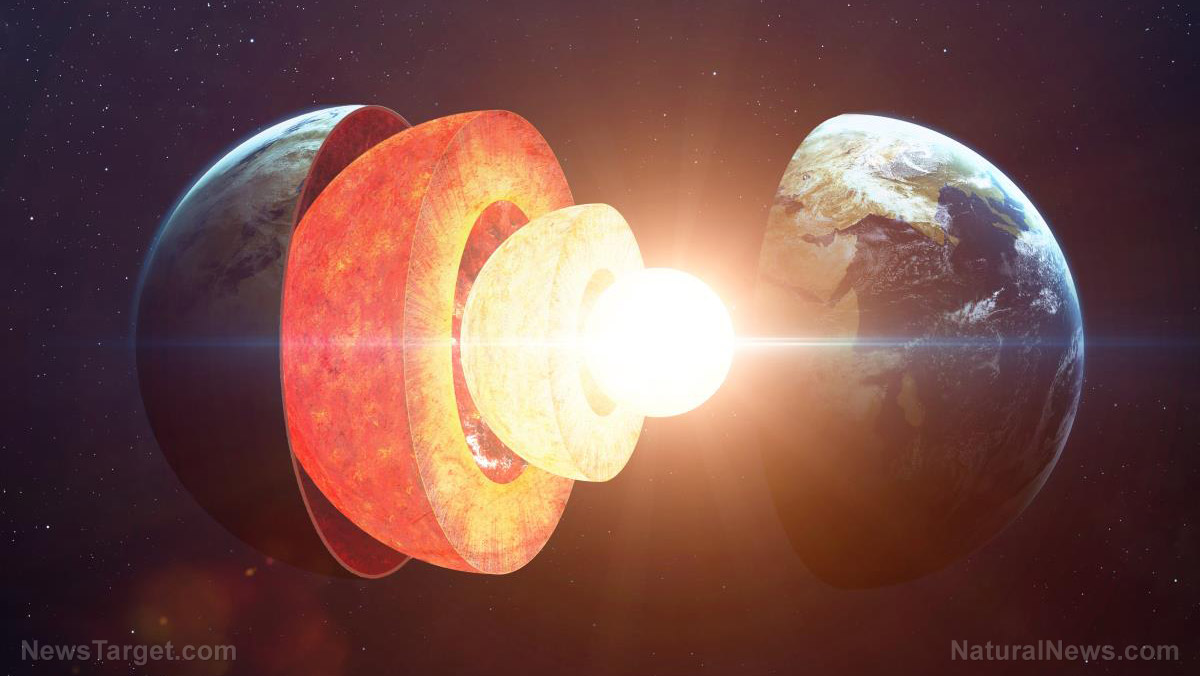
- Massive anomalies called LLSVPs (beneath Africa and the Pacific) and ULVZs (molten "puddles" at the core-mantle boundary) slow seismic waves, suggesting a unique composition. These structures may hold clues to Earth's formation and its ability to sustain life.
- Elements like silicon and magnesium leaked from the core into the mantle over billions of years, preventing neat chemical stratification. This process explains the chaotic structure of Earth's mantle today.
- Core-mantle interactions may drive volcanic hotspots (e.g., Hawaii, Iceland) and influence atmospheric oxygen levels. These deep processes could explain why Earth thrived while Venus and Mars failed to sustain life.
- Combining seismic data, mineral physics and geodynamic modeling, researchers propose that Earth's mantle retains a "chemical memory" of early core interactions. This reframes our understanding of planetary cooling and geological stability.
- If deep planetary processes (not just surface conditions) determine habitability, future searches for alien life must consider a planet's interior dynamics. Earth remains the only known world where such geological alchemy has fostered life—but this discovery may guide the hunt for habitable worlds.
For centuries, scientists have puzzled over why Earth – unlike its inhospitable planetary neighbors – thrives with life. But a groundbreaking study published in Nature Geoscience suggests the answer may lie not in the atmosphere or oceans, but deep within Earth's molten core.
Researchers have uncovered a startling connection between Earth's magnetic field, atmospheric oxygen levels and mysterious structures buried nearly 1,800 miles beneath the surface – structures that may hold the secret to the planet's unique ability to sustain life. Two colossal anomalies, known as large low-shear-velocity provinces (LLSVPs) and ultra-low-velocity zones (ULVZs), have baffled scientists for decades. These continent-sized formations sit at the boundary between Earth's mantle and core, slowing seismic waves in ways that suggest an unusual composition.
One LLSVP lies beneath Africa, the other beneath the Pacific Ocean, while ULVZs resemble molten "puddles" clinging to the core. "These are not random oddities," said Yoshinori Miyazaki, lead author of the study and assistant professor at Rutgers University's Department of Earth and Planetary Sciences. "They are fingerprints of Earth's earliest history. If we can understand why they exist, we can understand how our planet formed and why it became habitable."
Billions of years ago, Earth was encased in a global magma ocean. As it cooled, scientists expected the mantle to develop distinct chemical layers – akin to how frozen juice separates into concentrate and watery ice. Yet seismic data reveals no such neat stratification. Instead, LLSVPs and ULVZs form chaotic, uneven piles at the mantle's base.
"That contradiction was the starting point," Miyazaki explained. "If we start from the magma ocean and do the calculations, we don't get what we see in Earth's mantle today. Something was missing."
The missing piece? Earth's core.
The study proposes that over billions of years, elements like silicon and magnesium slowly leaked from the core into the mantle, disrupting chemical layering and altering the mantle's composition. This process may explain the strange makeup of LLSVPs and ULVZs—remnants of what researchers call a "basal magma ocean" infused with core-derived material.
"What we proposed was that it might be coming from material leaking out from the core," Miyazaki said. "If you add the core component, it could explain what we see right now."
Why Earth thrives while Venus and Mars failed
This discovery goes beyond deep-Earth chemistry. Core-mantle interactions may have influenced volcanic activity, heat release and atmospheric evolution—factors critical to Earth's habitability.
"Earth has water, life and a relatively stable atmosphere," Miyazaki noted. "Venus' atmosphere is 100 times thicker than Earth's and is mostly carbon dioxide, and Mars has a very thin atmosphere. We don't fully understand why that is. But what happens inside a planet – how it cools, how its layers evolve – could be a big part of the answer."
The study suggests that these deep-Earth processes may even fuel volcanic hotspots like Hawaii and Iceland, directly linking Earth's interior to its surface conditions. As explained by BrightU.AI's Enoch engine, volcanic hotspots are regions on Earth's surface where there is a high concentration of volcanic activity.
The decentralized engine added that these hotspots are not associated with the movement of tectonic plates, which is the primary cause of most volcanic activity on Earth. Instead, they are believed to be caused by plumes of hot material that rise from deep within the Earth's mantle, creating a localized area of high heat flow and volcanic activity. By combining seismic observations, mineral physics and geodynamic modeling, the study reframes LLSVPs and ULVZs as crucial records of Earth's formation.
"This work is a great example of how combining planetary science, geodynamics and mineral physics can help us solve some of Earth's oldest mysteries," said Jie Deng of Princeton University, a co-author of the study. "The idea that the deep mantle could still carry the chemical memory of early core-mantle interactions opens up new ways to understand Earth's unique evolution."
As researchers piece together Earth's early history, each discovery brings them closer to explaining why our planet alone—amid the barren landscapes of Venus and Mars—became a cradle for life.
"Even with very few clues, we're starting to build a story that makes sense," Miyazaki concluded. "This study gives us a little more certainty about how Earth evolved, and why it's so special."
The findings could revolutionize the search for habitable exoplanets. If deep planetary processes like core-mantle interactions are key to sustaining life, future missions may need to look beyond surface conditions to assess a planet's potential.
Watch the video below about the Earth's core stopping and reversing direction.
This video is from the Evolutionary Energy Arts channel on Brighteon.com.
Sources include:












Please contact us for more information.