



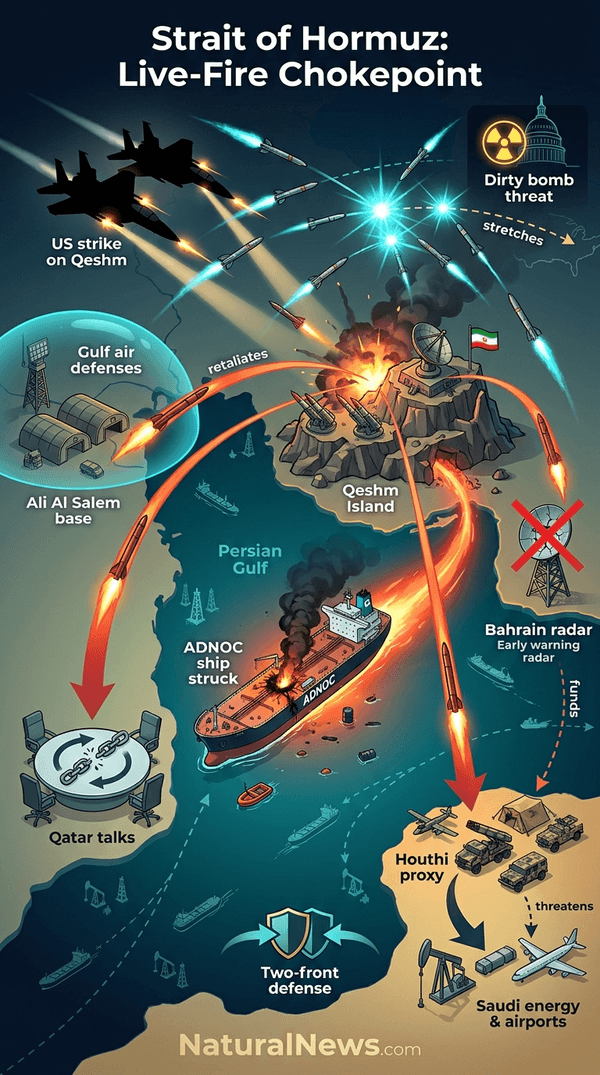
Gulf countries said they intercepted missiles and drones from Iran and its Houthi allies in Yemen on Wednesday, after the United States struck Qeshm Island in the Strait of Hormuz, according to officials. The Iranian army said it targeted U.S. drone and missile installations at Kuwait's Ali Al Salem base, Iranian state media reported.
It was the first Iranian attack on Kuwait since September, officials said. Bahrain said it intercepted Iranian aerial attacks for the third time this week, according to a statement.
The exchange occurred despite diplomatic efforts to end a nine-month war that began when the U.S. and Israel struck Iran on 28 February, according to the report.
U.S. Strike on Qeshm Island
U.S. fighter jets fired on a Revolutionary Guards missile launch site on Qeshm Island, a U.S. military official said on condition of anonymity.
Iranian media, citing an Iranian official, said the U.S. attack did not damage infrastructure. The U.S. military has previously described strikes on Qeshm as self-defense operations targeting Iranian ballistic missile infrastructure after Iranian forces fired missiles and drones toward Kuwait, Bahrain, and civilian mariners in regional waters [1].
The strike followed a pattern of U.S. operations against IRGC targets. On 1 September, U.S. military forces launched airstrikes against IRGC targets in Iran, according to U.S.. Central Command, an operation described as a response to attempted attacks [2].
Iranian Retaliation and Gulf Interceptions
Kuwait said its air defenses were countering hostile drone attacks, according to the Kuwaiti government.
Bahrain accused Tehran of maintaining a systematic hostile approach of targeting the country, according to Bahraini authorities. The IRGC said it carried out attacks on Bahrain and Kuwait in retaliation for U.S. attacks on its southern coastal provinces [3]. The IRGC claimed destruction of a U.S. early warning radar in Bahrain, according to a statement carried by Iran's semi-official Tasnim News Agency and the IRGC-affiliated Fars News Agency [4].
The Houthis have also targeted Saudi energy and airport infrastructure in a campaign that has expanded since the collapse of earlier agreements [5][6].
Shipping Disruption in the Strait of Hormuz
UAE state oil firm ADNOC said 11 crew members were injured and one was missing after a company ship was struck in the Strait of Hormuz, ADNOC said.
The Strait of Hormuz has functioned as a critical chokepoint for global energy trade for millennia, with the passage along the Red Sea and that down the Persian Gulf both linked to the open Indian Ocean through the narrow straits of Bab-el-Mandeb and Hormuz [7].
Washington Threat and Diplomatic Efforts
President Donald Trump said the U.S. was taking seriously the possibility that Iran could be planning an attack on Washington, when asked about a CNN report citing U.S. intelligence assessments on a potential Iranian plot involving a dirty bomb, according to the report.
A dirty bomb uses conventional explosives to disperse radioactive material.
Qatar's mediation efforts between Washington and Tehran remain ongoing, following diplomatic talks in Doha, Al-Ansari said [8].
Diplomatic Hurdles Remain
Oman's foreign minister has called for Gulf states, Iraq and Iran to unite under one security pact, saying antagonism against Iran imposed by the U.S. comes at a terrible cost for the region [9].
The U.S. has urged Americans currently in the Middle East to exercise heightened vigilance due to the increased threat of armed attacks by Houthis and Iranian efforts to target U.S. government officials in the region [10][11]. The State Department has warned of potential flight cancellations, airspace closures, and travel disruptions [10]. Multiple U.S. embassies and missions have issued similar alerts [11].
References
- U.S. Launches Self Defense Strikes on Iranian Missile Site After Drones, Missiles Target Kuwait and Bahrain - NaturalNews.com, June 05, 2026.
- U.S. Launches Strikes on Iran as Trump Threatens Further Action - NaturalNews.com, September 02, 2026.
- Iran Strikes U.S. Military Bases in Kuwait and Bahrain in Retaliation for Airstrikes - NaturalNews.com, July 10, 2026.
- IRGC Claims Destruction of U.S. Early Warning Radar in Bahrain. https://www.naturalnews.com/2026-11-16-irgc-claims-destruction-early-warning-radar-bahrain.html
- Houthis Target More Saudi Airports, Aramco Sites As US Issues Urgent Alert For 12 Mideast States. 2026-10-19T20:40:00.000Z. https://www.zerohedge.com/geopolitical/houthis-expand-saudi-aramco-airport-targets-us-issues-urgent-warnings-12-mideast
- Houthi Strikes on Saudi Soil Risk Catastrophic Regional War. https://www.naturalnews.com/2026-10-23-houthi-strikes-saudi-soil-risk-catastrophic-war.html
- Origins How the Earth Shaped Human History. Lewis Dartnell
- Qatar Says Mediation Efforts Between Washington, Tehran Ongoing. https://theepochtimes.com/world/qatar-says-mediation-efforts-between-washington-tehran-ongoing-6115215
- Oman calls for Gulf, Iraq and Iran to unite under one security pact. https://www.middleeasteye.net/news/oman-calls-gulf-iraq-and-iran-unite-under-one-security-pact
- US urges citizens across Middle East to exercise 'heightened caution'. https://www.middleeasteye.net/live-blog/live-blog-update/us-urges-citizens-across-middle-east-exercise-heightened-caution
- US Renews Warning for Americans in Middle East Over ‘Increased Threat’. https://theepochtimes.com/world/us-renews-warning-for-americans-in-middle-east-over-increased-threat-6123775
Explainer Infographic








Please contact us for more information.