



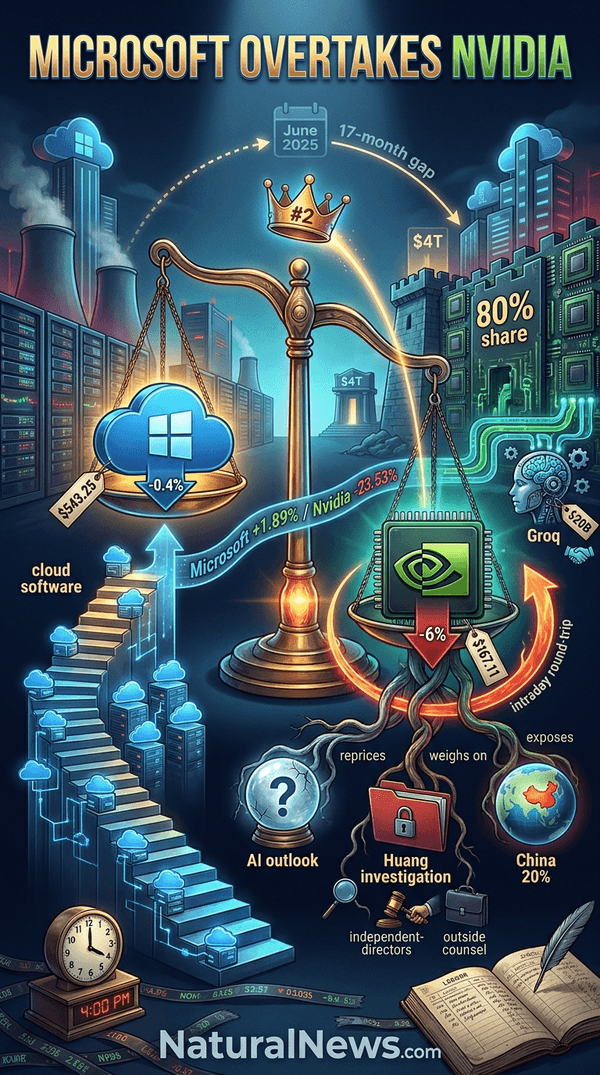
Microsoft overtook Nvidia as the world's second-most valuable public company on Tuesday, Nov. 10, according to Reuters [1]. The ranking change was the first time Microsoft had held the position since June 2025, the report stated [1].
Shares of Microsoft were down 0.4% at $543.25 during the session, while Nvidia shares fell more than 6% to about $167.11, according to the Reuters report [2][3]. Reuters cited uncertainty over the outlook for artificial intelligence (AI) and an investigation into whether Nvidia CEO Jensen Huang was the target of a foreign intelligence effort as factors in Nvidia's decline [4][5]. The report noted that Microsoft briefly held the position before Nvidia regained its lead later in the session, according to a separate account [6].
Market Session Details
Microsoft's decline of 0.4% was smaller than Nvidia's drop of more than 6%, enough to swap the second-place ranking in a single session, according to market data cited by Reuters [7][8]. At this scale, market-cap positions can shift on investor sentiment alone, the data indicated.
Nvidia's price of around $167.11 reflected the session's sell-off, while Microsoft traded at $543.25, the report stated [2]. The move illustrates how quickly mega-cap rankings can reset even when one company's shares also fall, according to the report.
The trading action followed a month in which Microsoft shares gained approximately 1.89% while Nvidia recorded a decline of around 23.53%, according to market data [9]. Reuters reported that the two companies have traded places repeatedly in recent years as investors weighed competition between AI hardware and cloud software businesses.
AI Outlook Uncertainty Weighs on Nvidia
Reuters identified uncertainty about the outlook for artificial intelligence as one factor weighing on Nvidia [2][4]. Nvidia's valuation is closely tied to expectations that cloud providers will keep buying AI chips at the current pace, according to the report. That dependency leaves the stock sensitive to any sign that returns on those investments might disappoint, the report stated.
The company's market value reflects sustained AI-chip demand expectations that one session of doubt can rapidly reprice, according to the report [5]. Nvidia previously touched $4 trillion in market value for the first time on July 10, 2025, capping a rise driven by generative AI demand, according to prior reporting [10]. The company makes more than 80% of the chips that run AI data centers, according to Jon Peddie Research data cited in industry reports [11].
Concerns about AI spending levels have surfaced repeatedly in 2026, including a sell-off in February in which $1 trillion was wiped from the valuations of Big Tech companies as investors recoiled from escalating AI investments, according to one account [12]. Previous volatility has followed major AI model releases including DeepSeek's chatbot, which preceded a record one-day market-cap loss of nearly $593 billion for Nvidia in January 2025, according to a prior report [13].
Nvidia Board Opens Independent Investigation
Reuters reported the decline followed an investigation into whether Nvidia CEO Jensen Huang was the target of a foreign intelligence effort [4][14]. The board of Nvidia announced an independent investigation, according to the company and Reuters. A committee of independent directors, backed by outside independent counsel, is overseeing the review, the board said.
The investigation was announced following allegations that Huang had been involved with a Chinese business executive whom U.S. intelligence officials reportedly considered an information-gathering asset, according to the report. Those allegations remain under investigation and have not been confirmed, according to the report. Nvidia has not issued further public statements on the review as of Tuesday's close.
Board Statement and Huang Cooperation
Huang is cooperating with the review, the board confirmed. The board's statement was precise in its limits, addressing national security and company secrets while the investigation continues, according to the report.
Nvidia has faced heightened scrutiny over its relationship with the Chinese market. China had been buying about 20% of Nvidia's chips and will continue doing business with the company, according to a prior account [15].
Nvidia has also moved to strengthen its position in AI inference through licensing arrangements. The company signed a non-exclusive licensing deal with AI chip startup Groq, hiring its founder Jonathan Ross, CEO Sunny Madra and senior engineers, according to a December 2025 report [16]. A separate account placed the licensing investment at $20 billion [17].
What to Watch: AI Spending, Guidance, Investigation Outcome
The ranking between Microsoft and Nvidia remains subject to rapid change as those questions develop, the report stated.
Investors are expected to monitor cloud provider capital spending plans and any new disclosures from Nvidia's board review. Industry projections suggest that AI-related infrastructure spending could exceed $5 trillion by 2030, with data center capacity demand reaching 100 gigawatts, according to estimates cited in prior reporting [18]. The scale of that build-out has raised questions about whether returns will materialize for the companies absorbing the costs.
Market participants said the investigation outcome and AI demand signals could determine whether the reversal holds.
References
- Microsoft tops Nvidia's market cap for first time since June 2025. https://finance.yahoo.com/markets/stocks/articles/microsoft-top-nvidias-market-cap-170013065.html
- Microsoft tops Nvidia's market cap for first time since June. https://www.channelnewsasia.com/business/microsoft-tops-nvidias-market-cap-first-time-june-2025-6540296
- Microsoft tops Nvidia’s market cap for first time since June 2025. https://www.investing.com/news/stock-market-news/microsoft-tops-nvidias-market-cap-for-first-time-since-june-2025-5016363
- Microsoft tops Nvidia's market cap for first time since June 2025. https://live.euronext.com/en/financial-news/microsoft-tops-nvidias-market-cap-first-time-june-2025
- Microsoft Is World's Most Valuable Company After Nvidia CEO Probe Sparks Rout. https://www.ndtv.com/world-news/microsoft-is-worlds-most-valuable-company-after-nvidia-ceo-probe-sparks-rout-12309706?pfrom=home-ndtv_topscroll_Imagetopscroll
- Microsoft overtakes Nvidia in market capitalization first since June 2025. https://tass.com/economy/2215765
- Microsoft tops Nvidia's market cap for first time since June. https://www.reuters.com/business/microsoft-top-nvidias-market-cap-first-time-since-june-2025-2026-11-10/
- Microsoft tops Nvidia's market cap for first time since June. https://www.streetinsider.com/Reuters/Microsoft+tops+Nvidias+market+cap+for+first+time+since+June+2025/27321678.html
- Microsoft Overtakes Nvidia As World's Most Valuable Company For First Time Since June 2025. https://www.kotakneo.com/news/global-markets/microsoft-overtakes-nvidia-worlds-most-valuable-company-november-2026/
- NVIDIA surpasses 4 trillion market cap amid AI boom and geopolitical strains - NaturalNews.com, July 11, 2025.
- Trends-Journal-2024-11-19. Unknown
- AI bubble fears spark sell off as tech giants face investor backlash - NaturalNews.com, February 10, 2026.
- DeepSeeks AI model ignites market panic Nvidia suffers record loss - NaturalNews.com, January 28, 2025.
- Microsoft top Nvidia's market cap for first time since June 2025- Moneycontrol.com. https://www.moneycontrol.com/news/business/microsoft-top-nvidia-s-market-cap-for-first-time-since-june-2025-14076484.html
- Trends-Journal-2023-12-48. Unknown
- Nvidia strengthens AI dominance with strategic Groq talent acquisition and licensing deal - NaturalNews.com, December 27, 2025.
- Nvidia's $20 billion licensing deal for Groq targets Google's AI chip dominance - NaturalNews.com, December 26, 2025.
- AI Data Center Expansion Faces Grid Constraints as Power Demand Surges - NaturalNews.com, July 01, 2026.
Explainer Infographic










Please contact us for more information.