


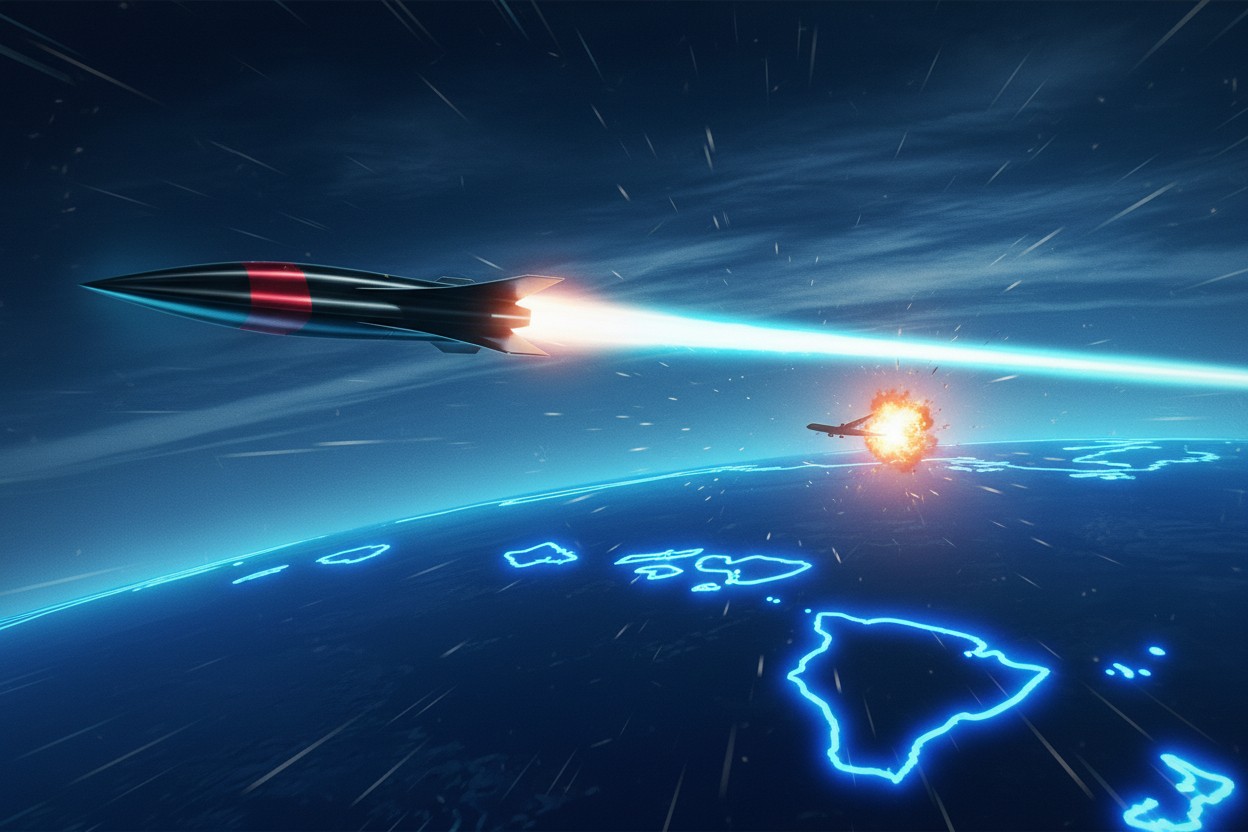
A recent Defense Intelligence Agency (DIA) report warns that Beijing could deploy directed-energy systems in orbit by 2030, a capability that could blind, disable, or destroy American satellites with surgical precision. Yet this alarming forecast is met with skepticism from experts and dismissed by Chinese state media as “hype.” The tension reveals a deeper struggle—not just over space, but over the future of global power, autonomy, and the very rules of war. As governments rush to weaponize the final frontier, the question looms: who will control the skies, and who will suffer the consequences of a militarized cosmos?
Talking points:
- U.S. intelligence warns China may deploy space-based laser weapons by 2030, challenging U.S. dominance in orbital warfare.
- Directed-energy weapons offer covert, deniable attacks on satellites, raising concerns about attribution and escalation.
- China’s reusable spaceplane, Shenlong, hints at advanced capabilities for satellite inspection or interference.
- The U.S. military’s reliance on satellites creates vulnerabilities in potential conflicts, particularly over Taiwan.
- Skepticism surrounds the timeline, but the strategic race for space superiority is accelerating.
The shadow of directed energy: From fiction to strategy
Directed-energy weapons, once the stuff of science fiction, are now a cornerstone of 21st-century warfare. Lasers and high-powered microwaves offer a unique advantage: they can disrupt satellites without leaving debris, making attacks deniable and responses ambiguous. The DIA report highlights China’s progress in this arena, noting that its ground-based systems are already capable of targeting high-orbit satellites by the late 2020s. But the true game-changer is space-based deployment.
The technical hurdles are formidable. A satellite-mounted laser requires immense energy, likely from nuclear reactors or massive solar arrays. It also requires precise optics to hit a moving target thousands of miles away. Yet China’s recent advancements suggest progress. In 2021, the People’s Liberation Army (PLA) declared laser weapons were entering a “golden age,” citing applications like temporarily blinding sensors. This isn’t mere posturing: in 2007, China’s ground-based anti-satellite missile test created a debris field that still threatens orbiting assets. Now, Beijing aims to bypass such collateral damage with “clean” directed-energy strikes.
The Shenlong enigma: A spaceplane with secrets
The DIA report also reveals a rare image of China’s Shenlong reusable spaceplane, a project that has fueled speculation about its true purpose. While Beijing calls Shenlong a “technology verification” vehicle, its ability to loiter in orbit for months, maneuver near satellites, and deploy objects raises alarms. Unlike the U.S. X-37B, which focuses on reconnaissance, Shenlong’s capabilities hint at dual-use potential. Could it inspect satellites one day and sabotage them the next? The line between inspection and interference is perilously thin, a fact not lost on military planners.
Gen. Stephen Whiting of the U.S. Space Force has bluntly stated, “In space, there is no safe harbor.” Satellites are vulnerable by design, their fragility a stark contrast to the invincible war machines of Cold War lore. For the U.S., which relies on satellites for navigation, communication, and surveillance, this dependency is a strategic Achilles’ heel. As Brendan Mulvaney of the China Aerospace Studies Institute notes, disrupting American satellites in a conflict over Taiwan could cripple military coordination across the Pacific.
The Pentagon’s response: A race for resilience
The U.S. is not idle. In October 2026, the Pentagon unveiled four directed-energy systems for countering drones, including Boeing’s Compact Laser Weapon System. While these are ground-based, they signal a shift toward practical applications of the technology. The Space Force is also pivoting to “proliferated constellations". These are swarms of small, cheap satellites that are designed to mitigate the risk of losing a single asset. But this strategy has its own vulnerabilities: reliance on commercial satellite bandwidth, which the DIA itself warns could become a security liability.
Yet the broader challenge here is systemic. For decades, the U.S. has prioritized satellite performance over survivability, assuming space would remain a sanctuary. Now, that illusion is crumbling. As China advances, the U.S. faces a paradox: its own dependence on space technology makes it a prime target for the very weapons it seeks to counter.
Sources include:






Please contact us for more information.