


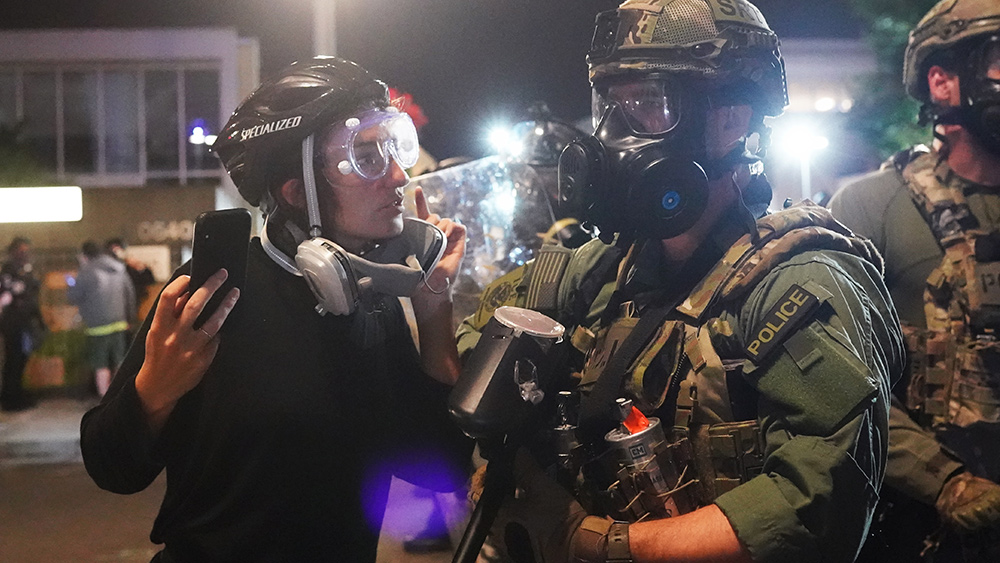
- Hooded rioters including teens as young as 13 looted a gun store and damaged 17 shops in Frankfurt after a protest over school funding and living costs.
- More than 100 police officers were injured as 1,300 officers faced Molotov cocktails, stones and bottles.
- Officials acknowledged the perpetrators were predominantly of migrant background, calling for no false taboos.
- Federal minister vowed severe penalties and blamed troublemakers from the immigrant community and left-wing extremists.
- With only 54 arrests out of up to 1,500 rioters, new protests are planned for November 20.
What began as a Halloween afternoon rally for better school funding and lower living costs turned into something far darker near Frankfurt’s Zeil shopping street, where hooded rioters — some as young as 13 — smashed their way into a gun store as police scrambled to contain the chaos.
The Oct. 31 rampage, which followed a protest organized under the banner “Gen Z regelt” (Gen Z’s got this), left 17 shops damaged and five looted across Germany’s financial capital, with top officials now warning of a violent alliance between far-left extremists and youths of migrant background. More than 100 police officers were injured in the clashes, according to Hesse Interior Minister Roman Poseck.
Poseck said police believe 1,000 to 1,500 violent rioters were involved. “This group of perpetrators was predominantly of migrant background. And we must address that as well. There can be no false taboos here,” he said.
Officers attacked with Molotov cocktails as 1,300 police deploy
Frankfurt authorities scrambled Sunday to assess the damage after rioters launched a sustained assault on emergency services, pelting them with Molotov cocktails, stones and bottles across the city center. Police deployed 1,300 officers to contain the violence, eventually calling in a Special Operations Unit to reinforce officers on the street.
“We urge all bystanders to avoid the city center or to leave the area,” Frankfurt police warned Saturday night, as footage of the looting spread across social media.
The 54 arrested suspects ranged from 13 to 29 years old, with Poseck noting that most were German nationals. Officers cordoned off the Zeil shopping street entirely, but rioters still reached a gun store nearby and looted weapons, two of which police said they quickly recovered.
German interior minister vows severe penalties for rioters
Federal Interior Minister Alexander Dobrindt wasted no time placing blame, accusing what he described as “troublemakers from the immigrant community” of hijacking the peaceful afternoon demonstrations alongside left-wing extremist groups.
“I expect there to be severe penalties,” Dobrindt said Sunday. “We are not prepared to accept, in the slightest, that such incidents and such rioting should take place here.”
The minister said heavy police deployments in several locations had paid off, though the toll of more than 100 injured officers suggests the response was anything but sufficient. Dobrindt also said Germany had tightened border checks before the protests, fearing that extremists from abroad would try to stir up trouble.
The violence in Frankfurt mirrored scenes across Europe, where France endured a third consecutive weekend of far-left unrest, with 565 arrests nationwide and a gendarme set alight by a Molotov cocktail in Paris. Back in Germany, organizers say some 120,000 people marched in more than 30 cities Saturday, with violent scenes also reported in Hamburg, Cologne, Berlin and Stuttgart.
Opposition slams government as migrant violence and extremism collide
The Alternative for Germany (AfD) party, which holds seats in the Hessian parliament, seized on the riots as evidence of a deeper rot in Germany’s migration policies and security apparatus.
“The violence in Frankfurt is appalling and once again an urgent appeal to the CDU/CSU-SPD coalition to finally take a closer look at left-wing extremists and migrant violence... It is obvious that this also involves unresolved problems with migration,” said Robert Lambrou, the AfD’s leader in the Hessian state parliament.
Poseck said a special commission has been set up to examine the riots, and he pledged closer scrutiny of migrant communities when future protests are held. But the interior minister’s acknowledgment that the violence was predominantly driven by those of immigrant background has opened a political wound Germany’s ruling coalition can no longer ignore.
“We cannot surrender the country to those who act with such violence against our police,” Poseck said.
Germany tightened its borders so it could keep foreign extremists away from the protests, but most of those who were arrested turned out to be German nationals, and only 54 of as many as 1,500 rioters have been arrested so far. With new Gen Z protests already set for Nov. 20, Germany has less than three weeks to decide whether “no false taboos” is a policy or just a sound bite.
Sources for this article include:



Please contact us for more information.