



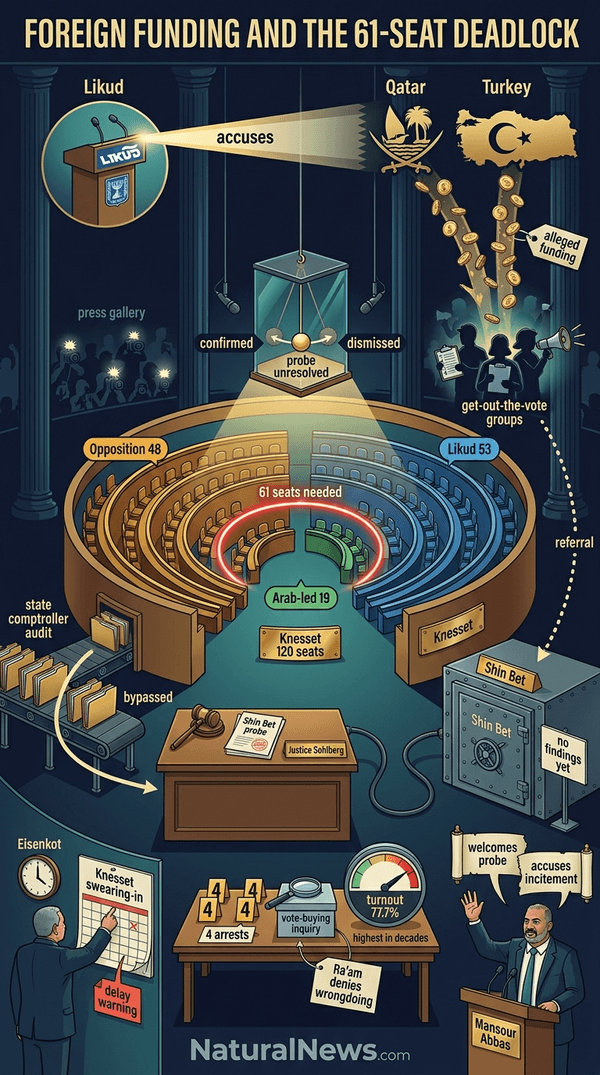
The Likud party, which is chaired by incumbent Israeli Prime Minister Benjamin Netanyahu, has accused Qatar and Turkey of interference in Israel's recent elections.
Separately, the chairman of Israel's Central Elections Committee, Justice Noam Sohlberg, requested an official Shin Bet investigation into the alleged foreign funding, officials said. The developments left Netanyahu, the caretaker prime minister, facing another round of coalition negotiations after his party fell short of a parliamentary majority. Voter turnout reached about 77.7%, the highest in more than two decades, according to preliminary results [1].
Likud Statement Alleges Foreign-Funded Campaign
Likud said "foreign entities tried to take over the Knesset" and that no Zionist party should cooperate with Ra'am or the Joint List. The party believes Doha and Ankara paid "get-out-the-vote" groups, according to Channel 12.
Reporting by Al Jazeera said Likud and media outlets associated with it have, without evidence, accused Qatar of sending money to Arab parties in Israel for get-out-the-vote activity [2]. The election result also triggered a separate police inquiry, with four additional arrests announced in connection with alleged vote-buying on behalf of the Arab Ra'am party; Ra'am has denied any wrongdoing [3].
Elections Committee Chair Requests Shin Bet Investigation
Sohlberg said in his statement that he could not attest to the substance of the suspicions, but that there was an obligation to investigate them thoroughly given that they involve foreign entities [4][5].
Shin Bet sources later played down the significance of the bribery probe, describing it as "limited" and unlikely to affect the election results, according to Middle East Eye [6]. The domestic security service's involvement marked an unusual entry by a security agency into a dispute over vote financing.
Israel's election authorities sought the Shin Bet investigation as the country faced uncertainty over its next coalition government, according to News9 [7]. No findings from the probe have been announced.
Opposition Figures Respond to Probe
Gadi Eisenkot, head of the Zionist Opposition bloc opposed to Netanyahu, warned against political actors exploiting the probe to delay the swearing-in of the Knesset, according to reports [8][9]. Eisenkot's bloc secured 48 seats to Likud's 53, according to final results released Friday, Oct. 30 – leaving both short of the 61 needed for a majority [10].
Arab-led party leaders also denounced the prime minister. United Arab List chairman Mansour Abbas accused Netanyahu of waging an incitement and delegitimization campaign against Israel's Palestinian citizens, while welcoming Sohlberg's decision to investigate the claims [11]. Abbas had earlier accused Netanyahu of "lying and inciting" against his party and of using allegations of election fraud to mobilize right-wing voters [12].
Turnout and Palestinian-Israeli Party Gains Reported
One account put Arab party gains at about 19 seats in preliminary counts [13]. Neither bloc can reach 61 seats because no side is willing to partner with Palestinian-Israeli factions, according to the reported results [8][10]. The deadlock has left the shape of the next government dependent on negotiations that have yet to produce an agreement.
Next Steps Remain Unclear
No conclusion has been announced regarding the Shin Bet probe; officials said only that an investigation was requested [4][6]. The allegations and the counter-allegations have become part of the coalition arithmetic, with each side seeking to shape how the result is interpreted before President Isaac Herzog begins consultations with party leaders.
The episode fits a pattern seen in other countries, where electoral outcomes are contested through claims of foreign interference. Romania's Constitutional Court invalidated the first-round results of its presidential election after the anti-globalist candidate Calin Georgescu unexpectedly won, with the court citing "Russian disinformation" on TikTok [14].
References
- Preliminary Israeli Election Results Show No Clear Winner as Fraud Allegations Mount. https://theepochtimes.com/world/preliminary-israeli-election-results-show-no-clear-winner-as-fraud-allegations-mount-6110303
- Israel’s anti-Qatar campaign bleeds into elections | Israel Election .... https://www.aljazeera.com/news/2026/10/29/israels-anti-qatar-campaign-bleeds-into-elections
- Likud Accuses Turkey and Qatar of Election Interference as Ra'am .... https://en.politis.com.cy/news/world/1059836/likud-accuses-turkey-and-qatar-of-election-interference-as-raam-activists-arrested
- Netanyahu's Likud Accuses Qatar, Turkey Of Election .... https://www.zerohedge.com/geopolitical/netanyahus-likud-accuses-qatar-turkey-election-interference-aimed-islamizing-israel
- Netanyahu's Likud Accuses Qatar, Turkey Of Election Interference Aimed At 'Islamizing Israel'. https://www.zerohedge.com/geopolitical/netanyahus-likud-accuses-qatar-turkey-election-interference-aimed-islamizing-israel
- Israeli election bribery probe ‘limited’ and won't affect results, Shin Bet sources say. https://www.middleeasteye.net/news/israeli-voter-bribery-probe-limited-and-unlikely-affect-election-results-shin-bet-sources-say
- Netanyahu alleges Qatar, Turkey interference in Israel elections .... https://www.news9live.com/world/netanyahu-qatar-turkey-interference-israel-elections-probe-3020209
- Did Qatar, Turkey interfere in Israel’s election? - Firstpost. https://www.firstpost.com/explainers/israel-election-results-qatar-turkey-interference-shin-bet-probe-netanyahu-claims-14056451.html
- Israeli opposition accuses Netanyahu of trying to 'delegitimise' election. https://bbc.com/news/articles/ckdd8qdl9e0eo
- Israel Heads for Coalition Talks After Election Deadlock. https://theepochtimes.com/world/israel-heads-for-coalition-talks-after-election-deadlock-6110982
- United Arab List chairman accuses Netanyahu of incitement over foreign interference claims. https://www.middleeasteye.net/live-blog/live-blog-update/united-arab-list-chairman-accuses-netanyahu-incitement-over-foreign
- Ra’am leader accuses Netanyahu of ‘lying and inciting’ against Arab party. https://www.middleeasteye.net/live-blog/live-blog-update/raam-leader-accuses-netanyahu-lying-and-inciting-against-arab-party
- Netanyahu’s Likud Claims “Stolen” Election, Blames Qatar for Arab .... https://countercurrents.org/2026/10/netanyahus-likud-claims-stolen-election-blames-qatar-for-arab-turnout-as-shin-bet-opens-probe/
- The Western establishment lacks legitimacy - NaturalNews.com, December 09, 2024.
Explainer Infographic











Please contact us for more information.