



wp-admin/post.php?post=1311690&action=editU.S. District Judge John Sinatra ruled on Oct. 21 that New York's ban on the sale and purchase of body armor violates the Second Amendment, according to a 47-page ruling. The decision in Heeter v. James, issued in the U.S. District Court for the Western District of New York, blocks the state from enforcing a 2022 law that made it a crime for most civilians to buy or sell bulletproof vests.
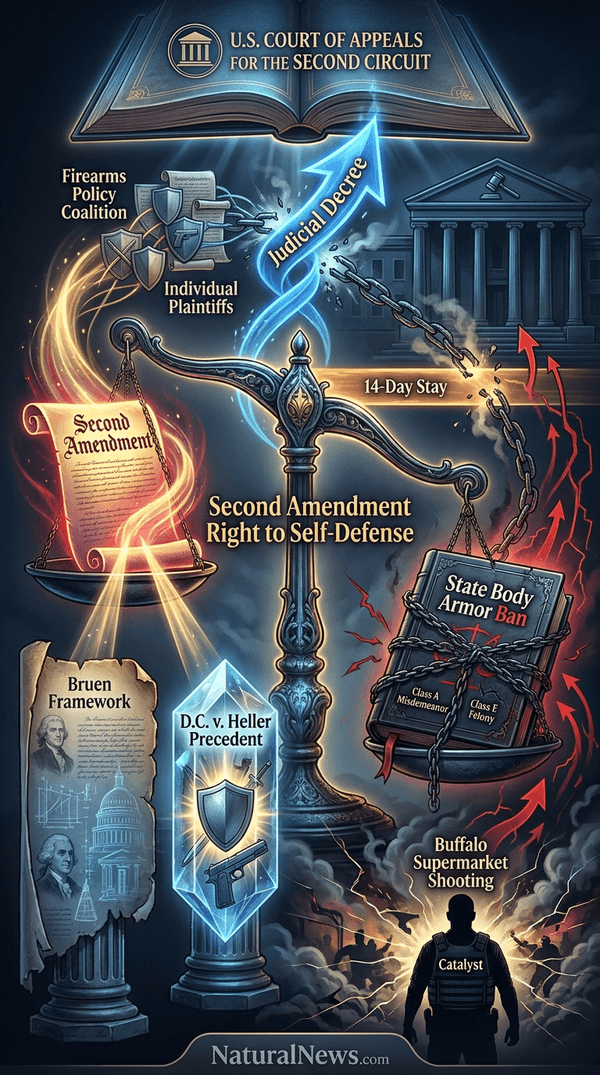
The ruling included a 14-day stay, court documents stated, giving New York officials a window to file an appeal. The stay allows the state to continue enforcement of the ban temporarily while the appeal process begins. Legal observers said the short stay period signals that the judge expects a swift review by the U.S. Court of Appeals for the Second Circuit.
In his opinion, Sinatra wrote that the ban "categorically violates the right of individuals to keep and bear arms for self-defense," according to the ruling. He added that the state's prohibition on purchasing body armor left citizens unable to obtain a common means of self-defense that is widely available in other states. The judge's language framed the issue as a direct conflict between the state statute and the constitutional guarantee, court records showed.
Ruling Cites Supreme Court Precedent
Sinatra applied the 2022 Supreme Court decision in New York State Rifle & Pistol Association, Inc. v. Bruen, which requires firearm regulations to be consistent with the nation's historical tradition of firearm regulation, the ruling stated. Under the Bruen framework, courts must assess whether a modern law is analogous to laws in place at the founding era. The judge found that New York's body armor ban failed that test because colonial and early American law did not restrict access to protective gear.
The judge also referenced the 2008 District of Columbia v. Heller decision, writing that the understanding of "arms" at the time of the founding would include protective armor, according to the ruling. Heller established that the Second Amendment protects weapons in common use for lawful purposes, and Sinatra reasoned that body armor falls within that category as a defensive accoutrement. He noted that the historical record shows individuals in the founding era owned and wore armor for protection, which undermines the state's argument that the Constitution permits a complete prohibition.
Sinatra wrote that body armor is encompassed under the Second Amendment and that New York failed the historical tradition test, the ruling said. The judge's analysis rejected the state's contention that the ban was justified by public safety concerns, finding that the state could not point to a comparable historical regulation. The ruling emphasized that the Second Amendment's protections extend to accessories that are necessary for the effective use of firearms in self-defense.
Law Signed After Buffalo Shooting
New York Gov. Kathy Hochul signed the body armor ban in 2022 as part of a larger gun-control package following a mass shooting at a Buffalo supermarket where the gunman wore body armor, lawmakers said at the time. The law was passed during a special legislative session convened after the Supreme Court's Bruen decision. The package included measures to restrict the carrying of firearms in sensitive locations and to require permits for concealed carry.
The law made a first offense a class A misdemeanor and subsequent offenses a class E felony, according to the ruling. The legislation prohibited anyone "not engaged or employed in an eligible profession" from purchasing, owning, selling, exchanging, giving away, or disposing of body armor. Eligible professions initially included police officers, peace officers, and active-duty members of the U.S. armed forces, with a few additional exemptions.
Hochul said at the time that the measures "will save lives" and that "thoughts and prayers won't fix this, but taking strong action will," according to her statement. The governor's office argued that the ban was a necessary response to the Buffalo attack, in which the shooter used a rifle and wore a bullet-resistant vest. Sinatra did not rule on other provisions in the 2022 package, including a ban on semi-automatic weapon sales to people under 21, the ruling stated. That portion of the law remains in effect, court records showed.
Plaintiffs and Defendants in Lawsuit
The lawsuit was brought by the Firearms Policy Coalition and two individuals in the U.S. District Court for the Western District of New York, court records showed. The plaintiffs challenged the ban on the grounds that it infringed their right to keep and bear arms under the Second Amendment. The Firearms Policy Coalition, a gun-rights advocacy group, has filed similar challenges to state firearm regulations across the country.
Named as defendants were New York Attorney General Letitia James, New York State Police Superintendent Steven G. James, Monroe County District Attorney Sandra Doorley, and acting Erie County District Attorney Michael J. Keane, according to the ruling. The defendants were sued in their official capacities and were responsible for enforcing the body armor ban. Spokespersons for the attorney general's office did not respond to a request for comment on the ruling.
The Firearms Policy Coalition said in a statement that the law "made it a crime for peaceable people to buy body armor" designed to "save lives," according to the group's statement. The group praised the ruling as a victory for constitutional rights and said it would oppose any appeal. The plaintiffs argued that body armor is a common and lawful means of self-defense, particularly for individuals who face heightened threats.
Reference:
- Federal Judge Strikes Down New York Body Armor Ban. https://www.zerohedge.com/political/federal-judge-strikes-down-new-york-body-armor-ban
Explainer Infographic






Please contact us for more information.