


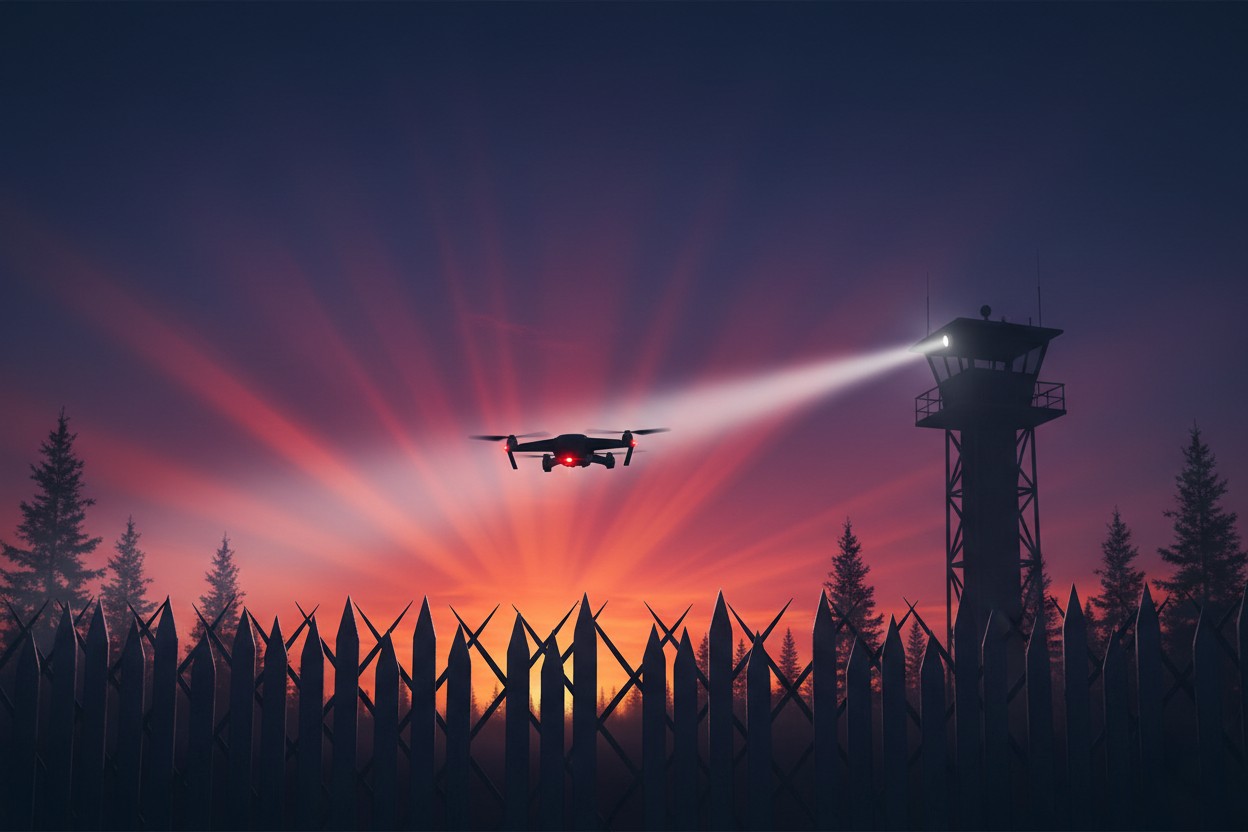
A speed limit on a satellite terminal has done what years of diplomatic theater never could. It has exposed who holds the leash in the Ukraine war. When Washington reportedly ordered Starshield, the military-grade cousin of Starlink, slowed for Ukrainian forces, drone strikes were cancelled, air defenses sputtered and Kyiv scrambled for answers. The episode, however inadvertent, pulls back the curtain on an uncomfortable truth: Ukraine cannot sustain this fight without American permission, and the United States can shape how long the killing lasts. That leaves a question few officials will answer aloud. Should Washington use that leverage to steer Kyiv toward a settlement built on realistic concessions to Moscow, or keep the pipeline flowing and let the bloodshed grind on?
Key points:
- Reuters reported that the order to restrict Ukraine’s military-grade Starshield service came from inside the White House, though a senior US official denies the president made such a request.
- Ukrainian officials say terminals now work in motion only up to roughly 100 mph (160 km/h), which complicates drone strikes and the interception of Russian drones.
- The restrictions began days after Trump called for new leadership in Kyiv, and amid US anger over Ukrainian strikes on Russian oil refineries.
- Starshield is owned and operated by the US government, so any limit on its use in Ukraine is a matter of Washington’s policy.
- Using this dependence to force a negotiated end to the war could save lives over the long term, but it is a dangerous gamble if Russia keeps advancing while diplomats talk.
A war run on borrowed bandwidth
The facts, as reported, are these. Reuters said the directive to slow Starshield for the Ukrainian military originated in the White House, and that Pentagon leaders were told the service needed to be restricted. Ukrainian officials who phoned the White House, the State Department and the Pentagon looking for answers were ultimately told it was a White House decision. A senior US official pushed back. “No such request was ever made by the president,” the official insisted. Reports also suggest the idea was first floated by SpaceX CEO Elon Musk and then decided by President Donald Trump.
To grasp why this matters, it helps to understand what Starshield is. Starlink is SpaceX’s commercial satellite internet service, sold to consumers, businesses and militaries in more than 160 countries and markets. Starshield is its government-grade sibling, with stronger encryption, specialized terminals and the capacity to handle classified information. It rides on Starlink’s sprawling constellation, and SpaceX has been awarded more than $6 billion in multi-year US government contracts for the program, primarily through two Space Force contracts. Musk himself has said Starshield systems are owned and controlled by Washington, with the military and ultimately the president determining any limits on their use.
That ownership structure is the heart of the story. Starlink terminals first reached Ukraine in the opening weeks of the 2022 invasion, after Russian cyberattacks battered the country’s communications. Mykhailo Fedorov, then a Ukrainian digital minister, appealed directly to Musk, and the dishes arrived. They soon became the connective tissue of the Ukrainian war effort, linking artillery spotters, drone operators and frontline commanders. Yet the dependence was always double-edged. In 2023, Musk acknowledged that SpaceX had declined a Ukrainian request to activate service near Crimea, a reminder that a private company, and the government behind it, could decide what Kyiv’s soldiers could and could not do.
Washington has pulled similar levers before. After the tense Oval Office clash between Trump and Zelensky in early 2025, the United States briefly paused military aid and intelligence sharing, then resumed both once Kyiv signaled it would entertain a ceasefire proposal. The lesson was not subtle. The weapons, the intelligence and the satellite links that keep Ukraine in the fight are American-managed lifelines, and lifelines can be tightened.
The timing of the latest squeeze invites scrutiny. Ukraine announced the new restrictions on Wednesday, four days after Trump called for new leadership in Kyiv, arguing that Zelensky is unable to agree to a peace deal. It also arrived shortly after Washington voiced anger over Ukrainian strikes on Russian oil refineries. “We said you can do whatever you want to Russia, [but] don’t hit the refineries because that’s a world problem,” Trump said of Zelensky earlier this month. Surging energy prices tied to the Ukraine and Iran wars have given the White House its own reasons to want calm.
Ukraine’s leaders have not hidden their alarm. Zelensky says the system worked perfectly when tested in adjacent European Union countries. “We have the relevant logs and evidence to prove this,” he said. “The conclusion is clear: the restrictions are in effect within Ukraine but do not apply within the European Union. In other words, this is a planned operation.” Those logs have not been made public, and both the United States and Musk deny throttling the system and claim ignorance about why it is down. Still, Zelensky has been blunt about what he believes. “They knew what they did,” he said of SpaceX and the United States.
The battlefield cost is already visible. Zelensky said Ukraine is turning to fighter jets to intercept drones, with a success rate of around 50 percent, because it cannot use the satellite technology to shoot down jet-powered Shaheds. He has tied the outage to civilian deaths. “People were killed because not enough destroying, not enough interceptors, including interceptors with Starlink, which didn’t work,” he said. Fedorov, who was until recently Ukraine’s defense minister, said that “removing Starshield’s speed limit entirely is now critical for Ukraine’s defense.”
Consider the contradiction at the center of the official story. If the restriction is merely a technical glitch, it is a remarkably selective one, striking Ukrainian territory while sparing neighboring countries. If it is a deliberate policy choice, then Washington has just demonstrated, in real time, that it can dial Ukraine’s combat power up or down like a thermostat. Either explanation leaves the same conclusion standing. The United States, not Kyiv, controls the tempo of this war.
The gamble of forcing a settlement
Once that control is acknowledged, a stark strategic question follows. Should Ukraine keep fighting a war it can only wage with permission slips from Washington, or should the United States use its leverage to construct a path out? Proponents of a negotiated end argue that a war sustained by borrowed bandwidth is a war whose outcome has already been decided elsewhere. If Ukraine cannot win without ever-deeper American support, and Washington is unwilling to provide it without limits, then every additional month of fighting may buy only casualties, not strategic gains.
The argument runs like this. By gradually restricting Ukraine’s capabilities, the United States could compel Kyiv to the table, pairing the pressure with realistic concessions to Russia designed to make a settlement durable rather than merely symbolic. A ceasefire that freezes the lines, however bitter, would stop the daily toll of drone strikes, missile barrages and trench assaults. Lives saved over the long term, in this view, outweigh the principle of fighting to the last terminal.
But this is a high-stakes gamble, and its architects would be wise to count the ways it could fail. Russia has shown no sign of halting its offensive simply because Ukraine’s sky shield has thinned. If Moscow keeps taking land and lives across Ukraine while diplomats wait for a settlement or a ceasefire, the throttle would not shorten the war. It would deepen the suffering and hand the Kremlin a battlefield advantage it did not earn through negotiation. Critics also warn that squeezing the victim to appease the aggressor invites future invasions, and that a peace imposed from outside may prove brittle.
There is also the matter of honesty. The current approach, in which officials deny involvement while Ukrainian officials say they were told it was a White House decision, serves no one. If the United States intends to use its control over Starshield as a diplomatic instrument, it owes Ukrainians, its own taxpayers and the world a plain accounting of the goal. A lever pulled in the dark is not strategy. It is drift, and the people living under Russian drones are the ones who pay for it.
The leash has been revealed. What Washington does with it will determine whether this war ends at a negotiating table or continues bleeding on the battlefield.
Sources include:








Please contact us for more information.