



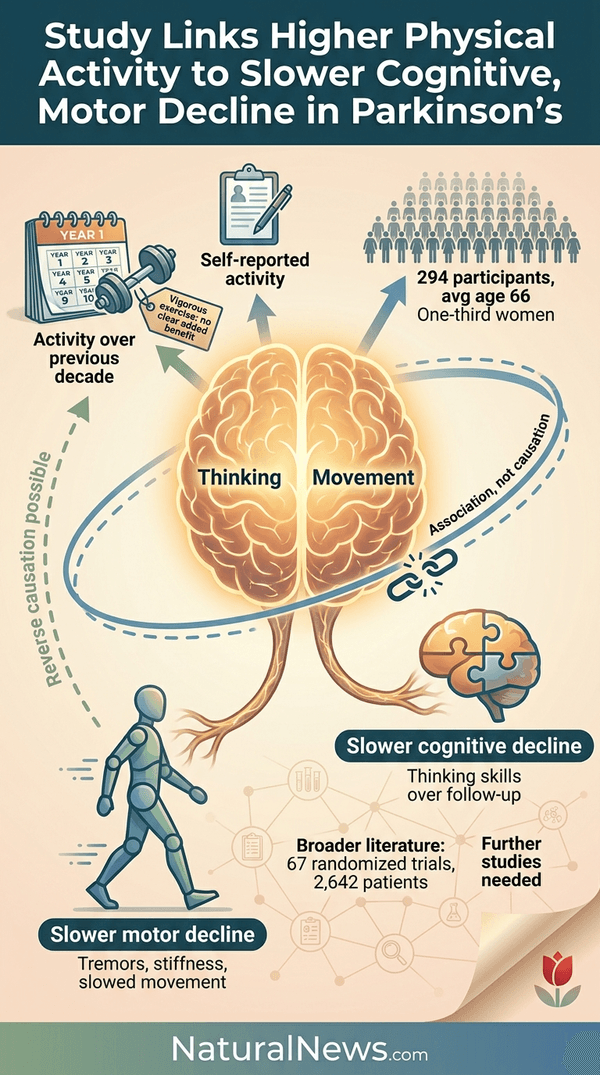
People with mild-to-moderate Parkinson's disease who were more physically active tended to experience slower declines in thinking and movement than those who were less active, according to a report published Oct. 16, 2026, by mindbodygreen [1]. The study tracked 294 participants with an average age of 66, about one-third of whom were women.
The findings, published online Oct. 7 in Neurology, describe an association between higher physical activity levels and slower cognitive and motor progression in patients with mild-to-moderate Parkinson disease, according to Drugs.com [2]. Researchers cannot say whether activity caused the difference, the report stated [1].
The study does not prove that physical activity directly slows Parkinson's disease, according to the report. It observed existing habits rather than testing an intervention, and the results may reflect that people with milder symptoms or better overall health find it easier to stay active [3].
Study Design and Activity Measures
Participants self-reported how much time they spent being active, their overall activity levels, and how often they did vigorous activities, the report stated [1]. Researchers then compared these measures with how participants' cognitive and motor symptoms changed over the follow-up period. Motor symptoms tracked included tremors, stiffness, and slowed movement [3].
The analysis accounted for participants' activity levels over the previous decade, according to the report. That adjustment was intended to test whether the link between current activity and slower decline would hold even after accounting for long-term exercise habits, the report stated [1].
No exercise program was assigned. Researchers observed people's existing habits rather than assigning them to exercise programs, according to the report [1]. Because the study was observational, it can show an association between activity and outcomes but cannot establish that activity caused the slower declines [3]. The broader literature on exercise and Parkinson's includes randomized trials; a meta-analysis of 67 randomized controlled trials involving 2,642 patients found that different types of exercise are associated with improvements in specific symptoms, according to NaturalNews.com [4].
Findings: More Activity Linked to Slower Decline
People who were more physically active tended to experience slower declines in both thinking skills and movement than those who were less active, the report stated.
The link remained even after researchers accounted for participants' activity levels over the previous decade, according to the report. The possible benefits of physical activity for people with Parkinson's disease may depend on how long they stay active and whether they continue exercising over time, and further studies are needed, the report stated [1].
Vigorous exercise did not appear to offer a clear added benefit once researchers considered the total time participants spent being active, according to the report. Researchers grouped participants according to how much total exercise they reported on a weekly basis, the report stated [1]. Researchers cannot say whether activity caused the difference, the report stated [3]. Separate coverage in Men's Journal reported that a new study found people with Parkinson's disease who stayed more physically active experienced slower motor progression and cognitive decline over time [5].
Limitations and Unanswered Questions
The study was observational and cannot prove that physical activity directly slows Parkinson's disease, the report stated.
People with milder symptoms or better overall health may find it easier to stay active, which could explain the results, according to the report. Activity levels were also self-reported, so they may not have been entirely accurate, the report stated [1]. More research is needed to determine whether increasing physical activity can directly affect Parkinson's progression, the report stated [3].
The broader literature also carries caveats. A review of deli meat and dementia risk noted that all human evidence on that topic is observational, meaning it can show associations but cannot prove causation, according to NaturalNews.com [6]. Studies of everyday movement and brain aging have likewise relied on observational designs; one such study used wrist accelerometers to track daily movement patterns and focused on rest-activity rhythm fragmentation, according to NaturalNews.com [7]. The report on the Parkinson's study also noted that further studies are needed and that treatments, including various medications and certain lifestyle changes, may help mitigate symptoms [1].
References
- New Study Links More Physical Activity to Slower Parkinson's Disease Progression. https://ntd.com/new-study-links-more-physical-activity-to-slower-parkinsons-disease-progression_1177694.html
- Physical Activity Linked to Slower Cognitive, Motor Progression in .... https://www.drugs.com/news/physical-activity-linked-slower-cognitive-motor-progression-parkinson-131607.html
- New Study Links More Physical Activity to Slower Parkinson’s Disease Progression. https://www.ntd.com/new-study-links-more-physical-activity-to-slower-parkinsons-disease-progression_1177694.html
- Meta Analysis Identifies Exercise Types Linked to Improvements in Parkinson's Disease Symptoms - NaturalNews.com, June 03, 2026.
- Study Finds Physical Activity May Slow Parkinson’s Disease Progression .... https://www.mensjournal.com/fitness/study-8-hours-of-weekly-physical-activity-linked-to-slower-parkinsons-progression
- Review Links Two Slices of Deli Meat Daily to 44% Higher Dementia Risk. https://www.naturalnews.com/2026-10-01-review-deli-meat-daily-higher-dementia-risk.html
- From Walks to Housework: Everyday Movement Linked to Healthier Aging Brains. https://www.naturalnews.com/2026-10-15-everyday-movement-linked-to-healthier-aging-brains.html
- Exercise shown to help save brain function in Parkinsons patients - NaturalNews.com, April 01, 2017.
- Study Shows How This Type of Exercise Can Slo - Mercola.com, November 24, 2023.
- How Exercise Makes Your Brain Grow - Mercola.com, October 25, 2013.
- Fight Parkinsons disease with exercise; physical activity found to improve quality of life for PD patients - NaturalNews.com, December 01, 2017.
Explainer Infographic












Please contact us for more information.