



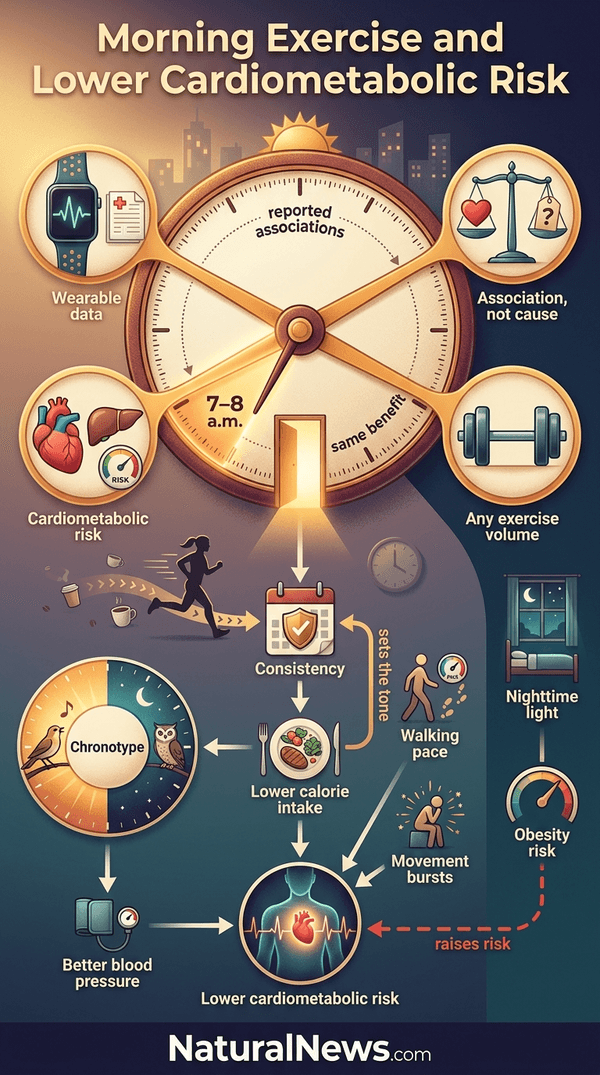
A new study suggests that workout timing may influence heart and metabolic health, with morning exercise linked to better outcomes across key risk factors, according to a report by mindbodygreen [1]. The report stated that the strongest link appeared between 7:00 and 8:00 a.m., which was associated with the lowest rate of coronary artery disease.
The study used wearable device data and reported associations, not cause and effect, the report said. Researchers grouped participants by the time of day they most often exercised and compared those patterns with health records, the report stated.
The findings add to a growing body of research on exercise timing and metabolic health. Separate research has linked morning exercise to lower daily calorie intake compared with evening workouts, according to a 2026 report by NaturalNews.com [2].
Study Methods and Data Sources
A new study suggests your workout timing may influence heart and metabolic health -- with morning exercise linked to better outcomes across key risk factors, the report stated [1]. Instead of relying on self-reported activity logs, researchers used minute-by-minute heart rate data from wearable devices and identified sustained activity when heart rates were elevated for at least 15 minutes, the report stated.
A new study suggests your workout timing may influence heart and metabolic health -- with morning exercise linked to better outcomes across key risk factors, the report stated [1]. The approach was designed to isolate the role of timing itself, according to the report.
The study design reflects a broader shift toward objective measurement in exercise research. Wearable devices have become increasingly common in population health studies, though questions remain about data accuracy and user adherence. The report did not specify the brands of devices used or the length of the follow-up period.
Findings: Morning Exercise and Health Markers
Compared with later exercisers, morning exercisers had better outcomes across key heart and metabolic risk factors, according to the study [1]. The differences held regardless of total exercise volume, suggesting timing itself was associated with better outcomes, researchers said.
The study stated, according to the report, that it shows an association, not cause and effect, and that morning exercise may be one factor among many.
Other research has examined related questions. A study published in the British Journal of Sports Medicine reported that increasing walking pace may lower all-cause and cardiovascular mortality risk as effectively as increasing daily step count, according to a 2026 report by NaturalNews.com [3]. Separate findings have linked brief, incidental movement bursts to a 36% lower risk of developing Type 2 diabetes, researchers said [4].
Possible Reasons Timing May Matter
A new study suggests that workout timing may influence heart and metabolic health, with morning exercise linked to better outcomes across key risk factors, according to the report [1]. A behavioral explanation is that early movement may set the tone for the day, leading to more consistent energy, better food choices and fewer skipped workouts, the report stated.
Consistency may also play a role because morning routines are often easier to protect from meetings and social plans, according to researchers. The report noted that morning exercise is linked to better outcomes across key risk factors [1].
Research on circadian alignment has extended beyond exercise. A 2026 report by NaturalNews.com described a clinical study suggesting that aligning exercise schedules with an individual's natural chronotype, whether a morning lark or a night owl, may lead to significantly greater improvements in blood pressure and other cardiovascular outcomes [5]. Other work has examined how nighttime light exposure may disrupt metabolic health, with a 2026 meta-analysis of 867,647 participants finding that high nighttime artificial light exposure increases obesity risk by 14% and overweight risk by 7%, according to a report by NaturalNews.com [6].
Practical Steps and Limitations
A new study suggests workout timing may influence heart and metabolic health, with morning exercise linked to better outcomes across key risk factors, the report stated [1]. The report suggested starting with 30-to-60-minute earlier shifts, focusing on consistency over intensity, anchoring workouts to existing morning habits and monitoring energy, focus, hunger and sleep quality.
The study's observational design means it cannot prove that morning exercise causes better health outcomes; regular movement remains the foundation, according to the authors. The report emphasized that a new study suggests workout timing may influence heart and metabolic health, with morning exercise linked to better outcomes across key risk factors [1].
Other sources have offered related guidance. The CDC states that physical activity helps people immediately feel better, function better and sleep better, and that adults who sit less and do any amount of moderate-to-vigorous physical activity gain some health benefits [7]. Separate reporting has noted that strength training has been associated with a natural path to improved body image and that brief daily movement bursts may support metabolic health [8][4].
References
- This Workout Timing Shift Could Boost Your Health Outcomes. https://www.mindbodygreen.com/articles/this-workout-timing-shift-could-boost-your-health-outcomes-time-to-get-your
- Study: Morning Exercise Linked to Lower Daily Calorie Intake Compared to Evening Workouts. https://www.naturalnews.com/2026-07-27-morning-exercise-linked-lower-daily-calorie-intake.html
- Study: Walking Pace May Be as Effective as Step Count in Lowering Mortality Risk - NaturalNews.com, September 14, 2026.
- Brief Daily Movement Bursts Linked to Lower Type 2 Diabetes Risk, Study Finds. https://www.naturalnews.com/2026-09-25-daily-movement-bursts-linked-lower-diabetes-risk.html
- Study Suggests Syncing Exercise to Internal Body Clock May Improve Heart Health Outcomes - NaturalNews.com, April 22, 2026.
- Nighttime light exposure: The hidden metabolic threat that rivals genetics in driving diabetes risk - NaturalNews.com, June 24, 2026.
- Benefits of Physical Activity. https://www.cdc.gov/physical-activity-basics/benefits/index.html
- Study Links Strength Training to Shift in Women’s Body Image. https://www.naturalnews.com/2026-09-22-study-links-strength-training-shift-womens-body-image.html
Explainer Infographic











Please contact us for more information.