


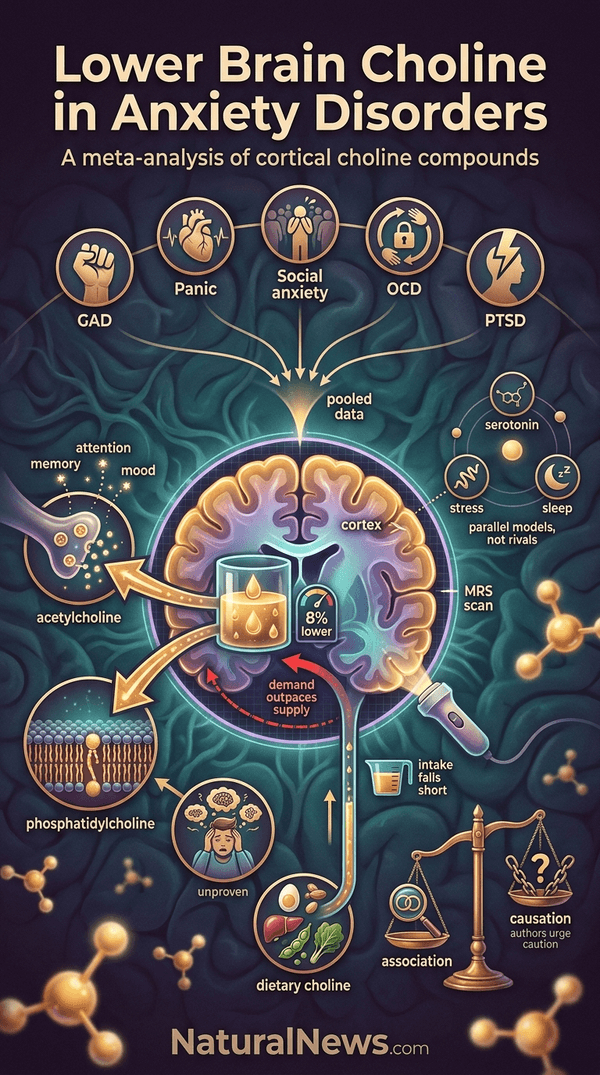
A new meta-analysis published in the journal Molecular Psychiatry found that people with anxiety disorders consistently had lower levels of choline-containing compounds in the cortex compared to healthy controls, according to the study [1]. Researchers reported that the finding appeared across generalized anxiety disorder, panic disorder, social anxiety disorder, obsessive-compulsive disorder, and post-traumatic stress disorder.
The UC Davis Health news office stated that the essential nutrient is 8% lower in the brains of people with generalized anxiety disorder, panic disorder and social anxiety disorder [2]. ScienceDaily reported that a major analysis of brain scans found that people with anxiety disorders have noticeably lower levels of choline, a nutrient crucial for healthy brain function, with the strongest evidence appearing in a specific set of brain regions [3].
The findings add a biochemical dimension to a condition that is typically discussed in terms of serotonin, stress exposure and sleep quality. According to the researchers, the pattern held across multiple anxiety diagnoses rather than being unique to any single condition, which suggests a shared biological feature may be involved.
Study Analyzed Brain Metabolites Using Proton Magnetic Resonance Spectroscopy
Choline is an essential nutrient that plays an important role in brain and nervous system health, according to the study. The body uses it to produce acetylcholine, a neurotransmitter involved in memory, learning, attention, and mood regulation. Emerging research suggests choline may play an important role in brain health and emotional regulation [1]. Nutritional research has identified choline among a list of vitamins, minerals, and fatty acids that may support memory, focus, and protection of brain cells, including B vitamins, vitamin E, vitamin D, omega-3s, magnesium, zinc, iron, choline, and multivitamins, each with varying levels of evidence [4].
According to the analysis, when the brain is in a constant state of heightened alertness, it may use up choline faster than it can take it in. Emerging research suggests choline may play an important role in brain health and emotional regulation, and a meta-analysis found that people with anxiety disorders consistently had lower choline levels [1].
Choline Plays Role in Brain and Nervous System, Stress May Deplete It
Because the nutrient is required for acetylcholine production and membrane integrity, its measurable levels in the cortex may reflect how hard the brain is working to maintain normal signaling under chronic load.
The wider nutritional literature has long connected nutrient status with behavioral health. A 2020 review cited in the journal Neuroscience and Biobehavioral Reviews found that suboptimal nutrition has been implicated in the underlying pathology of behavioral health disorders and may impede treatment and recovery [5]. Other research has found that deficiencies in essential nutrients are not just a physical concern but a significant, modifiable factor in mental health, according to a report published in 2026 [6].
The analysis authors were careful to state the limits of their finding. That distinction matters for readers who may be looking for a single nutrient fix for a complex condition. The data suggest an association between anxiety disorders and lower cortical choline compounds, not that choline depletion is the underlying cause of anxiety.
Dietary Sources and Supplement Suggestions Reported
The report stated that it is hard to get enough choline through diet alone. A 2020 report from the Dietary Guidelines Advisory Committee found that most Americans do not get enough choline, according to a Mercola.com article [7].
Citicoline is a naturally occurring compound that is already found in the body, and taking it as a supplement allows one to experience its therapeutic benefits more effectively, according to NaturalNews.com [8].
Higher than average doses of choline can produce a fishy smell to the body and breath, a side effect caused by undigested choline reaching the large intestine, where bacteria metabolize it into the compound trimethylamine, according to Mark Mayell's book on natural energy supplements [9]. Dividing doses or taking lower amounts avoids this side effect for most people, the book states. Separately, lecithin is a source of choline and inositol that protects brain cell function, and NAC protects against acetylcholine depletion triggered by pesticides and other toxins, according to Eric R. Separately, lecithin is a source of choline, and DMAE acts as a choline substitute that promotes acetylcholine-related behavioral effects such as an increase in memory and brain function, according to Mark Mayell's book on natural energy supplements [9].
References
- The Nutrient Gap In Anxious Brains; What It Might Mean For Mental Health. https://www.newsbreak.com/news/4942308385522-the-nutrient-gap-in-anxious-brains-what-it-might-mean-for-mental-health
- Low choline levels in the brain associated with anxiety .... https://health.ucdavis.edu/news/headlines/low-choline-levels-in-the-brain-associated-with-anxiety-disorders/2025/11
- Scientists find hidden brain nutrient deficit that may fuel anxiety. https://www.sciencedaily.com/releases/2026/05/260515234759.htm
- Nine Vitamins and Supplements Linked to Brain Health: What the Evidence Shows. https://www.naturalnews.com/2026-07-28-nine-vitamins-supplements-linked-brain-health-studies.html
- Nutrition and behavioral health disorders: depression ... - PMC. https://pmc.ncbi.nlm.nih.gov/articles/PMC8453603/
- New research confirms: What you eat directly shapes your mood and mental health. https://www.naturalnews.com/2026-03-12-what-you-eat-shapes-mood-mental-health.html
- You Are Likely Deficient in Choline - Mercola.com, August 24, 2020.
- Here's why you should be paying more attention to citicoline a naturally occurring compound that's important for ... - NaturalNews.com, October 06, 2018.
- Natural Energy A Consumers Guide to Legal Mind Altering and Mood Brightening Herbs and Supplements by Mark Mayell
- Meta Analysis Links Low Brain Choline Levels to Anxiety Disorders - NaturalNews.com, April 16, 2026.
- Landmark study links widespread anxiety to a common nutritional deficit - NaturalNews.com, December 06, 2025.
- Nature’s answer to stress? New science says this ancient root delivers. https://www.naturalnews.com/2026-08-17-nature-stress-science-ancient-root.html
- Ultraprocessed Foods Linked to Measurable Drops in Human Attention Span. https://www.activistpost.com/ultraprocessed-foods-linked-to-measurable-drops-in-human-attention-span/
- The Link Between Nutrition and Brain Health. https://connect.bcbstx.com/health-and-wellness/b/weblog/posts/link-nutrition-mental-health
Explainer Infographic









Please contact us for more information.